
Featuring market attractiveness scoring, total addressable market sizing, company benchmarking matrices, interactive Excel dashboards, deeper supply chain intelligence, emerging startup tracking, and granular product-level insights, The Business Research Company’s 2026 market reports are built to deliver research that is both more actionable and more strategically valuable.
Energy Security Market Size Outlook: How Quickly Will Revenue Expand Through 2030?
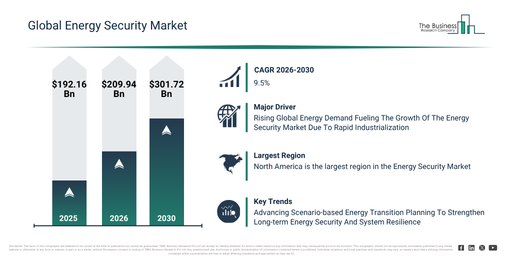
The energy security market has experienced robust growth recently. Its value is projected to increase from $192.16 billion in 2025 to $209.94 billion in 2026, demonstrating a compound annual growth rate (CAGR) of 9.3%. Historically, this expansion has been driven by factors such as a rise in global energy demand, escalating geopolitical tensions impacting supply chains, the development of centralized power infrastructure, more frequent grid failures, and a greater reliance on fossil fuel imports.
The energy security market is projected to experience substantial expansion over the upcoming years. It is set to reach $301.72 billion by 2030, demonstrating a compound annual growth rate (CAGR) of 9.5%. This expansion during the forecast period is fueled by factors such as the accelerated shift towards renewable energy systems, the increasing incorporation of artificial intelligence into energy management, heightened investment in modernizing electricity grids, wider uptake of distributed energy resources, and the broadening of cross-border energy links. Key developments anticipated during this period encompass the expanded deployment of resilient smart grid systems, escalating investment in cyber-physical security solutions for energy, the increasing utilization of predictive risk evaluation in energy infrastructure, the proliferation of decentralized energy storage networks, and a heightened emphasis on real-time grid surveillance and fault identification.
Get A Free Sample Report With In-Depth Market Insights:
Energy Security Market Industry Drivers: What’s Behind The Revenue Growth?
The projected increase in global energy demand is anticipated to fuel the expansion of the energy security market. Energy, obtained from natural resources like fossil fuels, renewables, and nuclear sources, is utilized globally to generate electricity, power transport, and support industrial, residential, and commercial operations. The surge in worldwide energy demand stems from rapid industrialization, as expanding manufacturing and significant production require considerable energy for machinery operation, facility power, and continuous functioning. Energy security facilitates the management of this escalating energy demand by ensuring a consistent, dependable, and varied supply of energy resources to meet growing consumption without interruptions or scarcities. For example, in March 2024, data from the International Renewable Energy Agency (IRENA), a UAE-based non-profit organization, showed that U.S. renewable energy capacity grew from 356,413 megawatts (MW) in 2022 to 387,549 megawatts (MW) in 2023, marking an 8.7% year-on-year rise. Consequently, the increasing global energy demand is a key driver for the growth of the energy security market.
Energy Security Market Segment Landscape And Growth Outlook
The energy security market covered in this report is segmented –
1) By Component: Hardware, Software, Services
2) By Cybersecurity: Physical Security, Cybersecurity Measures, Data Protection, Other Cybersecurities
3) By Infrastructure: Power Plants, Transmission Lines, Distribution Networks, Storage Facilities, Other Infrastructures
4) By Source: Fossil Fuels, Renewable Energy, Nuclear Energy, Other Sources
5) By End-User: Energy And Utility Companies, Government And Defense, Industrial And Commercial, Information Technology (IT) And Telecommunication
Subsegments:
1) By Hardware: Smart Grid Equipment, Energy Storage Systems, Power Generation Equipment, Transmission And Distribution Equipment, Monitoring And Surveillance Devices, Control Systems, Backup Power Systems, Physical Security Equipment
2) By Software: Energy Management Software, Grid Management Software, Risk Assessment Software, Cybersecurity Software, Data Analytics Software, Asset Management Software, Incident Response Software, Predictive Maintenance Software
3) By Services: Consulting Services, Integration And Deployment Services, Maintenance And Support Services, Risk Management Services, Security Assessment Services, Training And Education Services, Monitoring Services, Managed Security Services
#Energy Security Market Growth Trends: What’s Shaping The Future Outlook?
Leading companies within the energy security market are concentrating on strategic scenario frameworks, such as energy transition pathway analyses, to enhance energy resilience, ensure a dependable supply, and support sustainable long-term energy systems. These energy transition pathway analyses systematically evaluate various scenarios and strategies for progressively shifting energy systems from their reliance on fossil fuels towards low-carbon and renewable sources over time, aiming to achieve sustainability and climate goals. For instance, in February 2026, Shell plc, a UK-based energy and petrochemical company, launched its most recent Shell Scenarios Sketch titled India’s Energy Transition in a Security-Focused Age. This India-focused analysis delineates three future scenarios—Archipelagos, Surge, and Horizon—examining how the nation can fulfill its rapidly rising energy demand while simultaneously strengthening energy security, affordability, reliability, and decarbonization. The framework emphasizes the increasing importance of renewable energy, electrification, low-carbon fuels, natural gas, and carbon capture technologies in establishing a resilient and secure energy system, alongside supporting long-term competitiveness and climate objectives.
Energy Security Market Leading Companies And Competitive Benchmarking
Major companies operating in the energy security market are Siemens AG, Cisco Systems Inc., Johnson Controls International plc, Raytheon Technologies Corporation, Lockheed Martin Corporation, IBM Corporation, General Electric Company, Schneider Electric SE, Northrop Grumman Corporation, ABB Ltd, BAE Systems PLC, Eaton Corporation plc, Thales Group S.A., Emerson Electric Co., Rockwell Automation, Inc., Tapestry Solutions, Inc., Black And Veatch Holdings Company, Tenable Network Security Inc., COPA-DATA GmbH, Nozomi Networks Inc., AlertEnterprise Inc., IOActive LLC, Future Fibre Technologies Pty Ltd, Xage Security Inc.
View The Full Energy Security Market Report:
Energy Security Market Largest Region By Revenue And Market Share
North America was the largest region in the energy security market in 2025. Asia-Pacific is expected to be the fastest-growing region in the forecast period. The regions covered in the energy security market report are Asia-Pacific, South East Asia, Western Europe, Eastern Europe, North America, South America, Middle East, Africa.
Reach Out To Our Team:
The Business Research Company: https://www.thebusinessresearchcompany.com/
Americas: +1 310-496-7795
Asia: +44 7882 955267 & +91 8897263534
Europe: +44 7882 955267
Email us at: marketing@tbrc.info
Follow us on:
LinkedIn: https://in.linkedin.com/company/the-business-research-company
YouTube: https://www.youtube.com/channel/UC24_fI0rV8cR5DxlCpgmyFQ
Global Market Model: https://www.thebusinessresearchcompany.com/global-market-model

Wasay has over a decade of experience in market research, data modelling, and analytics, with prior experience at GlobalData and Decision Tree Consulting Services. At The Business Research Company , he leads research operations across syndicated studies, customized consulting engagements, and the Global Market Model platform. His professional experience includes supporting organizations such as Boston Consulting Group, KPMG, and Ernst & Young. Wasay holds a degree in Electronics and Communications Engineering, postgraduate management qualifications from International Management Institute Belgium and Indian School of Business and Entrepreneurship, and completed the Integrated Program in Business Analytics from Indian Institute of Management Indore.