
Featuring market attractiveness scoring, total addressable market sizing, company benchmarking matrices, interactive Excel dashboards, deeper supply chain intelligence, emerging startup tracking, and granular product-level insights, The Business Research Company’s 2026 market reports are built to deliver research that is both more actionable and more strategically valuable.
Product Carbon Footprint Verification Market Size Outlook: How Quickly Will Revenue Expand Through 2030?
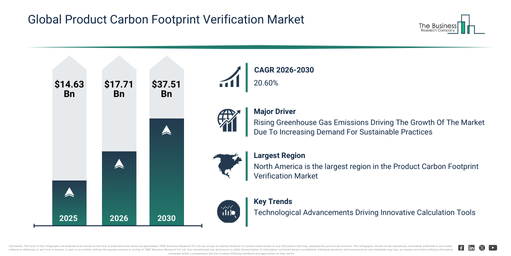
The product carbon footprint verification market size has experienced significant expansion in recent years. It is anticipated to increase from $14.63 billion in 2025 to $17.71 billion in 2026, demonstrating a compound annual growth rate (CAGR) of 21.0%. This historical market expansion can be linked to the implementation of international carbon reporting standards, nascent corporate sustainability initiatives, a greater emphasis from investors on ESG disclosures, the adoption of lifecycle assessment methodologies, and a rise in voluntary carbon reporting.
The product carbon footprint verification market size is anticipated to undergo significant expansion over the next few years. It is projected to reach $37.51 billion by 2030, demonstrating a compound annual growth rate (CAGR) of 20.6%. This growth during the forecast period is primarily driven by the escalating enforcement of carbon regulations, the increased uptake of science-based targets, the broadening of mandatory product labeling requirements, a surging demand for automated carbon verification tools, and the deeper integration of carbon metrics in procurement decisions. Furthermore, major trends in the forecast period include the rising adoption of lifecycle carbon assessment services, an increasing need for third-party verification, the growing deployment of carbon accounting software, the expansion of regulatory carbon disclosure requirements, and an enhanced focus on supply chain emission transparency.
Get A Free Sample Report With In-Depth Market Insights:
Product Carbon Footprint Verification Market Growth Catalysts And Demand Drivers
Escalating greenhouse gas emissions are projected to propel the expansion of the product carbon footprint verification moving forward. The rise in greenhouse gas (GHG) emissions stems from an increasing dependence on fossil fuels for energy generation, transportation, and industrial operations. As global energy demand intensifies, coal, oil, and natural gas remain the primary sources for power production, releasing substantial volumes of carbon dioxide (CO₂) and methane (CH₄) into the atmosphere. The product carbon footprint verification process promotes the implementation of low-carbon alternatives, such as sustainable materials, energy-efficient manufacturing methods, and optimized transit. Furthermore, verified carbon footprint data boosts consumer awareness, thereby stimulating demand for eco-friendly products and championing a more sustainable supply chain. For instance, in November 2025, according to the Office for National Statistics (ONS), a UK-based government agency, residence-based greenhouse gas (GHG) emissions were 1.70 tonnes of carbon dioxide equivalent (CO2e) per head in Quarter 2 (April to June) 2025. Consequently, the increasing greenhouse gas emissions are fueling the growth of the product carbon footprint verification market.
Product Carbon Footprint Verification Market Segment Landscape And Growth Outlook
The product carbon footprint verification market covered in this report is segmented –
1) By Service Type: Carbon Footprint Assessment, Carbon Footprint Verification, Consulting Services, Software Solutions, Training And Education
2) By Verification Type: Third-Party Verification, Self-Verification, Regulatory Verification
3) By Verification Standard: ISO 14064, ISO 14067, GHG Protocol, Science Based Targets Initiative (SBTI), Global Reporting Initiative (GRI)
4) By Organization Size: Small Enterprises, Medium Enterprises, Large Enterprises
5) By Industry: Manufacturing, Food And Beverage, Retail And E-Commerce, Transportation And Logistics, Energy And Utilities, Textiles And Apparel, Aerospace And Defense
Subsegments:
1) By Carbon Footprint Assessment: Life Cycle Assessment (LCA), Greenhouse Gas (GHG) Emissions Calculation, Scope 1, Scope 2, and Scope 3 Emissions Analysis, Product-Specific Carbon Footprint Evaluation, Carbon Reduction Strategy Development, Carbon Footprint Verification
2) By Third-Party Verification And Certification: Compliance Audits, Supply Chain Emission Verification, Corporate Sustainability Reporting Verification, Regulatory Compliance And Assurance
3) By Consulting Services: Carbon Neutrality Roadmap Development, Corporate Sustainability Strategy, Science-Based Targets (SBTi) Consulting, Carbon Offsetting And Reduction Planning, ESG (Environmental, Social, and Governance) Reporting
4) By Software Solutions: Carbon Accounting And Tracking Software, Emissions Data Management Platforms, AI-Based Carbon Footprint Analytics, Supply Chain Carbon Impact Monitoring, Carbon Footprint Reporting And Compliance Tools
5) By Training and Education: Corporate Sustainability And Carbon Management Training, Carbon Accounting And Reporting Workshops, Certification Programs on Carbon Footprint Standards, Employee Awareness And Engagement Programs, Industry-Specific Carbon Footprint Education
Product Carbon Footprint Verification Market Trends Shaping Long-Term Demand
Leading companies in the product carbon footprint verification market are increasingly focusing on technological advancements, such as product carbon footprint tools, to boost accuracy, streamline reporting procedures, and deliver real-time, data-driven insights for businesses. A Product Carbon Footprint (PCF) Tool is essentially a software or a defined methodology employed to measure, analyze, and report the total greenhouse gas (GHG) emissions of a product throughout its entire lifecycle. For example, in March 2023, HEINZ-GLAS GmbH & Co. KGaA, a German glass packaging manufacturer, introduced a Product Carbon Footprint (PCF) Tool designed to provide precise, real-time CO₂ emission measurements, which were independently verified by TÜV SÜD following ISO 14067:2019 standards. Unlike conventional approaches that rely on rough estimations, this tool facilitates highly accurate calculations, down to the gram, within five minutes, thereby establishing a new benchmark for sustainability reporting and transparency within the industry.
Product Carbon Footprint Verification Market Competitive Landscape: Who Leads The Industry?
Major companies operating in the product carbon footprint verification market report are SGS SA, Bureau Veritas, DEKRA SE, Intertek Group plc, TÜV SÜD AG, UL Solutions, Applus+ Services SA, TÜV Nord AG, BSI Group, Verra, LRQA, DQS Holding, Carbon Trust, SCS Global Services, ClimatePartner, Circular Ecology, Carbon Footprint Ltd, DNV GL, GEP Environmental, Carbon Credentials
View The Full Product Carbon Footprint Verification Market Report:
Product Carbon Footprint Verification Market Geographic Spread And Regional Opportunities
North America was the largest region in the product carbon footprint verification market in 2025. Asia-Pacific is expected to be the fastest-growing region in the forecast period. The regions covered in the product carbon footprint verification market report are Asia-Pacific, South East Asia, Western Europe, Eastern Europe, North America, South America, Middle East, Africa.
Reach Out To Our Team:
The Business Research Company: https://www.thebusinessresearchcompany.com/
Americas: +1 310-496-7795
Asia: +44 7882 955267 & +91 8897263534
Europe: +44 7882 955267
Email us at: marketing@tbrc.info
Follow us on:
LinkedIn: https://in.linkedin.com/company/the-business-research-company
YouTube: https://www.youtube.com/channel/UC24_fI0rV8cR5DxlCpgmyFQ
Global Market Model: https://www.thebusinessresearchcompany.com/global-market-model

Wasay has over a decade of experience in market research, data modelling, and analytics, with prior experience at GlobalData and Decision Tree Consulting Services. At The Business Research Company , he leads research operations across syndicated studies, customized consulting engagements, and the Global Market Model platform. His professional experience includes supporting organizations such as Boston Consulting Group, KPMG, and Ernst & Young. Wasay holds a degree in Electronics and Communications Engineering, postgraduate management qualifications from International Management Institute Belgium and Indian School of Business and Entrepreneurship, and completed the Integrated Program in Business Analytics from Indian Institute of Management Indore.