
Backed by market attractiveness analysis, total addressable market sizing, company benchmarking matrices, interactive Excel dashboards, wider supply chain intelligence, emerging startup coverage, and detailed product-level insights, The Business Research Company’s 2026 market reports are designed to offer research that is more actionable and strategically valuable than ever.
Reading Fluency Games Market Growth Potential: How Will Market Size Shift Through 2030?
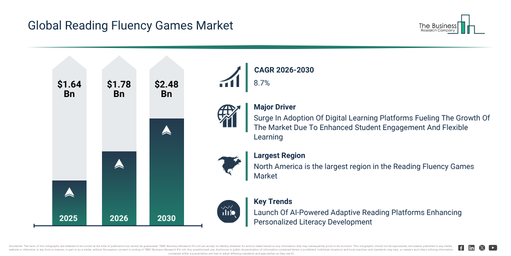
The reading fluency games market has experienced substantial expansion in recent years. Projections indicate it will grow from $1.64 billion in 2025 to $1.78 billion in 2026, at a compound annual growth rate (CAGR) of 8.4%. The historical growth in this market is attributable to an increasing focus on literacy development, the adoption of traditional reading exercises, the proliferation of school-based reading programs, the demand for interactive educational tools, and rising parental involvement in reading activities.
The reading fluency games market is anticipated to experience substantial expansion over the coming years. This market is projected to reach $2.48 billion in 2030, exhibiting a compound annual growth rate (CAGR) of 8.7%. Key factors driving this growth during the forecast period include the incorporation of AI and speech recognition into reading games, the proliferation of digital learning platforms, the increasing need for personalized reading interventions, the rise of mobile and web-based educational applications, and heightened investment in edtech innovation. Prominent trends expected in this period encompass gamified learning experiences, adaptive tools for reading fluency, the integration of speech recognition technology, timed reading challenges, and capabilities for progress tracking and analytics.
Get A Free Sample Report With In-Depth Market Insights:
Reading Fluency Games Market Demand Drivers: What’s Powering Industry Growth?
The market for reading fluency games is projected to expand due to the increasing integration of digital learning platforms. These platforms encompass online systems and software delivering educational content, training programs, and interactive learning experiences via digital devices and internet connections. Their growing usage stems from the need for adaptable, remote, and tailored learning solutions, offering learners access to educational content at any time and location. Reading fluency games bolster the uptake of digital learning platforms by offering interactive, skill-focused activities that boost reading speed, comprehension, and accuracy in online settings, thereby improving student engagement and educational results. As an illustration, Eurostat, a government agency based in Luxembourg, reported in January 2024 that in 2023, 30% of EU internet users aged 16 to 74 engaged in an online course or used online learning resources within a three-month period. This marked a 2-percentage-point rise from 28% recorded in 2022. Consequently, the expanding use of digital learning platforms is fueling the expansion of the reading fluency games market.
Reading Fluency Games Market Breakdown By Product Type And Application
The reading fluency games market covered in this report is segmented –
1) By Product Type: Board Games, Digital Games, Card Games, Mobile Applications, Other Product Types
2) By Age Group: Preschool, Elementary, Middle School, Other Age Groups
3) By Platform: Mobile Applications, Web Based Platforms, Desktop Software
4) By Distribution Channel: Online Stores, Specialty Stores, Supermarkets or Hypermarkets, Other Distribution Channels
5) By Application: Schools, Home Use, Tutoring Centers, Other Applications
Subsegments:
1) By Board Games: Phonics Based Reading Board Games, Sight Word Recognition Board Games, Sentence Construction Board Games, Reading Comprehension Strategy Board Games, Vocabulary Development Board Games
2) By Digital Games: Interactive Reading Fluency Computer Games, Timed Reading Challenge Games, Story Based Progression Reading Games, Pronunciation Practice Digital Games, Multiplayer Reading Skill Development Games
3) By Card Games: Sight Word Matching Card Games, Phonemic Awareness Card Games, Sentence Sequencing Card Games, Vocabulary Building Card Games, Reading Speed Practice Card Games
4) By Mobile Applications: Guided Oral Reading Practice Applications, Adaptive Reading Fluency Training Applications, Speech Recognition Reading Applications, Gamified Reading Comprehension Applications, Progress Tracking Reading Applications
5) By Other Product Types: Printable Reading Fluency Worksheets, Audio Assisted Reading Programs, Classroom Reading Fluency Kits, Reading Intervention Toolkits, Assessment Based Reading Practice Materials
Reading Fluency Games Market Innovation Trends: What Developments Are Reshaping The Industry?
Leading companies in the reading fluency games market are concentrating on developing novel solutions, such as AI-powered adaptive reading platforms, to satisfy the increasing need for captivating, data-driven, and individualized literacy interventions. AI-powered adaptive reading platforms refer to digital learning systems that utilize artificial intelligence to customize reading instruction for individual learners. For instance, in January 2025, Microsoft Corporation, a US-based technology company, unveiled Reading Coach, an innovative AI-powered tool engineered to support reading fluency development through adaptive, personalized exercises and performance tracking. Reading Coach is equipped with real-time speech analysis to monitor pronunciation and fluency, dynamically adjusts reading passages based on learner performance, includes motivational elements such as badges and streaks, accommodates multiple languages, and allows both classroom and home-based practice, making it remarkably versatile and effective for diverse learners. This platform elevates traditional digital reading solutions by integrating adaptive pacing, individualized feedback, and gamified engagement, thereby addressing the escalating demand for technology-driven literacy interventions that efficiently improve reading proficiency.
Reading Fluency Games Market Industry Leaders And Competitive Landscape
Major companies operating in the reading fluency games market are Scholastic Corporation, Houghton Mifflin Harcourt Publishing Company, Renaissance Learning Inc, Learning AZ LLC, Age of Learning Inc, 3P Learning Limited, Amira Learning Inc, Waterford Institute, MindPlay Education Inc, Epic Creations Inc, Squiggle Park Inc, Bookbot Learning Inc, Readability Inc, Read Naturally Inc, Hooked on Phonics Inc, Starfall Education Foundation, Originator Inc, Nessy Learning Limited, Reading Plus LLC, Raz Kids.
View The Full Reading Fluency Games Market Report:
Reading Fluency Games Market Regional Analysis And Top Geography
North America was the largest region in the reading fluency games market in 2025. Asia-Pacific is expected to be the fastest-growing region in the forecast period. The regions covered in the reading fluency games market report are Asia-Pacific, South East Asia, Western Europe, Eastern Europe, North America, South America, Middle East, Africa.
Reach Out To Our Team:
The Business Research Company: https://www.thebusinessresearchcompany.com/
Americas: +1 310-496-7795
Asia: +44 7882 955267 & +91 8897263534
Europe: +44 7882 955267
Email us at: marketing@tbrc.info
Follow us on:
LinkedIn: https://in.linkedin.com/company/the-business-research-company
YouTube: https://www.youtube.com/channel/UC24_fI0rV8cR5DxlCpgmyFQ
Global Market Model: https://www.thebusinessresearchcompany.com/global-market-model

Wasay has over a decade of experience in market research, data modelling, and analytics, with prior experience at GlobalData and Decision Tree Consulting Services. At The Business Research Company , he leads research operations across syndicated studies, customized consulting engagements, and the Global Market Model platform. His professional experience includes supporting organizations such as Boston Consulting Group, KPMG, and Ernst & Young. Wasay holds a degree in Electronics and Communications Engineering, postgraduate management qualifications from International Management Institute Belgium and Indian School of Business and Entrepreneurship, and completed the Integrated Program in Business Analytics from Indian Institute of Management Indore.