
Built to provide research that’s more actionable and strategically valuable, The Business Research Company’s 2026 market reports include market attractiveness analysis, total addressable market sizing, company benchmarking matrices, interactive Excel dashboards, broader supply chain intelligence, emerging startup tracking, and in-depth product insights.
Textile Waste Management Market Size Forecast: How Big Could The Market Get By 2030?
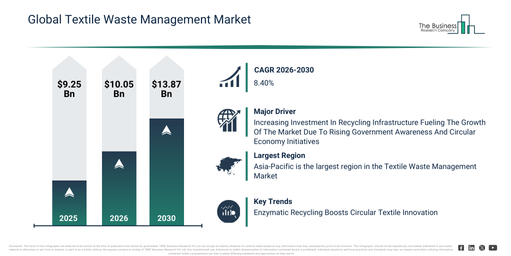
The textile waste management market has demonstrated substantial growth in recent years. It is anticipated to expand from $9.25 billion in 2025 to $10.05 billion in 2026, achieving a compound annual growth rate (CAGR) of 8.7%. Historically, this market expansion can be attributed to elements such as increased consumption of fast fashion, the rising volume of textile waste generated, the growth in apparel manufacturing, restricted landfill capacity, and heightened awareness concerning textile pollution.
The textile waste management market is projected for substantial growth in the coming years, anticipated to reach $13.87 billion by 2030, exhibiting a compound annual growth rate (CAGR) of 8.4%. This projected expansion stems from factors such as stricter regulatory requirements for textile recycling, increased funding for circular fashion initiatives, an increase in chemical recycling capabilities, higher demand for recycled fibers, and wider implementation of digital systems for tracking waste. Key trends expected during this period involve the wider acceptance of textile recycling technologies, a greater reliance on chemical recycling techniques, an intensified focus on developing closed-loop textile systems, the broader application of waste-to-energy solutions, and a stronger emphasis on ensuring textile traceability.
Get A Free Sample Report With In-Depth Market Insights:
Textile Waste Management Market Demand Drivers: What’s Powering Industry Growth?
Future expansion within the textile waste management market is anticipated due to rising investments in recycling infrastructure. This infrastructure encompasses the systems, facilities, and technologies crucial for the efficient collection, sorting, and transformation of textile waste into valuable reusable raw materials. Governments’ heightened awareness of textile waste’s environmental effects and the imperative to foster a circular economy are fueling this increased investment in recycling infrastructure. Such investment supports textile waste management by delivering sophisticated systems and technologies for effective collection, sorting, and processing, ultimately promoting sustainable resource recovery and diminishing landfill volumes. As an illustration, in September 2023, the Environmental Protection Agency (EPA), a US-based government agency, reported that over $100 million was allocated via President Biden’s Investing in America agenda to reinforce recycling infrastructure and waste management systems across the nation, representing the EPA’s most substantial recycling investment in 30 years. Furthermore, the EPA selected 25 communities to receive more than $73 million in grants through the recently established Solid Waste Infrastructure for Recycling funding program. Consequently, the expanding investment in recycling infrastructure is propelling the growth of the textile waste management market.
Textile Waste Management Market Segment Analysis And Revenue Potential
The textile waste management market covered in this report is segmented –
1) By Processing Method: Recycling, Waste-To-Energy, Landfilling, Incineration
2) By Waste Type: Post-Consumer Waste, Post-Industrial Waste, Pre-Consumer Waste, Unsold Goods
3) By Material Type: Natural Fibers, Synthetic Fibers, Blended Fabrics
4) By Application: Apparel, Home Furnishing, Industrial, Other Applications
5) By End User: Textile Manufacturers, Retailers, Recyclers, Consumers
Subsegments:
1) By Recycling: Mechanical Recycling, Chemical Recycling, Open-Loop Recycling, Closed-Loop Recycling
2) By Waste-To-Energy: Incineration With Energy Recovery, Gasification, Pyrolysis, Anaerobic Digestion
3) By Landfilling: Municipal Solid Waste Landfills, Industrial Landfills, Bioreactor Landfills
4) By Incineration: Mass Burn Incineration, Refuse-Derived Fuel (RDF) Incineration, Fluidized Bed Incineration
Textile Waste Management Market Innovation Trends: What Developments Are Reshaping The Industry?
Leading companies active in the textile waste management market are prioritizing the development of advanced technological solutions, notably enzymatic recycling technologies, to boost sustainability and efficiency in their recycling operations. Enzymatic recycling technologies describe processes utilizing specially engineered enzymes to break down synthetic and natural polymers present in textile or plastic waste into their original monomers or raw materials, which can then be utilized to create new products. For instance, in April 2024, Samsara Eco, an Australia-based recycling technology enterprise, partnered with Lululemon, a Canada-based athletic apparel brand, to launch a clothing line manufactured from enzymatically recycled polyester. This launch features garments produced via Samsara Eco’s patented enzymatic process, which converts end-of-life textiles into regenerated polyester without affecting its durability or performance. This innovation propels the textile waste management industry forward by decreasing reliance on virgin resources and promoting a closed-loop, circular economy.
Textile Waste Management Market Key Players Shaping Industry Direction
Major companies operating in the textile waste management market report are Veolia Environnement SA, Republic Services Inc, Infinited Fiber Company, TEXAID, Procotex Corporation SA, Boer Group Recycling Solutions GmbH, ICOLLECT India Private Limited, Pure Waste Textiles Oy, Nathan’s Wastesavers Ltd, Retex Textiles Inc, Ecocitex, Lenzing AG, Worn Again Technologies, Circ BV, Recover Textile Systems SL, SOEX Group, Martex Fiber Southern Corporation, Leigh Fibers Inc, FabScrap Inc, Evrnu Inc, Ambercycle Inc
View The Full Textile Waste Management Market Report:
Textile Waste Management Market Regional Analysis: Which Geography Leads On Revenue?
Asia-Pacific was the largest region in the textile waste management market in 2025. North America is expected to be the fastest-growing region in the forecast period. The regions covered in the textile waste management market report are Asia-Pacific, South East Asia, Western Europe, Eastern Europe, North America, South America, Middle East, Africa.
Reach Out To Our Team:
The Business Research Company: https://www.thebusinessresearchcompany.com/
Americas: +1 310-496-7795
Asia: +44 7882 955267 & +91 8897263534
Europe: +44 7882 955267
Email us at: marketing@tbrc.info
Follow us on:
LinkedIn: https://in.linkedin.com/company/the-business-research-company
YouTube: https://www.youtube.com/channel/UC24_fI0rV8cR5DxlCpgmyFQ
Global Market Model: https://www.thebusinessresearchcompany.com/global-market-model

Wasay has over a decade of experience in market research, data modelling, and analytics, with prior experience at GlobalData and Decision Tree Consulting Services. At The Business Research Company , he leads research operations across syndicated studies, customized consulting engagements, and the Global Market Model platform. His professional experience includes supporting organizations such as Boston Consulting Group, KPMG, and Ernst & Young. Wasay holds a degree in Electronics and Communications Engineering, postgraduate management qualifications from International Management Institute Belgium and Indian School of Business and Entrepreneurship, and completed the Integrated Program in Business Analytics from Indian Institute of Management Indore.