Backed by market attractiveness analysis, total addressable market sizing, company benchmarking matrices, interactive Excel dashboards, wider supply chain intelligence, emerging startup coverage, and detailed product-level insights, The Business Research Company’s 2026 market reports are designed to offer research that is more actionable and strategically valuable than ever.
Chemical Tanker Shipping Market Size, Value And Growth Trajectory Through 2030
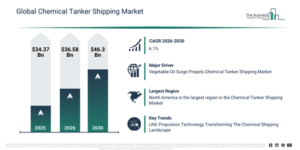
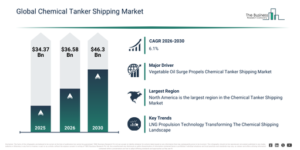
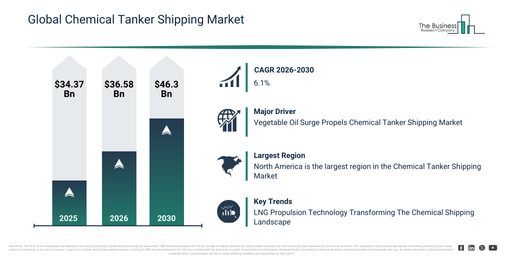
The chemical tanker shipping market size has seen robust growth in recent years. It is projected to expand from $34.37 billion in 2025 to $36.58 billion in 2026, achieving a compound annual growth rate (CAGR) of 6.4%. This historical expansion is attributed to the global increase in chemical trade volumes, a rise in the seaborne movement of liquid chemicals, the emergence of petrochemical production hubs, an escalating demand for bulk liquid logistics, and the advancement of inland and coastal waterways.
The chemical tanker shipping market size is projected to experience substantial expansion in the coming years. This market is set to reach $46.3 billion by 2030, exhibiting a compound annual growth rate (CAGR) of 6.1%. Key drivers for this growth during the forecast period include greater investments in eco-friendly chemical tankers, a heightened regulatory emphasis on maritime safety standards, the broadening of long-range chemical shipping routes, increasing requirements for high-purity chemical transport, and the ongoing replacement of older tanker fleets. Significant trends anticipated in the forecast period encompass a wider adoption of specialized coated chemical tankers, an uptick in demand for IMO-compliant fleet expansion, a stronger focus on cargo segregation and safety systems, increased use of stainless steel tankers, and an enhanced commitment to fleet modernization.
Get A Free Sample Report With In-Depth Market Insights:
Chemical Tanker Shipping Market Growth Momentum: What Factors Are Shaping Demand?
The growing need for vegetable oils is projected to drive the expansion of the chemical tanker shipping market. Vegetable oils are oils obtained from various plant sources, predominantly from the seeds, nuts, or fruits of plants. Chemical tankers are essential for the transportation of vegetable oils, facilitating their movement from production facilities to different distribution points and end-users. For instance, in May 2024, the United States Department of Agriculture, a US-based government agricultural agency, reported that global vegetable oil production in 2024/25 is expected to increase by 2% to about 228 million tons, primarily driven by significant gains in soybean, palm, and rapeseed oil output. Therefore, the escalating demand for vegetable oils is fostering the growth of the chemical tanker shipping market.
Chemical Tanker Shipping Market Segment Outlook: Which Categories Are Growing Fastest?
The chemical tanker shipping market covered in this report is segmented –
1) By Type: Inland Chemical Tankers (1,000-4,999 DWT), Coastal Chemical Tankers (5,000-9,999 DWT), Deep-Sea Chemical Tankers (10,000-50,000 DWT)
2) By Cargo Type: IMO I, IMO II, IMO III
3) By Fleet Material: Stainless Steel, Coated, Epoxy
4) By Application: Organic Chemicals, Inorganic Chemicals, Vegetables Oils And Fats, Other Applications
Subsegments:
1) By Inland Chemical Tankers (1,000-4,999 DWT): Small Tanker Barges, River Tankers
2) By Coastal Chemical Tankers (5,000-9,999 DWT): Coastal Tankers For Short Routes, Regional Tankers
3) By Deep-Sea Chemical Tankers (10,000-50,000 DWT): Medium-Range (MR) Tankers, Long-Range (LR) Tankers
Chemical Tanker Shipping Market Trends Redefining Industry Growth
Leading entities within the chemical tanker shipping market are concentrating on creating novel solutions, including LNG propulsion technology. This technology involves utilizing liquefied natural gas (LNG) to energize ships and various marine craft. As an illustration, in April 2023, Fukuoka Shipbuilding, a Japanese firm specializing in vessel manufacturing, unveiled its ‘LNG Dual-fuel Chemical Tanker’. This tanker is constructed from stainless steel and incorporates LNG propulsion technology. This modern dual-fuel chemical tanker facilitates a reduction in carbon dioxide emissions by up to 25% when measured against traditional marine fuels.
Chemical Tanker Shipping Market Leading Companies And Competitive Benchmarking
Major companies operating in the chemical tanker shipping market are Sinochem Corporation, Stolt-Nielsen Ltd., Frontline Ltd., Diamond S Shipping Inc., Ardmore Shipping, International Seaways Inc., Petronav Caspian Sea Marine Services Pvt. Ltd., Uni-Tankers A/S, PT. Berlian Laju Tanker Tbk., BW Group, Odfjell SE, Seatrans Group, Team Tankers International Ltd., Tokyo Marine Asia Pte Ltd., Duzgit Group, MOL Chemical Tankers, Nordic Tankers, Hansa Tankers, Navig8 Chemical Tankers Inc., Iino Kaiun Kaisha Ltd., Stena Bulk, Maersk Tankers, MOL Nordic Tankers, JO Tankers, Eitzen Chemical, Ace Tankers Management B.V., Scorpio Tankers Inc., TORM
View The Full Chemical Tanker Shipping Market Report:
Chemical Tanker Shipping Market Global Footprint: Which Region Leads The Market?
North America was the largest region in the chemical tanker shipping market in 2025. The regions covered in the chemical tanker shipping market report are Asia-Pacific, South East Asia, Western Europe, Eastern Europe, North America, South America, Middle East, Africa.
Reach Out To Our Team:
The Business Research Company: https://www.thebusinessresearchcompany.com/
Americas: +1 310-496-7795
Asia: +44 7882 955267 & +91 8897263534
Europe: +44 7882 955267
Email us at: marketing@tbrc.info
Follow us on:
LinkedIn: https://in.linkedin.com/company/the-business-research-company
YouTube: https://www.youtube.com/channel/UC24_fI0rV8cR5DxlCpgmyFQ
Global Market Model: https://www.thebusinessresearchcompany.com/global-market-model

Wasay has over a decade of experience in market research, data modelling, and analytics, with prior experience at GlobalData and Decision Tree Consulting Services. At The Business Research Company , he leads research operations across syndicated studies, customized consulting engagements, and the Global Market Model platform. His professional experience includes supporting organizations such as Boston Consulting Group, KPMG, and Ernst & Young. Wasay holds a degree in Electronics and Communications Engineering, postgraduate management qualifications from International Management Institute Belgium and Indian School of Business and Entrepreneurship, and completed the Integrated Program in Business Analytics from Indian Institute of Management Indore.