Built to provide research that’s more actionable and strategically valuable, The Business Research Company’s 2026 market reports include market attractiveness analysis, total addressable market sizing, company benchmarking matrices, interactive Excel dashboards, broader supply chain intelligence, emerging startup tracking, and in-depth product insights.
Connected Work Zone Alerting Market Size, Value And Growth Trajectory Through 2030
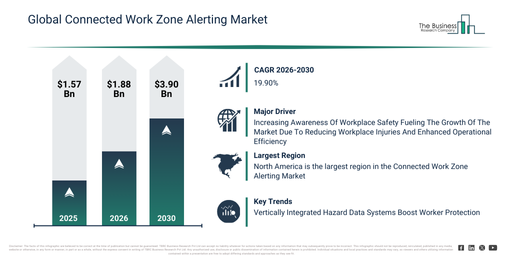
The connected work zone alerting market has experienced rapid expansion in its size over recent years. This market is projected to expand from $1.57 billion in 2025 to reach $1.88 billion in 2026, demonstrating a compound annual growth rate (CAGR) of 20.2%. Factors contributing to this historical growth include an increased emphasis on worker safety and adherence to regulations, a surge in traffic volumes on key routes, stricter regulatory demands for temporary traffic management, heightened public understanding of dangers in work zones, and an uptick in incidents and near misses occurring in these areas.
The connected work zone alerting market is projected for significant expansion over the coming years. It is anticipated to reach $3.90 billion by 2030, exhibiting a compound annual growth rate (CAGR) of 19.9%. This anticipated growth during the forecast period stems from factors such as expanded investments in modernizing infrastructure, increased government financial support for initiatives aimed at road safety, a stronger focus on decreasing work zone accidents and severe injuries, an escalating need among operators for real-time situational understanding, and heightened liability and insurance demands on those responsible for projects. Key trends expected within this period encompass the broader embrace of cellular vehicle-to-everything communication for conveying messages between vehicles and infrastructure, the proliferation of the internet of things (IoT) and low-power wide-area networks (LPWANs) for widespread sensing, the implementation of fifth-generation-enabled communication in work zones for services requiring high throughput and minimal latency, breakthroughs in artificial intelligence-powered video analytics for automatically detecting incidents, and the creation of vehicle-to-infrastructure collaborative systems for synchronized alerts.
Get A Free Sample Report With In-Depth Market Insights:
Connected Work Zone Alerting Market Growth Factors: What’s Supporting Expansion?
The heightened focus on workplace safety is projected to drive the expansion of the connected work zone alerting market in the future. Workplace safety refers to the protocols and actions put in place to shield employees from injuries, illnesses, and risks within their professional environment. This awareness is increasing as companies recognize that fostering a secure workplace enhances employee productivity and minimizes costs linked to work-related incidents. Connected work zone alerting improves workplace safety by delivering real-time digital warnings in construction and maintenance areas, making it easier for drivers and workers to avoid accidents. This technology reduces collision risks by enabling faster reactions and well-informed choices, thereby improving overall operational safety and efficiency. For instance, in February 2025, according to Cross River Therapy, a US-based provider of applied behavior analysis, workplace illness rates saw a significant decline, with the incidence rate dropping to 19.0 cases per 10,000 full-time equivalent (FTE) workers in 2023, down from 45.2 in 2022, which reflects the growing effectiveness of workplace safety initiatives. Therefore, the increasing awareness of workplace safety is fueling the growth of the connected work zone alerting market.
Connected Work Zone Alerting Market Breakdown By Product Type And Application
The connected work zone alerting market covered in this report is segmented –
1) By Component: Hardware, Software, Services
2) By Deployment Mode: On-Premises, Cloud-Based
3) By Technology: Cellular Vehicle to Everything, Dedicated Short Range Communication, Internet of Things and Low Power Wide Area Networks, Fifth Generation Enabled Work Zone Communication, Cloud Based Real Time Alerting Systems
4) By Application: Traffic Management, Incident Detection, Worker Safety, Fleet Management, Other Applications
5) By End-User: Construction Companies, Government Agencies, Transportation Authorities, Other End-Users
Subsegments:
1) By Hardware: Sensors And Detectors, Cameras And Video Systems, Warning Beacons And Dynamic Signage, Roadside Communication Units, Vehicle To Infrastructure Units, Portable Cabinets And Power Systems, Mounting Poles And Support Structures
2) By Software: Analytics And Incident Detection Software, Traffic Management Platform, Fleet Management Software, Mobile Applications For Field Staff, Video Management And Analytics Software, Geographic Information System Mapping Software, Predictive Analytics And Machine Learning Modules
3) By Services: Installation And Commissioning Services, System Design And Engineering Services, Maintenance And Technical Support Services, Remote Monitoring And Management Services, Training And Capacity Building Services, Consulting And Project Management Services, Data Hosting And Information Management Services
Connected Work Zone Alerting Market Industry Trends: What’s Reshaping Demand?
Major companies operating in the connected work zone alerting market are concentrating on creating sophisticated offerings, such as vertically integrated real-time hazard data orchestration systems. These developments aim to bolster roadway worker protection, optimize vehicle-to-work-zone communication, and overcome the drawbacks of older hazard notification approaches. Vertically integrated real-time hazard data orchestration systems gather, process via algorithms, and disseminate hazard intelligence among connected vehicles, work-zone apparatus, fleet platforms, and emergency responders. This facilitates synchronized, rapid alerts that are beyond the capabilities of conventional hazard lights or standalone connected systems. An example of this is the launch in May 2025 by Emergency Safety Solutions (ESS), a US-based roadway safety technology company, of its H.E.L.P. Alert Network. This platform represents a next-generation hazard communication solution, integrating vehicles, roadway personnel, fleets, and emergency services into a unified smart alerting network. This real-time hazard data orchestration system sends precisely calculated hazard notifications to vehicle displays and navigation applications with remarkable accuracy and speed, providing immediate situational awareness that substantially enhances work-zone safety and decreases the likelihood of collisions for all individuals using the roads.
Connected Work Zone Alerting Market Industry Leaders And Competitive Landscape
Major companies operating in the connected work zone alerting market are Robert Bosch GmbH, Qualcomm Incorporated, 3M Company, NXP Semiconductors N.V., Siemens Mobility GmbH, Kapsch TrafficCom AG, TransCore LP, Wanco Inc., Iteris Inc., Ouster Inc., Hill & Smith PLC, Commsignia Inc., Wavetronix LLC, Cohda Wireless Pty Ltd, Econolite Group Inc., Sensys Networks Inc., ClearObject Inc., Applied Information Inc., HAAS Alert Inc., Cubic Transportation Systems Inc.
View The Full Connected Work Zone Alerting Market Report:
Connected Work Zone Alerting Market Regional Analysis And Leading Geography
North America was the largest region in the connected work zone alerting market in 2025. Asia-Pacific is expected to be the fastest-growing region in the forecast period. The regions covered in the connected work zone alerting market report are Asia-Pacific, South East Asia, Western Europe, Eastern Europe, North America, South America, Middle East, Africa.
Reach Out To Our Team:
The Business Research Company: https://www.thebusinessresearchcompany.com/
Americas: +1 310-496-7795
Asia: +44 7882 955267 & +91 8897263534
Europe: +44 7882 955267
Email us at: marketing@tbrc.info
Follow us on:
LinkedIn: https://in.linkedin.com/company/the-business-research-company
YouTube: https://www.youtube.com/channel/UC24_fI0rV8cR5DxlCpgmyFQ
Global Market Model: https://www.thebusinessresearchcompany.com/global-market-model

Wasay has over a decade of experience in market research, data modelling, and analytics, with prior experience at GlobalData and Decision Tree Consulting Services. At The Business Research Company , he leads research operations across syndicated studies, customized consulting engagements, and the Global Market Model platform. His professional experience includes supporting organizations such as Boston Consulting Group, KPMG, and Ernst & Young. Wasay holds a degree in Electronics and Communications Engineering, postgraduate management qualifications from International Management Institute Belgium and Indian School of Business and Entrepreneurship, and completed the Integrated Program in Business Analytics from Indian Institute of Management Indore.