Built to provide research that’s more actionable and strategically valuable, The Business Research Company’s 2026 market reports include market attractiveness analysis, total addressable market sizing, company benchmarking matrices, interactive Excel dashboards, broader supply chain intelligence, emerging startup tracking, and in-depth product insights.
Electric Green Taxiing System (EGTS) Market Size, Value And Growth Trajectory Through 2030
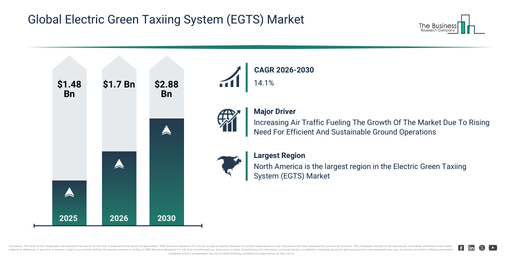
The market size for the electric green taxiing system (egts) has expanded quickly in recent years. It is anticipated to increase from $1.48 billion in 2025 to $1.7 billion in 2026, demonstrating a compound annual growth rate (CAGR) of 14.9%. This historical expansion can be linked to heightened airport congestion levels, increased aircraft ground fuel consumption, the early trials of electric taxiing technologies, mounting pressure to reduce airline operating costs, and an initial regulatory focus on airport emissions.
The market size for the electric green taxiing system (egts) is projected for significant expansion in the coming years. It is anticipated to reach $2.88 billion by 2030, demonstrating a compound annual growth rate (CAGR) of 14.1%. This expansion during the forecast period is driven by factors such as objectives to reduce aviation’s carbon footprint, increased funding into sustainable airport technologies, airlines’ heightened emphasis on operational efficiency, progress in aircraft electrification systems, and the growing uptake of hybrid and electric aviation solutions. Key trends anticipated for this period involve the greater implementation of engine-off taxiing solutions, the increasing incorporation of electric wheel drive systems, a stronger emphasis on technologies that reduce fuel costs, the expansion of automated taxiing assistance systems, and a heightened focus on minimizing emissions during ground operations.
Get A Free Sample Report With In-Depth Market Insights:
Electric Green Taxiing System (EGTS) Market Development Factors: What’s Supporting Demand?
The escalating volume of air traffic is projected to drive the expansion of the electric green taxiing system market in the coming years. Air traffic refers to the organized movement of aircraft both in the air and on the ground, crucial for maintaining safety and efficiency in aviation operations. This increase in air traffic is attributed to the flourishing tourism sector, as more accessible travel options, simplified visa procedures, and increased promotion of global destinations encourage a greater number of people to explore various international and domestic locations. Electric green taxiing systems aid in controlling air traffic by enabling smoother, faster ground movements, which in turn reduce runway congestion and improve overall airport efficiency. For example, in January 2025, the Airports Council International (ACI), a Canada-based organization of airport authorities, anticipated that global passenger traffic would surpass pre-pandemic levels, reaching 9.5 billion in 2024, exceeding 12 billion by 2030, and doubling to 19.5 billion by 2042 compared to 2024 levels. Thus, the growth of the electric green taxiing system market is being fueled by rising air traffic.
Electric Green Taxiing System (EGTS) Market Segmentation: How Does The Market Break Down By Category?
The electric green taxiing system (egts) market covered in this report is segmented –
1) By Component: Electric Motors, Power Electronics, Batteries, Other Components
2) By Type Of Aircraft: Commercial Aircraft, Private Jets, Cargo Aircraft, Military Aircraft
3) By Technology: Battery Electric Systems, Hybrid Electric Systems, Fuel Cell Technology, Integrated Automation Systems
4) By Application: Airport Operations, Airline Ground Support Equipment, Environmental Compliance, Cost-Efficiency Initiatives
5) By End User: Airlines, Airport Authorities, Ground Handling Service Providers, Government Or Military Organizations
Subsegments:
1) By Electric Motors: Wheel Hub Motors, Axial Flux Motors, Radial Flux Motors, Permanent Magnet Synchronous Motors (PMSM), Induction Motors
2) By Power Electronics: Inverters, Converters, Motor Controllers, Power Distribution Units, Thermal Management Systems
3) By Batteries: Lithium-Ion Batteries, Nickel-Metal Hydride (NiMH) Batteries, Solid-State Batteries, Battery Management Systems (BMS)
4) By Other Components: Landing Gear Actuators, Cabling And Connectors, Sensors And Control Units, Charging Interfaces, Energy Recovery Systems
Electric Green Taxiing System (EGTS) Market Transformation Trends: What Innovations Are Driving Change?
Companies within the electric green taxiing system (EGTS) market are prioritizing strategic alliances to speed up technology advancements, obtain regulatory approvals, broaden market acceptance, and improve operational effectiveness while simultaneously lessening environmental effects. An example of this is the collaboration formed in June 2025 between StandardAero, a US-based aerospace component manufacturer, and Green Taxi Solutions (GTS), a US-based aviation firm. Their partnership aims to secure Federal Aviation Administration (FAA) supplemental type certificate (STC) approval for an aircraft-integrated electric taxiing system specifically designed to decrease emissions, fuel consumption, and noise during ground operations. This initiative is supported by a $5.6 million FAA CLEEN grant. The system has been successfully demonstrated on an Airbus A320, having met Airbus’ no technical objection criteria, with certification anticipated by 2027. Further approvals from EASA and Brazil’s ANAC are also projected. The system, designed for easy retrofitting, utilizes electric motors on the main landing gear, powered by the aircraft’s APU. This configuration reduces fuel consumption by approximately 85% compared to using main engines, leading to annual savings of up to 80,000 gallons, alongside decreased operational costs, reduced brake wear, and faster turnaround times, all with minimal changes to existing infrastructure.
Electric Green Taxiing System (EGTS) Market Competitive Overview And Top Companies
Major companies operating in the electric green taxiing system (egts) market are Boeing Company, Airbus S.A.S., Raytheon Technologies Corporation, Honeywell International Inc., General Electric Company, BAE Systems, UTC Aerospace Systems, Collins Aerospace, Safran S.A., Rolls-Royce Holdings plc, Parker Hannifin Corporation, Liebherr Group, Lufthansa Technik, Embraer S.A., Moog Inc., Thales Group, Meggitt PLC, Crane Aerospace & Electronics, Technodinamika srl, WheelTug plc
View The Full Electric Green Taxiing System (EGTS) Market Report:
Electric Green Taxiing System (EGTS) Market Geographic Analysis: Where Is Demand Rising Fastest?
North America was the largest region in the electric green taxiing system market in 2025. Asia-Pacific is expected to be the fastest-growing region in the forecast period. The regions covered in the electric green taxiing system (egts) market report are Asia-Pacific, South East Asia, Western Europe, Eastern Europe, North America, South America, Middle East, Africa.
Reach Out To Our Team:
The Business Research Company: https://www.thebusinessresearchcompany.com/
Americas: +1 310-496-7795
Asia: +44 7882 955267 & +91 8897263534
Europe: +44 7882 955267
Email us at: marketing@tbrc.info
Follow us on:
LinkedIn: https://in.linkedin.com/company/the-business-research-company
YouTube: https://www.youtube.com/channel/UC24_fI0rV8cR5DxlCpgmyFQ
Global Market Model: https://www.thebusinessresearchcompany.com/global-market-model

Wasay has over a decade of experience in market research, data modelling, and analytics, with prior experience at GlobalData and Decision Tree Consulting Services. At The Business Research Company , he leads research operations across syndicated studies, customized consulting engagements, and the Global Market Model platform. His professional experience includes supporting organizations such as Boston Consulting Group, KPMG, and Ernst & Young. Wasay holds a degree in Electronics and Communications Engineering, postgraduate management qualifications from International Management Institute Belgium and Indian School of Business and Entrepreneurship, and completed the Integrated Program in Business Analytics from Indian Institute of Management Indore.