
Enhanced with market attractiveness analysis, total addressable market evaluation, company benchmarking matrices, interactive Excel dashboards, expanded supply chain intelligence, emerging startup coverage, and detailed product insights, The Business Research Company’s 2026 market reports deliver more actionable and strategically valuable research.
Traffic Equipment Market Size, Value And Growth Trends Through 2030
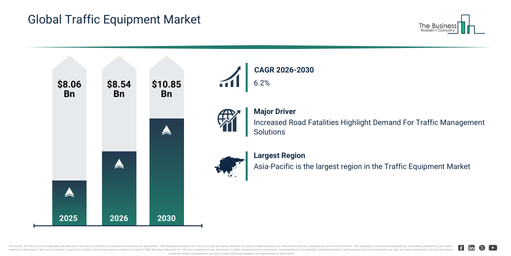
The traffic equipment market has experienced robust expansion in recent years. Forecasts indicate it will expand from $8.06 billion in 2025 to $8.54 billion in 2026, demonstrating a compound annual growth rate (CAGR) of 6.0%. This historical growth is primarily due to factors such as the expansion of urban road networks, an increase in vehicle ownership rates, a heightened demand for traffic regulation, the implementation of conventional traffic control devices, and an uptick in public safety initiatives.
The traffic equipment market is projected to experience robust expansion over the upcoming years. This market is anticipated to reach $10.85 billion by 2030, demonstrating a compound annual growth rate (CAGR) of 6.2%. The anticipated growth during this period stems from heightened investments in smart city infrastructure, an escalating need for real-time traffic analytics, the broadening of connected traffic systems, an amplified emphasis on pedestrian safety solutions, and the increasing implementation of intelligent traffic enforcement. Key trends for the forecast duration encompass the expanded deployment of smart traffic control systems, the increasing uptake of digital signage and monitoring devices, a growing reliance on automated enforcement technologies, the proliferation of urban traffic management solutions, and a heightened focus on road safety equipment.
Download A Free Sample Report For Comprehensive Market Insights:
Traffic Equipment Market Growth Drivers And Industry Catalysts
An anticipated rise in road accidents is projected to fuel the expansion of the traffic equipment market in the future. Defined as occurrences on roads involving vehicles, pedestrians, or cyclists, road accidents typically result in harm, fatalities, or property destruction, frequently stemming from elements like human error, vehicle malfunctions, or unfavorable weather. The increasing frequency of these accidents can be linked to various elements, such as distracted driving, excessive speed, impaired driving due to alcohol or drugs, substandard road infrastructure, and novice drivers. Tools like cones, barriers, and warning signs constitute traffic equipment that assists in managing road accidents by guiding vehicles, maintaining safety, and averting subsequent crashes. As an illustration, the Road Safety Authority, an Ireland-based state agency that promotes road safety, reported in January 2024 that during 2023, road fatalities climbed by 19%, reaching 184 deaths across 173 fatal collisions, a notable increase of 29 deaths when contrasted with the 155 deaths from 149 collisions in 2022. Consequently, the escalating incidence of road accidents serves as a primary impetus for the traffic equipment market.
Traffic Equipment Market Segmentation And Category Breakdown
The traffic equipment market covered in this report is segmented –
1) By Equipment Type: Traffic Safety Barriers, Traffic Cones, Traffic Safety Signs, Shell Protection, Digital Products, Running Plates, Traffic Beams, Shut-Off Gates, Tenting, Other Equipment Types
2) By Traffic Management Solution: Smart Signaling, Route Guidance And Route Optimization, Traffic Analytics, Smart Surveillance, Automatic Number Plate Recognition System (ANPR), Facial Recognition, Pedestrian Detection, Incident Detection, Other Traffic Management Solutions
3) By Traffic Control Application: Urban Traffic, Highway Management, Inter-Urban, Parking Management, Info-Mobility, Public Transport, Tolling, Construction Zone, Other Traffic Control Applications
4) By Distribution Channel: Direct Sales, Government Agencies, Distributors Or Online Platform
5) By End-User: Government And Municipal Authorities, Construction Companies, Transportation Agencies, Commercial And Residential Areas, Education Institutions, Airports And Seaports, Industrial, Other End-Users
Subsegments:
1) By Traffic Safety Barriers: Concrete Barriers, Plastic Barriers, Steel Barriers, Portable Barriers
2) By Traffic Cones: Standard Traffic Cones, Collapsible Traffic Cones, Lighted Traffic Cones, Weighted Traffic Cones
3) By Traffic Safety Signs: Regulatory Signs, Warning Signs, Informational Signs, Custom Signs
4) By Shell Protection: Shell Panels, Shell Covers, Shell Shields
5) By Digital Products: Digital Message Signs, Radar Speed Signs, Traffic Cameras, Traffic Monitoring Systems
6) By Running Plates: Steel Running Plates, Composite Running Plates, Rubber Running Plates
7) By Traffic Beams: Impact Attenuator Beams, Crash Cushion Beams, Steel Traffic Beams, Composite Traffic Beams
8) By Shut-Off Gates: Manual Shut-Off Gates, Automatic Shut-Off Gates, Swing Shut-Off Gates, Sliding Shut-Off Gates
9) By Tenting: Temporary Traffic Tents, Weather Protection Tents, Work Zone Safety Tents, Portable Traffic Canopies
10) By Other Equipment Types: Traffic Delineators, Speed Bumps and Humps, Road Studs and Markers, Temporary Road Fencing
Traffic Equipment Market Trends Influencing Long-Term Demand
Leading companies within the traffic equipment market are prioritizing the development of advanced products, such as next-generation traffic controllers, aimed at improving traffic flow efficiency and enhancing road safety. These sophisticated traffic management systems are designed to optimize traffic flow and increase safety by incorporating real-time data from various sources like sensors and connected vehicles, leveraging innovative technologies such as artificial intelligence and machine learning for superior decision-making and operational performance. For instance, Yunex Traffic, a Germany-based company known for developing innovative mobility ecosystems, introduced the Yutraffic Blade Advanced Traffic Controller Platform in April 2023. This platform is a cutting-edge computing system equipped with a dual-core processor, customizable analytics, CV2X capabilities, and a 7-inch touchscreen, engineered to manage complex intersection traffic control demands presently and in the future.
Traffic Equipment Market Competitive Analysis Of Major Industry Participants
Major companies operating in the traffic equipment market are Honeywell International Inc., 3M Company, Siemens Mobility, Indra Sistemas S.A., Brady Worldwide Inc., SWARCO, Jenoptik Group, 3A Composites GmbH, Kapsch TrafficCom, RoadSafe Traffic Systems Inc., Pexco LLC, The Cortina Companies, TrafFix Devices Inc., Fortran Traffic Systems Limited, Metro Infrasys Pvt. Ltd., Omnitec Group, All Traffic Solutions, Gatekeeper Security Inc., Evelux USA, North America Traffic, Roadtech Manufacturing, Cubic Corporation
Access The Complete Traffic Equipment Market Report:
Traffic Equipment Market Regional Analysis: Which Region Leads By Revenue?
Asia-Pacific was the largest region in the traffic equipment market in 2025. The regions covered in the traffic equipment market report are Asia-Pacific, South East Asia, Western Europe, Eastern Europe, North America, South America, Middle East, Africa.
Get in touch with us:
The Business Research Company: https://www.thebusinessresearchcompany.com/
Americas: +1 310-496-7795
Asia: +44 7882 955267 & +91 8897263534
Europe: +44 7882 955267
Email us at: marketing@tbrc.info
Follow us on:
LinkedIn: https://in.linkedin.com/company/the-business-research-company
YouTube: https://www.youtube.com/channel/UC24_fI0rV8cR5DxlCpgmyFQ
Global Market Model: https://www.thebusinessresearchcompany.com/global-market-model

Wasay has over a decade of experience in market research, data modelling, and analytics, with prior experience at GlobalData and Decision Tree Consulting Services. At The Business Research Company , he leads research operations across syndicated studies, customized consulting engagements, and the Global Market Model platform. His professional experience includes supporting organizations such as Boston Consulting Group, KPMG, and Ernst & Young. Wasay holds a degree in Electronics and Communications Engineering, postgraduate management qualifications from International Management Institute Belgium and Indian School of Business and Entrepreneurship, and completed the Integrated Program in Business Analytics from Indian Institute of Management Indore.