Featuring market attractiveness scoring, total addressable market sizing, company benchmarking matrices, interactive Excel dashboards, deeper supply chain intelligence, emerging startup tracking, and granular product-level insights, The Business Research Company’s 2026 market reports are built to deliver research that is both more actionable and more strategically valuable.
Halal Logistics Market Poised To Hit $572.05 Billion By 2030 With A 8.4% CAGR
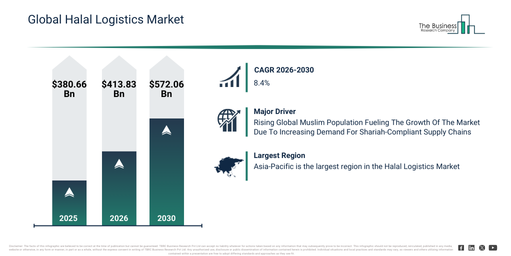
The halal logistics market size has experienced robust growth in recent years. This market is projected to expand from $380.66 billion in 2025 to $413.83 billion in 2026, exhibiting a compound annual growth rate (CAGR) of 8.7%. Historically, this growth can be attributed to an increase in halal food trade volumes, rising consumption among the Muslim population, the development of basic halal certification systems, the expansion of cross-border trade routes, and a heightened awareness of halal integrity.
The halal logistics market is set for significant expansion in the upcoming years, with projections indicating it will reach $572.06 billion by 2030, growing at a compound annual growth rate (CAGR) of 8.4%. This anticipated growth is driven by several factors, including increased investments in halal-compliant cold chain logistics, the rising adoption of digital traceability tools, an expansion in the distribution of halal pharmaceuticals, evolving regulatory standardization, and a growing demand for certified halal logistics partners. Over the forecast period, key trends are expected to involve the expansion of halal-certified logistics infrastructure, the increasing use of blockchain-based traceability systems, a heightened need for segregated storage and transport solutions, the wider implementation of digital halal compliance platforms, and a stronger emphasis on achieving end-to-end supply chain transparency.
Get A Free Sample Report With In-Depth Market Insights:
Halal Logistics Market Growth Catalysts And Demand Drivers
The expanding global Muslim population is expected to drive the future growth of the halal logistics market. This demographic refers to the total number of individuals identifying as followers of Islam within a specific region, country, or worldwide. The increase in the Muslim population is largely attributable to higher fertility rates in Muslim-majority countries, where families tend to have more children on average compared to other religious groups. Halal logistics ensures that the Muslim population has access to goods complying with Islamic principles, thus fostering trust, convenience, and ethical supply chains. For instance, in December 2024, according to Equantu Technology Pte. Ltd., a Singapore-based manufacturer of Muslim worship products, the global Muslim population is projected to reach 2.1 billion by the end of 2025, making up 26.4% of the world’s population and increasing at an annual rate of 1.8%. By 2050, this number is anticipated to rise to 2.8 billion, representing 29.7% of the global population. Therefore, the growing worldwide Muslim population is a significant factor propelling the expansion of the halal logistics market.
Halal Logistics Market Segment Analysis: What Are The Core Market Categories?
The halal logistics market covered in this report is segmented –
1) By Component: Storage, Services, Transportation, Hardware, Software, Monitoring Components
2) By Transport: Railways, Roadways, Airways, Waterways
3) By End-User: Food And Beverages, Pharmaceuticals And Nutraceuticals, Cosmetic And Personal Care, Chemicals, Other End-Users
Subsegments:
1) By Storage: Cold Storage, Dry Storage, Bulk Storage, Segregated Storage, Warehouse Management Systems
2) By Services: Halal Certification And Compliance Services, Supply Chain Consulting, Halal Auditing And Inspection, Third-Party Logistics (3PL), Packaging And Labeling
3) By Transportation: Road Transport, Air Freight, Sea Freight, Rail Transport, Last-Mile Delivery
4) By Hardware: Radio Frequency Identification And Barcode Scanners, Internet Of Things-Enabled Sensors, Global Positioning System Tracking Devices, Smart Storage Equipment, Cold Chain Equipment
5) By Software: Halal Supply Chain Management Software, Blockchain For Halal Product Traceability, Enterprise Resource Planning (ERP) Systems, Transportation Management Systems (TMS), Cloud-Based Warehouse Management Solutions
6) By Monitoring Components: Temperature And Humidity Monitoring Systems, Halal Compliance And Traceability Solutions, Live Global Positioning System And Route Optimization Tools, Artificial Intelligence-Driven Quality Control Systems, Data Analytics For Supply Chain Efficiency
Halal Logistics Market Trends Shaping Long-Term Demand
Leading companies in the halal logistics market are concentrating on creating digital compliance and traceability solutions, particularly halal logistics management platforms, to boost transparency, ensure certification adherence, and strengthen supply chain integrity. These halal logistics management platforms represent digital systems that merge logistics operations with halal compliance requirements by overseeing product handling, segregation, and certification status throughout the supply chain. This integration provides capabilities such as real-time tracking, digital audit trails, contamination risk detection, and certification verification. As an example, in June 2025, TransTRACK, an Indonesia-based logistics technology solutions provider, launched HalalLog. This halal logistics platform is designed to facilitate end-to-end halal compliance across transportation and warehousing operations, featuring real-time shipment tracking, digital halal certification validation, and e-Seal-based monitoring. HalalLog thereby enhances operational transparency, regulatory compliance, and trust within halal supply chains.
Halal Logistics Market Top Companies Driving Competitive Growth
Major companies operating in the halal logistics market are Nippon Express Holdings, TIBA Group, Yusen Logistics CO LTD, SEJUNG SHIPPING CO LTD, TASCO Berhad, Kontena Nasional BHD, MASkargo SDN BHD, DB Schenker, Al Furqan Shipping And Logistics LLC, Northport Malaysia BHD, Freight Management Holdings Berhad, HAVI Logistics, PCS Logistics, Halal Logistics Indonesia, Kerry Logistics Network Limited, Rhenus Indonesia, 3i Logistics Pvt Limited, HALA Logistics Saudi Arabia, Inticorp Logistics Group, MABKARGO SDN BHD
View The Full Halal Logistics Market Report:
Halal Logistics Market Geographic Landscape: Which Region Leads Industry Growth?
Asia-Pacific was the largest region in the halal logistics market in 2025 and it is expected to be the fastest-growing region in the forecast period. The regions covered in the halal logistics market report are Asia-Pacific, South East Asia, Western Europe, Eastern Europe, North America, South America, Middle East, Africa.
Reach Out To Our Team:
The Business Research Company: https://www.thebusinessresearchcompany.com/
Americas: +1 310-496-7795
Asia: +44 7882 955267 & +91 8897263534
Europe: +44 7882 955267
Email us at: marketing@tbrc.info
Follow us on:
LinkedIn: https://in.linkedin.com/company/the-business-research-company
YouTube: https://www.youtube.com/channel/UC24_fI0rV8cR5DxlCpgmyFQ
Global Market Model: https://www.thebusinessresearchcompany.com/global-market-model

Wasay has over a decade of experience in market research, data modelling, and analytics, with prior experience at GlobalData and Decision Tree Consulting Services. At The Business Research Company , he leads research operations across syndicated studies, customized consulting engagements, and the Global Market Model platform. His professional experience includes supporting organizations such as Boston Consulting Group, KPMG, and Ernst & Young. Wasay holds a degree in Electronics and Communications Engineering, postgraduate management qualifications from International Management Institute Belgium and Indian School of Business and Entrepreneurship, and completed the Integrated Program in Business Analytics from Indian Institute of Management Indore.