
Featuring market attractiveness scoring, total addressable market sizing, company benchmarking matrices, interactive Excel dashboards, deeper supply chain intelligence, emerging startup tracking, and granular product-level insights, The Business Research Company’s 2026 market reports are built to deliver research that is both more actionable and more strategically valuable.
Intermodal Freight Transportation Market Value Analysis: What Growth Lies Ahead Over The Forecast Period?
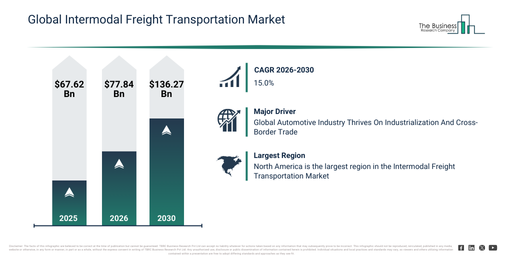
The market size for intermodal freight transportation has experienced rapid expansion in recent years. It is projected to increase from $67.62 billion in 2025 to $77.84 billion in 2026, exhibiting a compound annual growth rate (CAGR) of 15.1%. The historical growth of this market is attributable to the expansion of global trade activities, development of containerization standards, growth of rail and port infrastructure, increasing demand for cost-efficient freight transport, and adoption of multimodal logistics models.
The intermodal freight transportation market is projected to experience substantial expansion in the coming years. This market is forecast to reach a value of $136.27 billion by 2030, exhibiting a compound annual growth rate (CAGR) of 15.0%. This projected growth is driven by factors such as the development of smart freight corridors, increased investments in environmentally friendly logistics solutions, the wider uptake of digital freight platforms, a heightened need for robust supply chains, and the incorporation of low-emission transportation methods. Key trends anticipated during this period encompass the greater adoption of containerized freight, the increasing convergence of rail-road logistics networks, the broader implementation of digital platforms for freight coordination, the enlargement of cross-border intermodal routes, and a sharpened emphasis on the effectiveness of cargo handling.
Get A Free Sample Report With In-Depth Market Insights:
Intermodal Freight Transportation Market Growth Catalysts And Demand Drivers
Growing industrialization is expected to drive the expansion of the intermodal freight transportation market moving forward. Industrialization represents the transformation of an economy from primarily agricultural to one focused on manufacturing goods and services. This increase in industrialization is attributed to globalization, improved supply chain efficiency, diversification of market demand, and various trade agreements. Intermodal freight transportation plays a critical role in industrialization by enhancing the efficiency and effectiveness of logistics and supply chain systems. It supports global trade, infrastructure development, and economic growth, establishing itself as a cornerstone of modern industrial economies. For instance, in November 2025, according to Eurostat, a Luxembourg-based statistical office of the European Union, industrial production in September 2025 climbed by 1.2% in the euro area and by 2.0% in the EU, compared to September 2024. Therefore, the rise in industrialization is propelling the growth of the intermodal freight transportation market.
Intermodal Freight Transportation Market Segment Breakdown: Which Categories Lead On Revenue?
The intermodal freight transportation market covered in this report is segmented –
1) By Type: Railway Transport, Road Transport, Air And Sea Transport, Other Types
2) By Component: Software, Service
3) By Modes: Rail Road, Road Water, Road Air, Other Modes
4) By Verticals: Consumer And Retail, Oil And Gas, Industrial And Manufacturing, Energy And Mining, Food And Beverages, Aerospace And Defense, Construction, Chemicals, Pharmaceuticals And Healthcare, Other Verticals
Subsegments:
1) By Railway Transport: Freight Rail Transport (Long-Distance) Or Regional Rail Freight Transport Or Intermodal Rail Transport (Containerized And Trailerized) Or Rail Transport For Bulk Commodities (Coal, Grains)
2) By Road Transport: Freight Trucking (Long-Haul) Or Regional And Local Freight Trucking Or Container Trucking Or Refrigerated Trucking (For Perishables) Or Heavy-Duty Freight Trucks
3) By Air And Sea Transport: Air Freight Transport Or Sea Freight Transport (Ocean Freight) Or Air-Sea Combined Transport Or Air Freight For Time-Sensitive Cargo Or Sea Freight For Bulk Cargo (Containerized And Non-Containerized)
4) By Other Types: Inland Waterways Transport Or Multimodal Transport (Involving More Than Two Modes) Or Pipeline Transport For Bulk Liquids Or Gases Or Hybrid Intermodal Systems (Combining Rail, Road, And Sea Or Air Transport)
Intermodal Freight Transportation Market Trends Shaping Long-Term Demand
Leading companies operating within the intermodal freight transportation market are concentrating on developing innovative technologies, such as AI-powered transport management solutions, to enhance efficiency, optimize routes, and improve overall supply chain performance. AI-based transport management solutions represent sophisticated systems that leverage artificial intelligence (AI) to advance and streamline various aspects of transportation management. For instance, in September 2023, 3SC Solutions, a Netherlands-based provider of supply chain solutions, introduced iTMS (Intelligent Transport Management Solution). This solution integrates advanced AI and machine learning technologies to deliver real-time route optimization, thereby boosting efficiency and reducing operational costs. iTMS also features predictive analytics capabilities designed to anticipate potential disruptions and proactively adjust logistics strategies. Its dynamic dashboard provides comprehensive insights into all transportation activities, enabling seamless coordination across multiple modes of transport.
Intermodal Freight Transportation Market Leading Players And Competitive Positioning
Major companies operating in the intermodal freight transportation market are Deutsche Post DHL Group, FedEx Corporation, A.P. Moller-Maersk A/S, CMA CGM Group, Deutsche Bahn AG, Kuehne + Nagel International AG, Hapag-Lloyd AG, DSV A/S, SAP SE, DB Schenker, C.H. Robinson Worldwide Inc., DP World, J.B. Hunt Transport Services Inc., Canadian Pacific Railway Limited, Schneider National Inc., Hub Group Inc., APM Terminals, XPO Logistics Inc., Swift Transportation Company, STG Logistics Inc., WiseTech Global Limited, Yusen Logistics Co. Ltd., Air Ground Xpress, CLX Logistics LLC, LOGISTEED Ltd.
View The Full Intermodal Freight Transportation Market Report:
Intermodal Freight Transportation Market Regional Breakdown: Where Is Demand Concentrated?
North America was the largest region in the intermodal freight transportation market in 2025. Asia-Pacific is expected to be the fastest-growing region in the forecast period. The regions covered in the intermodal freight transportation market report are Asia-Pacific, South East Asia, Western Europe, Eastern Europe, North America, South America, Middle East, Africa.
Reach Out To Our Team:
The Business Research Company: https://www.thebusinessresearchcompany.com/
Americas: +1 310-496-7795
Asia: +44 7882 955267 & +91 8897263534
Europe: +44 7882 955267
Email us at: marketing@tbrc.info
Follow us on:
LinkedIn: https://in.linkedin.com/company/the-business-research-company
YouTube: https://www.youtube.com/channel/UC24_fI0rV8cR5DxlCpgmyFQ
Global Market Model: https://www.thebusinessresearchcompany.com/global-market-model

Wasay has over a decade of experience in market research, data modelling, and analytics, with prior experience at GlobalData and Decision Tree Consulting Services. At The Business Research Company , he leads research operations across syndicated studies, customized consulting engagements, and the Global Market Model platform. His professional experience includes supporting organizations such as Boston Consulting Group, KPMG, and Ernst & Young. Wasay holds a degree in Electronics and Communications Engineering, postgraduate management qualifications from International Management Institute Belgium and Indian School of Business and Entrepreneurship, and completed the Integrated Program in Business Analytics from Indian Institute of Management Indore.

