Backed by market attractiveness analysis, total addressable market sizing, company benchmarking matrices, interactive Excel dashboards, wider supply chain intelligence, emerging startup coverage, and detailed product-level insights, The Business Research Company’s 2026 market reports are designed to offer research that is more actionable and strategically valuable than ever.
Logistics Market Set To Climb From $6045.52 Billion In 2026 To $8065.59 Billion By 2030
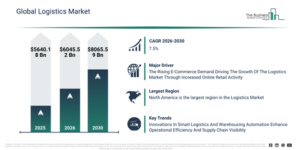
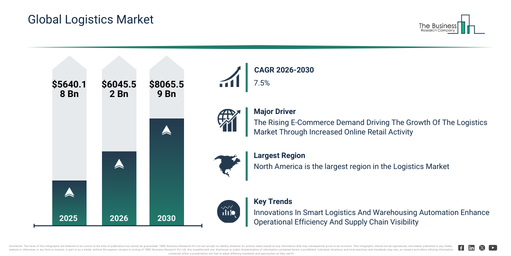
The logistics market size has witnessed significant expansion in recent years. It is anticipated to expand from $5640.18 billion in 2025 to $6045.52 billion in 2026, exhibiting a compound annual growth rate (CAGR) of 7.2%. The historical growth can be ascribed to elements like the rise of e-commerce and retail consumption, the enlargement of global trade routes, the implementation of sophisticated warehouse management systems, increasing capital expenditure in transportation infrastructure, and the heightened outsourcing of logistics services.
The logistics market size is anticipated to undergo significant expansion over the next few years, projected to reach $8065.59 billion by 2030, exhibiting a compound annual growth rate (CAGR) of 7.5%. This growth in the forecast period is driven by factors such as the increasing adoption of automated and autonomous logistics solutions, a heightened focus on sustainable and green logistics practices, the development of digital supply chain platforms, the integration of multimodal transport solutions, and the expansion of 3PL and 4PL services. Important trends expected in this period include real-time shipment tracking, improvements in last-mile delivery, enhanced cold chain efficiency, integrated supply chain consulting services, and the ongoing growth of third-party logistics.
Get A Free Sample Report With In-Depth Market Insights:
Logistics Market Growth Factors Behind Sustained Expansion
The expanding demand for e-commerce is anticipated to fuel the advancement of the logistics market moving ahead. E-commerce, or electronic commerce, involves the online exchange of goods or services. This encompasses supporting activities like online advertising, digital payment processing, managing orders, customer support, and the virtual delivery of items or data. The surge in e-commerce is propelled by advancements in digital infrastructure and widespread smartphone adoption, as enhanced internet connectivity and mobile technologies allow for effortless online shopping, enabling consumers to easily explore, compare, and buy products at their convenience. This heightened e-commerce demand necessitates robust transportation, storage, and final-mile delivery solutions to manage larger order quantities and fulfill customer desires for quick deliveries. As an illustration, data from the U.S. Census Bureau, a US-based government agency, released in February 2024, indicated that total e-commerce sales in 2023 reached an estimated $1,118.7 billion, showing a 7.6% rise over 2022 figures. Consequently, the expanding demand for e-commerce is a key driver for the logistics market’s growth.
Logistics Market Breakdown By Product Type And Application
The logistics market covered in this report is segmented –
1) By Service: Transportation Services, Warehousing and Distribution Services, Freight Forwarding Services, Inventory Management Services, Value-Added Logistics Services, Integration And Consulting Services
2) By Model: Third-Party (3PL) Or Contract Logistics, Fourth-Party (4PL) Or Lead Logistics, Other Models
3) By Mode Of Transport: Roadways, Waterways, Airways, Railways
4) By Operation: Domestic, International
5) By End Use: Retail And E-commerce, Food And Beverages, Automotive, Industrial Machinery And Equipment, Consumer Electronics, Healthcare, Aerospace And Defense
Subsegments:
1) By Transportation Services: Road Transportation, Rail Transportation, Air Transportation, Sea Transportation, Multimodal Transportation
2) By Warehousing And Distribution Services: General Warehousing, Cold Storage Warehousing, Bonded Warehousing, Distribution Center Operations, Fulfillment Services
3) By Freight Forwarding Services: Domestic Freight Forwarding, International Freight Forwarding, Customs Clearance Services, Cargo Consolidation Services, Documentation And Compliance Services
4) By Inventory Management Services: Stock Monitoring Services, Order Management Services, Demand Planning Services, Inventory Optimization Services
5) By Value-Added Logistics Services: Packaging Services, Labeling Services, Assembly And Kitting Services, Quality Inspection Services, Returns Processing Services
6) By Integration And Consulting Services: Supply Chain Consulting, Logistics Network Design, Process Optimization Consulting, Digital Transformation Consulting
Logistics Market Industry Trends Fueling Future Revenue Growth
Leading companies in the logistics sector are increasingly adopting advanced automation technologies, specifically digital-intelligence logistics platforms, to improve real-time supply chain visibility and achieve quicker, more dependable order fulfillment. A digital-intelligence logistics platform utilizes AI data analytics and automation to optimize logistics operations across the entire supply chain, providing real-time insight, enabling smarter decisions, and ensuring seamless coordination throughout logistics networks. For example, in August 2025, Huawei, a China-based ICT infrastructure and smart technologies company, launched its SMART Logistics & Warehousing Solution. This digital-intelligence platform is designed to transform global logistics and supply chain operations, built on a “1+N” architecture that integrates a smart operations cloud with coordinated services across logistics parks and yards. The solution facilitates digital operations management, intelligent allocation, automated relocation, and unattended transportation, while employing AI-driven planning, intelligent recognition, and secure data collaboration to address challenges such as elevated operating costs and fragmented data, ultimately enhancing productivity and responsiveness within logistics and warehousing environments.
Logistics Market Competitive Overview And Top Companies
Major companies operating in the logistics market are DHL Group, United Parcel Service Inc, Maersk Logistics and Services AS, Kuehne and Nagel International AG, DSV AS, CEVA Logistics SA, DP World Limited, CH Robinson Worldwide Inc, Sinotrans Limited, Nippon Express Holdings Inc, GEODIS SA, JB Hunt Transport Services Inc, Ryder System Inc, Penske Logistics LLC, GXO Logistics Inc, DACHSER SE, Rhenus SE and Co KG, Total Quality Logistics LLC, Landstar System Inc, NFI Industries Inc, Hub Group Inc, ID Logistics Group SA,
View The Full Logistics Market Report:
Logistics Market Top Region: Where Does Most Revenue Come From?
North America was the largest region in the logistics in 2025. Asia-Pacific is expected to be the fastest-growing region in the forecast period. The regions covered in the logistics market report are Asia-Pacific, South East Asia, Western Europe, Eastern Europe, North America, South America, Middle East, Africa.
Reach Out To Our Team:
The Business Research Company: https://www.thebusinessresearchcompany.com/
Americas: +1 310-496-7795
Asia: +44 7882 955267 & +91 8897263534
Europe: +44 7882 955267
Email us at: marketing@tbrc.info
Follow us on:
LinkedIn: https://in.linkedin.com/company/the-business-research-company
YouTube: https://www.youtube.com/channel/UC24_fI0rV8cR5DxlCpgmyFQ
Global Market Model: https://www.thebusinessresearchcompany.com/global-market-model

Wasay has over a decade of experience in market research, data modelling, and analytics, with prior experience at GlobalData and Decision Tree Consulting Services. At The Business Research Company , he leads research operations across syndicated studies, customized consulting engagements, and the Global Market Model platform. His professional experience includes supporting organizations such as Boston Consulting Group, KPMG, and Ernst & Young. Wasay holds a degree in Electronics and Communications Engineering, postgraduate management qualifications from International Management Institute Belgium and Indian School of Business and Entrepreneurship, and completed the Integrated Program in Business Analytics from Indian Institute of Management Indore.