Enhanced with market attractiveness analysis, total addressable market evaluation, company benchmarking matrices, interactive Excel dashboards, expanded supply chain intelligence, emerging startup coverage, and detailed product insights, The Business Research Company’s 2026 market reports deliver more actionable and strategically valuable research.
Maritime Freight Transport Market Size And Revenue Forecast Through 2030
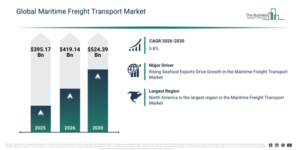
The scale of the maritime freight transport market has shown robust expansion over the past few years. Forecasts indicate an increase from $395.17 billion in 2025 to $419.14 billion by 2026, demonstrating a compound annual growth rate (CAGR) of 6.1%. Historically, this expansion has been driven by the expansion of global trade volumes, growth of containerization in shipping, development of major port infrastructure, rising demand for cost-effective bulk transport, and the increasing role of maritime logistics.
The maritime freight transport market size is projected to experience substantial expansion over the upcoming years. Its valuation is anticipated to reach $524.39 billion by 2030, exhibiting a compound annual growth rate (CAGR) of 5.8%. This anticipated growth during the forecast period stems from factors such as heightened investments in environmentally friendly shipping technologies, a greater emphasis on digitalizing maritime operations, the widening of trade routes in developing markets, the increasing embrace of alternative marine fuels, and the growing need for robust global supply chains. Key trends identified for the forecast period encompass the wider utilization of fuel-efficient cargo ships, the increasing implementation of intelligent port and fleet management solutions, a surging demand for containerized goods transport, the extension of lengthy maritime trade paths, and an intensified commitment to meeting emission reduction standards.
Download A Free Sample Report For Comprehensive Market Insights:
Maritime Freight Transport Market Expansion Drivers: What Is Shaping Future Growth?
The expanding seafood export sector is anticipated to propel the growth of the maritime freight transport market in the future. Seafood export denotes the process of dispatching seafood products such as fish, shellfish, and other marine life from one country to another for sale in international markets. This rise in seafood export is attributed to increasing global demand for seafood, advancements in aquaculture and fishing technologies, and improved cold chain logistics. Maritime freight transport facilitates seafood export by providing a reliable and efficient means of shipping large quantities of perishable seafood products to international markets, ensuring timely delivery and maintaining product quality through refrigerated shipping containers. For instance, in 2023, according to the United States Department of Agriculture, a U.S.-based federal agency, U.S. seafood exports reached a total value of $5.18 billion with a volume of 1.28 million metric tons, marking a 40% increase compared to previous years and indicating a strong recovery and rising demand. Therefore, the expanding seafood export industry is driving the growth of the maritime freight transport market.
Maritime Freight Transport Market Segment Landscape And Growth Potential
The maritime freight transport market covered in this report is segmented –
1) By Maritime Transport Type: Bulk Carriers, Container Ships, General Cargo Ships, Reefer Vessels, Heavy Lift Cargo Vessels, Roll On – Roll Off (Ro-Ro) Vessels
2) By Application: Short-Distance, Long-Distance
3) By Industry Type: Food And Beverages, Manufacturing, Oil And Ores, Electrical And Electronics, Other Industries
Subsegments:
1) By Bulk Carriers: Dry Bulk Carriers, Liquid Bulk Carriers, Self-Unloading Bulk Carriers, Specialized Bulk Carriers
2) By Container Ships: Feeder Container Ships, Panamax Container Ships, Post-Panamax Container Ships, Ultra Large Container Vessels (ULCVs)
3) By General Cargo Ships: Breakbulk Cargo Ships, Multi-Purpose Cargo Vessels, Conventional General Cargo Ships
4) By Reefer Vessels: Dedicated Reefer Ships, Reefer Container Ships, Refrigerated Cargo Carriers
5) By Heavy Lift Cargo Vessels: Heavy Lift Ships, Semi-Submersible Heavy Lift Vessels, Deck Cargo Barges
6) By Roll On – Roll Off (Ro-Ro) Vessels: Pure Ro-Ro Vessels, Combination Carriers, Ro-Pax Ferries
Maritime Freight Transport Market Strategic Trends: What Is Defining The Next Phase Of Growth?
Leading companies active in the maritime freight transport market are developing entirely automated navigational assistants aimed at improving operational effectiveness, increasing safety, and reducing human error in maritime activities. These fully automated navigational assistants leverage advanced algorithms and real-time data analysis to enhance route planning, optimize fuel usage, and bolster overall vessel safety. For example, in January 2024, Orca AI, an Israel-based maritime technology company, introduced SeaPod. This system is a fully automated navigational assistant built to augment and replicate human watchkeeping functions. It operates continuously, processing various information sources in mere seconds to evaluate complex marine traffic situations in real time. The system identifies, tracks, and classifies targets regardless of their size or distance, delivering crucial data to a user-friendly interface. Automating the detection of all targets and the prioritization of risks substantially decreases the workload and fatigue experienced by bridge officers, thereby enhancing situational awareness and empowering crews to make quicker, more informed decisions.
Maritime Freight Transport Market Competitive Landscape: Who Are The Leading Companies?
Major companies operating in the maritime freight transport market are Maersk Line A/S, CMA CGM Group, COSCO SHIPPING Lines Co. Ltd., Mediterranean Shipping Company S.A., Hapag-Lloyd AG, NYK Line (Nippon Yusen Kabushiki Kaisha), Yang Ming Marine Transport Corporation, ZIM Integrated Shipping Services Ltd., Mitsui O.S.K. Lines Ltd., Seaboard Marine Ltd., Wan Hai Lines Ltd., Evergreen Marine Corporation, HMM Company Limited, Kawasaki Kisen Kaisha Ltd., Ocean Network Express Holdings Ltd., American President Lines LLC, Matson Inc., Crowley Maritime Corporation, National Shipping Company of Saudi Arabia (Bahri), Samskip Holding B.V., Islamic Republic of Iran Shipping Line Group, Pacific International Lines, X-Press Feeders Limited, Eimskip, Ark Shipping Inc.
Access The Complete Maritime Freight Transport Market Report:
Maritime Freight Transport Market Geographic Landscape: Which Region Dominates Industry Growth?
North America was the largest region in the maritime freight transport market in 2025. Asia-Pacific is expected to be the fastest-growing region in the forecast period. The regions covered in the maritime freight transport market report are Asia-Pacific, South East Asia, Western Europe, Eastern Europe, North America, South America, Middle East, Africa.
Get in touch with us:
The Business Research Company: https://www.thebusinessresearchcompany.com/
Americas: +1 310-496-7795
Asia: +44 7882 955267 & +91 8897263534
Europe: +44 7882 955267
Email us at: marketing@tbrc.info
Follow us on:
LinkedIn: https://in.linkedin.com/company/the-business-research-company
YouTube: https://www.youtube.com/channel/UC24_fI0rV8cR5DxlCpgmyFQ
Global Market Model: https://www.thebusinessresearchcompany.com/global-market-model

Wasay has over a decade of experience in market research, data modelling, and analytics, with prior experience at GlobalData and Decision Tree Consulting Services. At The Business Research Company , he leads research operations across syndicated studies, customized consulting engagements, and the Global Market Model platform. His professional experience includes supporting organizations such as Boston Consulting Group, KPMG, and Ernst & Young. Wasay holds a degree in Electronics and Communications Engineering, postgraduate management qualifications from International Management Institute Belgium and Indian School of Business and Entrepreneurship, and completed the Integrated Program in Business Analytics from Indian Institute of Management Indore.