Enhanced with market attractiveness analysis, total addressable market evaluation, company benchmarking matrices, interactive Excel dashboards, expanded supply chain intelligence, emerging startup coverage, and detailed product insights, The Business Research Company’s 2026 market reports deliver more actionable and strategically valuable research.
Passenger Rail Transport Market Forecast Highlighting Growth From $307.44 Billion To $412.67 Billion
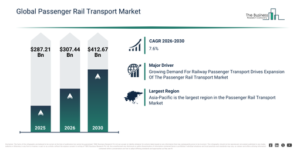
The passenger rail transport market size has experienced robust growth in recent years. It is anticipated to increase from $287.21 billion in 2025 to $307.44 billion in 2026, exhibiting a compound annual growth rate (CAGR) of 7.0%. The expansion observed in the historic period can be attributed to several factors: the expansion of national rail infrastructure, increasing urban population density, rising demand for affordable mass transit, the modernization of aging rail networks, and the availability of public funding for rail projects.
The passenger rail transport market is projected to experience robust expansion over the coming years. Its value is anticipated to reach $412.67 billion by 2030, demonstrating a compound annual growth rate (CAGR) of 7.6%. This expansion during the projection period stems from a heightened emphasis on environmentally friendly transport, the broadening of smart mobility programs, increasing requirements for unified multimodal transportation, escalating capital expenditure in rail electrification, and the rising uptake of digital rail management platforms. Key developments predicted for this period encompass the enlargement of high-speed rail infrastructures, a surge in funding for urban and suburban rail networks, an intensified commitment to improving passenger amenities, the wider implementation of smart ticketing solutions, and enhanced rail safety and dependability protocols.
Download A Free Sample Report For Comprehensive Market Insights:
Passenger Rail Transport Market Growth Factors: Which Forces Are Supporting Market Expansion?
The expansion of the passenger rail transport market is anticipated due to the increasing need for railway passenger transport. This mode of transport entails moving people using trains on railway lines. A key factor in this rising demand is the growing preference for travel methods that are both economical and environmentally conscious. Furthermore, railway passenger transport facilitates passenger mobility by offering a secure, budget-friendly, and energy-saving way to travel, linking urban and regional areas via dependable timetables, extensive service capacity, alleviation of road traffic, and environmentally sound mass transit. An illustrative example, cited in October 2024 by Eurostat, the European Union’s statistical office based in Luxembourg, shows that rail passenger transport throughout the European Union achieved 429 billion passenger-kilometres in 2023. This marks a rise from 386 billion passenger-kilometres in 2022, indicating an 11.2% year-on-year growth. Consequently, the escalating need for railway passenger transport is a significant catalyst for the expansion of the passenger rail transport market.
Passenger Rail Transport Market Segment Landscape: Which Areas Lead Market Development?
The passenger rail transport market covered in this report is segmented –
1) By Type: Medium-Distance Passenger Transport, Long-Distance Passenger Transport, Short-Distance Passenger Transport
2) By Service Type: Core Passenger Transportation Services, Rail Support And Allied Services
3) By Application: City, Rural
Subsegments:
1) By Medium-Distance Passenger Transport: Regional Rail Services, Intercity Rail Services
2) By Long-Distance Passenger Transport: High-Speed Rail Services, Overnight Train Services
3) By Short-Distance Passenger Transport: Commuter Rail Services, Urban Rail
Passenger Rail Transport Market Industry Trends: What Changes Are Reshaping Demand?
Companies in the passenger rail transport sector are increasingly adopting technological innovations, such as linear motor-based rail propulsion, to boost efficiency, flexibility, and overall network capacity. This advanced propulsion system utilizes electromagnetic forces integrated along rail corridors or within vehicles to achieve controlled traction and braking. It facilitates partial automation, improves energy consumption, and allows for scalable enhancements to existing rail infrastructure. An illustrative example occurred in May 2023 when Nevomo, a deep-tech company based in Poland, collaborated with GATX Rail Europe, an Austrian full-service railcar firm, to launch a MagRail booster for rail freight. The components of this MagRail booster present an economical solution for expanding railway line capacity and increasing the operational efficiency of rail transport. These components can be fitted onto standard freight wagons provided by GATX Rail Europe. The technology enables automated traffic management and infrastructure electrification, thereby offering greater adaptability, capacity, and improved operational dynamics. A distinctive characteristic of MagRail is its ability for individual wagons to operate autonomously, making it particularly suitable for last-mile applications like cargo terminals and industrial sites.
Passenger Rail Transport Market Industry Leaders And Market Competition
Major companies operating in the passenger rail transport market are Central Japan Railway Company, SNCF, Deutsche Bahn, West Japan Railway Company (JR-West), Indian Railways, East Japan Railway Company, MTR Corporation Ltd., Russian Railways, Canadian Pacific Railway Ltd., China Railways, KiwiRail Ltd., PT Kereta Api Indonesia (Persero), Abellio ScotRail, Arriva Rail London, Avanti West Coast, Caledonian Sleeper, Chiltern Railways, CrossCountry, East Midlands Railway, Eurostar, Govia Thameslink Railway, Greater Anglia, Great Western Railway, Hull Trains, Grand Central, Merseyrail, Virgin Trains, ScotRail, London Overground, Ceské dráhy, Die Länderbahn, GW Train Regio, Emperor Franz Joseph Railway, Caile Ferate Române, Regiojet, Leo Express, The National Railroad Passenger Corporation (Amtrak), Hudson Bay Railway Co., Companhia do Metropolitano de São Paulo, Perurail, Belmond Andean Explorer, Ferrovías Central Andina, Nuevos Ferrocarriles Argentinos, Trenes Metropolitanos, Brazil Great Southern Railway, Ferrocarril Transandino, Saudi Railway Company, Israel Railways Ltd., Iraq Republic Railways Co., Middle East Rail, Turkish State Railways (TCDD), Arabian Railway Company, Egyptian National Railways (ENR), Passenger Rail Agency of South Africa (PRASA), Transnet SOC Ltd, Union of African Railways, Botswana Railways, Zambia Railways, National Railways of Zimbabwe, Nigerian Railway Corporation
Access The Complete Passenger Rail Transport Market Report:
Passenger Rail Transport Market Largest Region: Which Geography Holds The Highest Market Share?
Asia-Pacific was the largest region in the passenger rail transport market in 2025. Western Europe was the second largest region in the passenger rail transport market. The regions covered in the passenger rail transport market report are Asia-Pacific, South East Asia, Western Europe, Eastern Europe, North America, South America, Middle East, Africa.
Get in touch with us:
The Business Research Company: https://www.thebusinessresearchcompany.com/
Americas: +1 310-496-7795
Asia: +44 7882 955267 & +91 8897263534
Europe: +44 7882 955267
Email us at: marketing@tbrc.info
Follow us on:
LinkedIn: https://in.linkedin.com/company/the-business-research-company
YouTube: https://www.youtube.com/channel/UC24_fI0rV8cR5DxlCpgmyFQ
Global Market Model: https://www.thebusinessresearchcompany.com/global-market-model

Wasay has over a decade of experience in market research, data modelling, and analytics, with prior experience at GlobalData and Decision Tree Consulting Services. At The Business Research Company , he leads research operations across syndicated studies, customized consulting engagements, and the Global Market Model platform. His professional experience includes supporting organizations such as Boston Consulting Group, KPMG, and Ernst & Young. Wasay holds a degree in Electronics and Communications Engineering, postgraduate management qualifications from International Management Institute Belgium and Indian School of Business and Entrepreneurship, and completed the Integrated Program in Business Analytics from Indian Institute of Management Indore.