Through market attractiveness analysis, total addressable market evaluation, company benchmarking matrices, interactive Excel dashboards, expanded supply chain intelligence, emerging startup coverage, and detailed product insights, The Business Research Company’s 2026 market reports provide more actionable and strategically valuable research.
Self-Driving Bus Market Expected To Reach $3.99 Billion By 2030 At 27.2% CAGR
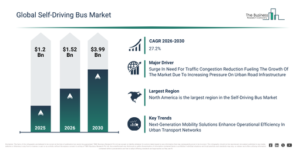
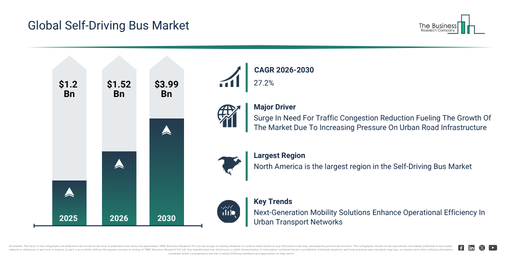
The autonomous bus sector has experienced remarkable exponential expansion in recent years. Its market value is projected to increase from $1.2 billion in 2025 to $1.52 billion in 2026, reflecting a compound annual growth rate (CAGR) of 27.0%. This historical growth has been driven by escalating urban congestion and traffic density, a heightened need for more efficient public transit options, the substantial operational expenses associated with human-operated bus fleets, an intensified emphasis on enhancing road safety, and the current lack of automation within mass transit systems.
The self-driving bus market is anticipated to experience rapid expansion over the coming years, reaching a valuation of $3.99 billion by 2030, driven by a compound annual growth rate (CAGR) of 27.2%. This forecasted growth is fueled by the development of smart city and autonomous mobility programs, the growing integration of electric autonomous fleets in public transport, progress in real-time navigation systems powered by artificial intelligence, increased funding for connected vehicle infrastructure, and a rising need for sustainable and low-emission transportation options. Key trends shaping this period include AI-driven autonomous bus navigation systems, vehicle-to-everything coordination for public transport, intelligent fleet management for driverless buses, the rollout of electric autonomous shuttles in urban settings, and sensor fusion-based technologies designed to boost passenger safety.
Download A Free Sample Report For Comprehensive Market Insights:
Self-Driving Bus Market Expansion Drivers: What Is Shaping Future Growth?
The increasing demand for alleviating traffic congestion is anticipated to drive expansion in the self-driving bus market moving forward. Traffic congestion reduction encompasses initiatives and tactics designed to mitigate road overcrowding, enhance traffic flow effectiveness, and cut down on hold-ups triggered by high vehicle density in both urban and interurban transit networks. This rising necessity to curb congestion stems from swift urbanization, heightened vehicle ownership, and swelling city populations, which collectively strain current road infrastructure and public transit systems. Autonomous buses aid in diminishing congestion through high-capacity, streamlined route planning, platooning features, and uninterrupted operations with minimal human mistakes, thus boosting traffic efficiency, cutting wasted time, and optimizing public transport usage. For example, in June 2025, the United Kingdom Government Digital Service, a unit under the UK Government’s Department for Science, Innovation and Technology (DSIT), reported that for the year ending March 2025, vehicles on local ‘A’ roads faced an average delay of 47.9 seconds per mile compared to free-flow conditions, marking a 2.4 percent rise from the prior year and underscoring a persistent increase in traffic jams. Consequently, a growing imperative to reduce traffic congestion is fueling the growth of the self-driving bus market.
Self-Driving Bus Market Segment Analysis: What Are The Major Market Categories?
The self-driving bus market covered in this report is segmented –
1) By Component: Hardware, Software, Services
2) By Propulsion Type: Internal Combustion Engine, Battery Electric Self Driving Buses, Hybrid Buses
3) By Technology: Light Detection And Ranging Based Navigation, Camera Based Systems, Radar Based Systems, Ultrasonic Sensors, Vehicle To Everything Communication Technology
4) By Application: Public Transportation Systems, Airport Shuttle Services, Corporate Campuses, University Campuses, Tourism And Sightseeing
5) By End-User: Government Agencies, Private Transportation Companies, Educational Institutions, Tourism Operators, Healthcare Institutions
Subsegments:
1) By Hardware: Light Detection And Ranging Sensors, Radar Sensors, Cameras, Ultrasonic Sensors, Global Positioning System Modules, Inertial Measurement Units, Electronic Control Units, Onboard Computers, Batteries, Charging Systems
2) By Software: Autonomous Driving Software, Navigation Software, Fleet Management Software, Vehicle To Everything Communication Software, Safety And Security Software, Passenger Information System Software, Data Analytics Software, Artificial Intelligence Software
3) By Services: Maintenance Services, Consulting Services, Integration Services, Training Services, Remote Monitoring Services, Software Update Services, Fleet Management Services, Customer Support Services
Self-Driving Bus Market Strategic Trends: What Is Defining The Next Phase Of Growth?
Major players in the self-driving bus sector are placing significant emphasis on creating advanced automation functions, including the management of autonomous electric shuttles, to boost operational productivity, safety, and dependability in densely populated urban environments. This involves the deployment and oversight of self-driving, battery-operated shuttle vehicles that transport passengers along either established or adaptable routes without the need for a human operator. For example, in December 2023, BOLDLY Co., Ltd., a Japanese firm specializing in autonomous driving technology, introduced the self-driving electric vehicle “MiCa” for continuous year-round operation at HANEDA INNOVATION CITY®. MiCa is equipped with obstacle detection, Level 4 autonomous driving capabilities, and scheduled passenger shuttle services; this innovation enhances mobility for both workers and visitors, streamlines route efficiency, and offers a replicable model for the automation of urban transportation.
Self-Driving Bus Market Leading Companies Driving Competitive Growth
Major companies operating in the self-driving bus market are AB Volvo, Hyundai Motor Company, Apollo Baidu, EasyMile SAS, Zhengzhou Yutong Bus Co. Ltd., The Hi-Tech Robotic Systemz Ltd., Daimler Truck AG, WeRide Inc., Pony.ai Inc., Karsan Otomotiv Sanayii ve Ticaret A.S., Aurrigo International plc, Mercedes-Benz Group AG, Robert Bosch GmbH, Aptiv Plc, May Mobility Inc., Ohmio Automation Limited, Imagry Inc., Glydways Inc., Beep Inc., Ultra Fairwood
Access The Complete Self-Driving Bus Market Report:
https://www.thebusinessresearchcompany.com/report/self-driving-bus-market-report
Self-Driving Bus Market Geographic Distribution And Regional Opportunities
North America was the largest region in the self-driving bus market in 2025. Asia-Pacific is expected to be the fastest-growing region in the forecast period. The regions covered in the self-driving bus market report are Asia-Pacific, South East Asia, Western Europe, Eastern Europe, North America, South America, Middle East, Africa.
Access a Customized Self-Driving Bus Market Report for Deeper Competitive Insights
Get in touch with us:
The Business Research Company: https://www.thebusinessresearchcompany.com/
Americas: +1 310-496-7795
Asia: +44 7882 955267 & +91 8897263534
Europe: +44 7882 955267
Email us at: marketing@tbrc.info
Follow us on:
LinkedIn: https://in.linkedin.com/company/the-business-research-company
YouTube: https://www.youtube.com/channel/UC24_fI0rV8cR5DxlCpgmyFQ
Global Market Model: https://www.thebusinessresearchcompany.com/global-market-model

Wasay has over a decade of experience in market research, data modelling, and analytics, with prior experience at GlobalData and Decision Tree Consulting Services. At The Business Research Company , he leads research operations across syndicated studies, customized consulting engagements, and the Global Market Model platform. His professional experience includes supporting organizations such as Boston Consulting Group, KPMG, and Ernst & Young. Wasay holds a degree in Electronics and Communications Engineering, postgraduate management qualifications from International Management Institute Belgium and Indian School of Business and Entrepreneurship, and completed the Integrated Program in Business Analytics from Indian Institute of Management Indore.