Featuring market attractiveness scoring, total addressable market sizing, company benchmarking matrices, interactive Excel dashboards, deeper supply chain intelligence, emerging startup tracking, and granular product-level insights, The Business Research Company’s 2026 market reports are built to deliver research that is both more actionable and more strategically valuable.
Ship Leasing Market Revenue Growth On Track For A 14.6% CAGR Through 2030
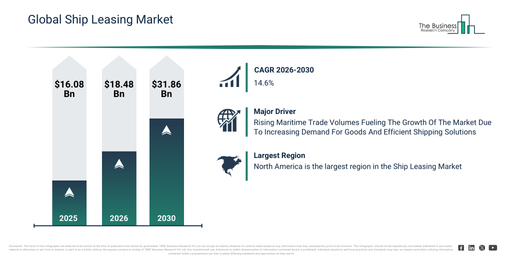
The ship leasing market has experienced substantial growth in its size recently. It is projected to increase from $16.08 billion in 2025 to $18.48 billion in 2026, exhibiting a compound annual growth rate (CAGR) of 14.9%. Historically, this expansion is attributable to the broadening of global maritime trade, the cyclical volatility inherent in shipping demand, the elevated capital costs associated with vessel ownership, the rise of containerized shipping, and a heightened reliance on chartered vessels.
The ship leasing market is anticipated to experience substantial expansion in the coming years. It is projected to reach $31.86 billion by 2030, exhibiting a compound annual growth rate (CAGR) of 14.6%. This forecasted increase is driven by the growing embrace of low-emission shipping fleets, increased capital allocation towards intelligent vessel monitoring systems, the proliferation of LNG and other alternative fuel vessels, a heightened emphasis on managing financial risks, and an escalating need for adaptable charter arrangements. Key trends during this period are expected to encompass a growing inclination towards agile fleet expansion methods, an uptick in demand for temporary vessel leases, the increasing implementation of data-centric fleet management practices, the wider deployment of environmentally friendly and fuel-efficient vessels, and a sharpened focus on asset-light approaches within shipping operations.
Get A Free Sample Report With In-Depth Market Insights:
Ship Leasing Market Growth Factors Behind Sustained Expansion
The future expansion of the ship leasing market is anticipated to be propelled by increasing maritime trade volumes. Maritime trade volumes refer to the total quantity of goods or cargo transported by sea over a specific period. The rise in these volumes stems from growing consumer demand for diverse products, necessitating countries to import and export beyond their local production capabilities. Ship leasing supports maritime trade volumes by offering flexible fleet access, enabling shipping companies to scale operations without large upfront investments. This enhances global trade efficiency by ensuring vessels are available to meet demand fluctuations, thus improving supply chain reliability. For instance, in 2024, according to the United Nations Conference on Trade and Development, a Switzerland-based intergovernmental organization, global maritime trade rose by 2.4% to 12.3 billion tons in 2023, marking a recovery from the decline in 2022. Additionally, it is projected to grow by 2% in 2024 and maintain an average annual growth rate of 2.4% through 2029. Therefore, the increasing maritime trade volumes are driving the growth of the ship leasing market.
Ship Leasing Market Segment Analysis Spotlighting Growth Areas
The ship leasing market covered in this report is segmented –
1) By Type: Bareboat Charter, Real-Time Lease, Periodic Tenancy, Other Types
2) By Lease Type: Financial Lease, Full-Service Lease
3) By Vessel Type: Bulk Carriers, Tankers, Container Ships, Offshore Support Vessels, Roll-On Or Roll-Off Ships (RoRo), Passenger Ships, Specialized Vessels
4) By Application: Container Ships, Bulk Carriers
5) By End User Industry: Oil And Gas, Manufacturing And Industrial, Automotive, Agriculture And Food, Retail And Consumer Goods, Other End Users
Subsegments:
1) By Bareboat Charter: Single Voyage Bareboat Charter, Long Term Bareboat Charter, Finance Or Lease Purchase Bareboat Charter
2) By Real-Time Lease: Hourly Real-Time Lease, Daily Real-Time Lease, Weekly Real-Time Lease
3) By Periodic Tenancy: Short Term Periodic Tenancy, Medium Term Periodic Tenancy, Long Term Periodic Tenancy
4) By Other Types: Hybrid Lease Models, Operating Lease, Finance Lease
Ship Leasing Market Industry Trends Fueling Future Revenue Growth
Major companies in the ship leasing market are prioritizing the establishment of leasing units to facilitate structured ship financing, take advantage of tax and regulatory incentives, enable foreign currency transactions, and provide adaptable fleet capacity to clients while reducing initial capital expenditures. For example, in April 2025, Reliance Industries Limited, an India-based conglomerate company, initiated a ship leasing unit at the International Financial Services Centre (IFSC) in GIFT City, Gujarat. This action aims to expand its involvement in maritime financing and global trade services. This initiative delivers crucial advantages such as a unified regulatory framework, appealing tax incentives including a 100% profit-linked tax holiday for up to 10 years, and relief from various taxes like GST and withholding tax on lease payments. This time charter also grants a deemed foreign jurisdiction status, which improves access to global markets and foreign currency funding at competitive rates. The framework is engineered to fortify India’s maritime sector by attracting ship leasing operations traditionally located in overseas hubs, thereby fostering growth, investment, and global trade.
Ship Leasing Market Leading Companies: Who Holds The Strongest Market Presence?
Major companies operating in the ship leasing market are Mitsui O.S.K. Lines Ltd., Macquarie Group, Triton International Limited, Atlas Corp, Navios Maritime Partners L.P., Costamare Inc., Textainer Group, Hamburg Commercial Bank AG, CSSC (Hong Kong) Shipping Company Limited, Euroseas Ltd., Ocean Yield ASA, Sumitomo Mitsui Finance & Leasing Co. Ltd., Seaco Global Limited, Minsheng Financial Leasing Co. Ltd., Avic Leasing Co. Ltd., Zodiac Maritime Ltd., Eastern Pacific Shipping Pte. Ltd., ICBC Financial Leasing Co. Ltd., Seaspan Corporation, FSL Holdings Inc., CAI International Inc., Maritime Partners LLC
View The Full Ship Leasing Market Report:
Ship Leasing Market Largest Region: Which Geography Holds The Biggest Share?
North America was the largest region in the ship leasing market in 2025. Asia-Pacific is expected to be the fastest-growing region in the forecast period. The regions covered in the ship leasing market report are Asia-Pacific, South East Asia, Western Europe, Eastern Europe, North America, South America, Middle East, Africa.
Reach Out To Our Team:
The Business Research Company: https://www.thebusinessresearchcompany.com/
Americas: +1 310-496-7795
Asia: +44 7882 955267 & +91 8897263534
Europe: +44 7882 955267
Email us at: marketing@tbrc.info
Follow us on:
LinkedIn: https://in.linkedin.com/company/the-business-research-company
YouTube: https://www.youtube.com/channel/UC24_fI0rV8cR5DxlCpgmyFQ
Global Market Model: https://www.thebusinessresearchcompany.com/global-market-model

Wasay has over a decade of experience in market research, data modelling, and analytics, with prior experience at GlobalData and Decision Tree Consulting Services. At The Business Research Company , he leads research operations across syndicated studies, customized consulting engagements, and the Global Market Model platform. His professional experience includes supporting organizations such as Boston Consulting Group, KPMG, and Ernst & Young. Wasay holds a degree in Electronics and Communications Engineering, postgraduate management qualifications from International Management Institute Belgium and Indian School of Business and Entrepreneurship, and completed the Integrated Program in Business Analytics from Indian Institute of Management Indore.