
Backed by market attractiveness analysis, total addressable market sizing, company benchmarking matrices, interactive Excel dashboards, wider supply chain intelligence, emerging startup coverage, and detailed product-level insights, The Business Research Company’s 2026 market reports are designed to offer research that is more actionable and strategically valuable than ever.
Smart logistics Market Forecast: Value Set To Climb From $62.74 Billion To $131.92 Billion
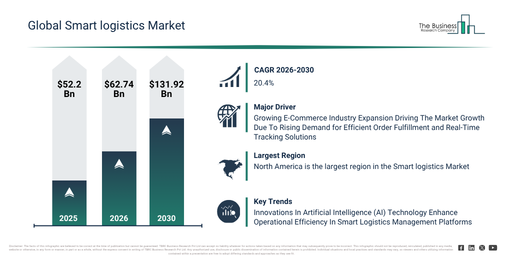
The smart logistics market has seen significant expansion in recent years. It is projected to grow from $52.2 billion in 2025 to $62.74 billion in 2026, achieving a compound annual growth rate (CAGR) of 20.2%. The historical development can be linked to factors such as the wider adoption of warehouse management systems, the surge in e-commerce and retail logistics, an increasing need for transportation management solutions, the spread of inventory tracking technologies, and the intensifying drive to reduce operational costs.
The smart logistics market size is anticipated to undergo significant expansion over the next few years. It is projected to reach $131.92 billion by 2030, demonstrating a compound annual growth rate (CAGR) of 20.4%. The expansion during the forecast period is fueled by the increasing adoption of IoT-enabled tracking systems, the growing deployment of autonomous mobile robots, a rising demand for predictive maintenance analytics, the proliferation of AI-driven route optimization platforms, and an intensifying focus on end-to-end supply chain visibility. Prominent trends expected in the forecast period encompass the increasing embrace of predictive analytics for supply chain optimization, a surging demand for real-time inventory tracking and monitoring, the growing integration of automated warehouse systems, the expansion of route optimization solutions for last-mile delivery, and an increasing emphasis on collaborative robotics in logistics operations.
Get A Free Sample Report With In-Depth Market Insights:
Smart logistics Market Growth Factors: What’s Supporting Expansion?
The expanding e-commerce sector is anticipated to fuel the advancement of the smart logistics market in the future. This growth in e-commerce denotes a swift rise in online shopping, driven by consumers’ increasing inclination to buy products and services via digital channels. The expansion of the e-commerce industry, spurred by increased smartphone adoption and pervasive internet availability, has empowered more shoppers to buy online, simultaneously prompting retailers to enhance their digital frameworks. A sharp increase in online orders directly heightens the demand for smart logistics solutions, such as automated storage, optimized last-mile delivery, and instantaneous shipment tracking, which are crucial for managing larger order quantities effectively and satisfying customer desires for prompt, precise deliveries. For example, in February 2024, the U.S. Census Bureau, a U.S.-based government agency, reported that total e-commerce sales in 2023 reached an estimated $1,118.7 billion, marking a 7.6% rise from 2022. Consequently, the ongoing expansion of the e-commerce industry is propelling the growth of the smart logistics market.
Smart logistics Market Segmentation: How Does The Market Break Down By Category?
The smart logistics market covered in this report is segmented –
1) By Type: Internet Of Things Tracking, Warehouse Automation, Predictive Analytics, Route Optimization, Robotics Integration
2) By Service Type: Consulting And Advisory, System Integration, Managed Services, Support And Maintenance
3) By Application: Warehouse Management, Transportation Management, Order Fulfillment, Inventory Tracking And Management
4) By End-Use Industry: Retail, Manufacturing, Electronic Commerce, Healthcare
Subsegments:
1) By Internet Of Things Tracking: Real Time Asset Tracking Systems, Vehicle And Fleet Tracking Systems, Shipment And Cargo Monitoring Systems, Cold Chain Monitoring Systems, Container Tracking And Visibility Systems
2) By Warehouse Automation: Automated Storage And Retrieval Systems, Automated Guided Vehicle Systems, Autonomous Mobile Robot Systems, Automated Sorting And Conveyor Systems, Robotic Picking And Packing Systems
3) By Predictive Analytics: Demand Forecasting Analytics Platforms, Inventory Optimization Analytics Systems, Predictive Maintenance Analytics Systems, Supply Chain Risk Prediction Platforms, Operational Performance Analytics Solutions
4) By Route Optimization: Dynamic Route Planning Systems, Fleet Route Optimization Software, Last Mile Delivery Route Optimization Platforms, Traffic Aware Route Planning Systems, Multi Stop Delivery Route Optimization Systems
5) By Robotics Integration: Robotic Picking And Handling Systems, Autonomous Mobile Robot Integration Platforms, Robotic Palletizing And Depalletizing Systems, Collaborative Warehouse Robot Systems, Robotic Sorting And Distribution Systems
Smart logistics Market Industry Trends: What’s Reshaping Demand?
Leading companies in the smart logistics market are concentrating on developing advancements in artificial intelligence-based logistics analytics. This technology aims to monitor logistics operations, detect anomalies, and recommend immediate corrective actions to enhance supply chain efficiency. Artificial intelligence-based logistics analytics involves employing AI technologies to analyze supply chain and logistics data, providing real-time insights, enabling predictive decision-making, and optimizing operational effectiveness. For instance, in August 2023, Shipsy, an India-based AI-native SaaS company, launched an AI co-pilot, LIA, Logistics Intelligent Assistant. This tool was designed to improve real-time decision-making across logistics operations. Leveraging generative AI and data analytics, it facilitates automated planning, offers predictive insights, and manages exceptions. The solution assists businesses in boosting supply chain visibility, optimizing routes, and reducing operational inefficiencies.
Smart logistics Market Key Participants And Competitive Landscape
Major companies operating in the smart logistics market are Verizon Communications Inc., Deutsche Post DHL Group, United Parcel Service Inc., FedEx Corporation, A.P. Moller – Maersk A/S, Kuehne + Nagel International AG, Schenker AG, C.H. Robinson Worldwide Inc., Nippon Express Holdings Inc., Sinotrans Limited, GEODIS S.A., Ryder System Inc., XPO Inc., Hellmann Worldwide Logistics SE & Co. KG, Daifuku Co. Ltd., Dematic Holdings LLC, Samsara Inc., Manhattan Associates Inc., Swisslog Holding AG, Geotab Inc., Geekplus Technology Co. Ltd., Vontier Corporation, GreyOrange Pte. Ltd., ORBCOMM Inc.
View The Full Smart logistics Market Report:
Smart logistics Market Geographic Analysis: Where Is Demand Rising Fastest?
North America was the largest region in the smart logistics market in 2025. Asia-Pacific is expected to be the fastest-growing region in the forecast period. The regions covered in the smart logistics market report are Asia-Pacific, South East Asia, Western Europe, Eastern Europe, North America, South America, Middle East, Africa.
Reach Out To Our Team:
The Business Research Company: https://www.thebusinessresearchcompany.com/
Americas: +1 310-496-7795
Asia: +44 7882 955267 & +91 8897263534
Europe: +44 7882 955267
Email us at: marketing@tbrc.info
Follow us on:
LinkedIn: https://in.linkedin.com/company/the-business-research-company
YouTube: https://www.youtube.com/channel/UC24_fI0rV8cR5DxlCpgmyFQ
Global Market Model: https://www.thebusinessresearchcompany.com/global-market-model

Wasay has over a decade of experience in market research, data modelling, and analytics, with prior experience at GlobalData and Decision Tree Consulting Services. At The Business Research Company , he leads research operations across syndicated studies, customized consulting engagements, and the Global Market Model platform. His professional experience includes supporting organizations such as Boston Consulting Group, KPMG, and Ernst & Young. Wasay holds a degree in Electronics and Communications Engineering, postgraduate management qualifications from International Management Institute Belgium and Indian School of Business and Entrepreneurship, and completed the Integrated Program in Business Analytics from Indian Institute of Management Indore.