
Delivering more actionable and strategically valuable research, The Business Research Company’s 2026 market reports feature market attractiveness analysis, total addressable market evaluation, company benchmarking matrices, interactive Excel dashboards, expanded supply chain intelligence, emerging startup coverage, and detailed product insights.
Urban Traffic Simulation Artificial Intelligence (AI) Market Value Analysis: What Growth Is Expected Over The Forecast Period?
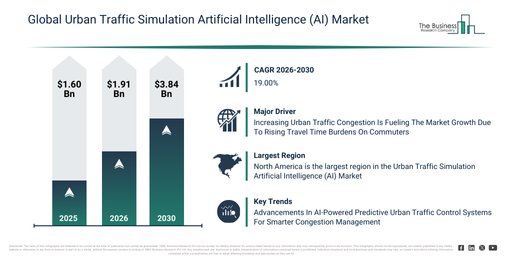
The urban traffic simulation artificial intelligence (AI) market has seen a rapid increase in size during recent years. Its value is anticipated to rise from $1.60 billion in 2025 to $1.91 billion in 2026, achieving a compound annual growth rate (CAGR) of 19.3%. This historical expansion is largely due to increasing urban congestion, the growing adoption of digital traffic tools, a rising need for real-time roadway insights, expanding smart city initiatives, and increasing investment in intelligent transportation systems.
The urban traffic simulation artificial intelligence (AI) market size is anticipated to expand significantly over the coming years, reaching $3.84 billion by 2030, demonstrating a compound annual growth rate (CAGR) of 19.0%. This projected increase is driven by several factors, including the increasing need for predictive traffic management, the growing adoption of artificial intelligence in mobility systems, the continued expansion of connected infrastructure, the expanding application of digital twins for urban planning, and a heightened focus on sustainable urban mobility. Key developments anticipated during this period involve progress in AI traffic modelling, novel approaches in digital twin simulation, enhancements in real-time mobility prediction, ongoing research and development in autonomous traffic ecosystems, and improvements in cloud-based simulation platforms.
Download A Free Sample Report For Comprehensive Market Insights:
#Urban Traffic Simulation Artificial Intelligence (AI) Market Demand Drivers Creating New Revenue Opportunities
The escalating urban traffic congestion is set to propel the urban traffic simulation AI market during the forecast period. Urban traffic congestion refers to road networks becoming saturated, where the demand for transport surpasses their capacity, leading to decreased speeds, longer trip durations, and vehicles forming queues. With the continuous rise in private vehicle ownership, more automobiles are filling urban roads, intensifying traffic jams and hindering overall mobility within cities. Urban traffic simulation AI, employing machine learning algorithms, is expected to benefit from this situation by offering real-time predictive modeling, optimizing signal timings, and performing scenario analysis to ease bottlenecks and enhance traffic flow. For instance, in August 2025, data from the National Travel Survey, published by the Department for Transport, a UK government department, revealed that people spent an average of 362 hours travelling in 2024, marking a 2% increase compared to 2023 (353 hours on average). This indicates a growing burden of travel time directly linked to congestion. Therefore, the increasing urban traffic congestion is driving the growth of the urban traffic simulation AI market.
Urban Traffic Simulation Artificial Intelligence (AI) Market Segment Breakdown: Which Categories Generate The Most Revenue?
The urban traffic simulation artificial intelligence (AI) market covered in this report is segmented –
1) By Component: Software, Hardware, Services
2) By Deployment Mode: On-Premises, Cloud
3) By Application: Traffic Management, Urban Planning, Autonomous Vehicles, Public Transportation, Emergency Response, Other Applications
4) By End-User: Government Agencies, Transportation Authorities, Research Institutes, Smart City Developers, Other End-Users
Subsegments:
1) By Software: Traffic Simulation Platforms, Artificial Intelligence Algorithms, Data Analytics Engines, Visualization Tools, Digital Twin Platforms, Real-Time Prediction Systems
2) By Hardware: Traffic Sensors, Cameras, Edge Computing Devices, High Performance Servers, Networking Equipment, Data Storage Systems
3) By Services: Consulting Services, System Integration Services, Training Services, Support and Maintenance Services, Managed Services, Deployment Services
Urban Traffic Simulation Artificial Intelligence (AI) Market Trends Driving Strategic Industry Expansion
Major companies within the urban traffic simulation AI market are increasingly concentrating on AI-powered automated traffic control and predictive management systems, including AI-driven predictive urban traffic control systems, to enhance real-time traffic optimization and overall transportation efficiency in expanding urban environments. These AI-powered predictive urban traffic control systems aid cities in alleviating congestion by automatically adjusting traffic signals and routing decisions based on real-time data and projected vehicle movement patterns. As an illustration, in September 2025, TRL Software Limited, a UK-based technology enterprise, introduced SCOOT, an AI-powered predictive urban traffic control (UTC) system, developed from the long-standing SCOOT platform already in use across over 350 cities globally. This innovative offering leverages artificial intelligence to forecast traffic conditions up to 30 minutes in advance, allowing for proactive signal optimizations that can decrease journey times by up to 15%, accelerate incident detection by 40%, and seamlessly integrate with existing hardware, active travel modes, connected vehicles, and data platforms such as Waze for Cities.
Urban Traffic Simulation Artificial Intelligence (AI) Market Key Players And Strategic Industry Positioning
Major companies operating in the urban traffic simulation artificial intelligence (AI) market are Siemens Mobility GmbH, Dassault Systèmes SE, Hexagon AB, Cubic Corporation, Environmental Systems Research Institute Inc., SWARCO AG, Bentley Systems Incorporated, HERE Global B.V., TomTom N.V., Altair Engineering Inc., PTV Planung Transport Verkehr AG, Iteris Inc., INRIX Inc., Miovision Technologies Inc., Transport Simulation Systems Ltd., Transoft Solutions Inc., Rapid Flow Technologies Inc., Aimsun SLU, Flow Labs Inc., Kapsch TrafficCom AG, Waycare Technologies Ltd., Urban SDK Inc., Caliper Corporation
Access The Complete Urban Traffic Simulation Artificial Intelligence (AI) Market Report:
#Urban Traffic Simulation Artificial Intelligence (AI) Market Largest Region: Which Geography Holds The Highest Market Share?
North America was the largest region in the urban traffic simulation artificial intelligence (AI) market in 2025. Asia-Pacific is expected to be the fastest-growing region in the forecast period. The regions covered in the urban traffic simulation artificial intelligence (AI) market report are Asia-Pacific, South East Asia, Western Europe, Eastern Europe, North America, South America, Middle East, Africa.
Get in touch with us:
The Business Research Company: https://www.thebusinessresearchcompany.com/
Americas: +1 310-496-7795
Asia: +44 7882 955267 & +91 8897263534
Europe: +44 7882 955267
Email us at: marketing@tbrc.info
Follow us on:
LinkedIn: https://in.linkedin.com/company/the-business-research-company
YouTube: https://www.youtube.com/channel/UC24_fI0rV8cR5DxlCpgmyFQ
Global Market Model: https://www.thebusinessresearchcompany.com/global-market-model

Wasay has over a decade of experience in market research, data modelling, and analytics, with prior experience at GlobalData and Decision Tree Consulting Services. At The Business Research Company , he leads research operations across syndicated studies, customized consulting engagements, and the Global Market Model platform. His professional experience includes supporting organizations such as Boston Consulting Group, KPMG, and Ernst & Young. Wasay holds a degree in Electronics and Communications Engineering, postgraduate management qualifications from International Management Institute Belgium and Indian School of Business and Entrepreneurship, and completed the Integrated Program in Business Analytics from Indian Institute of Management Indore.