
Enhanced with market attractiveness analysis, total addressable market evaluation, company benchmarking matrices, interactive Excel dashboards, expanded supply chain intelligence, emerging startup coverage, and detailed product insights, The Business Research Company’s 2026 market reports deliver more actionable and strategically valuable research.
Artificial Intelligence (AI) In Self-Driving Cars Market Revenue Outlook: What CAGR Is Expected Through 2030?
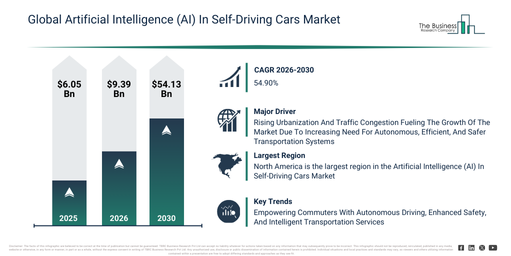
The market size for artificial intelligence (AI) in self-driving cars has witnessed rapid expansion in recent years. This market is projected to expand from $6.05 billion in 2025 to $9.39 billion in 2026, demonstrating a compound annual growth rate (CAGR) of 55.2%. Historically, this expansion has stemmed from advancements in sensor technology, an increase in computing power, greater data availability, government funding and research initiatives, progress in machine learning, and a rising demand for enhanced road safety.
The artificial intelligence (AI) in self-driving cars market is anticipated to undergo significant expansion in the upcoming years, with projections indicating a rise to $54.13 billion by 2030, exhibiting a compound annual growth rate (CAGR) of 54.9%. This projected growth is driven by elements such as regulatory approvals, the decreasing expense of sensors, the expansion of smart infrastructure, the growing demand for autonomous mobility services, strategic partnerships between automakers and tech firms, and continuous improvements in AI algorithms. Prominent trends expected during this forecast period encompass higher levels of vehicle autonomy, the integration of generative AI, vehicle-to-everything communication, the proliferation of robotaxi services, increased utilization of simulation and digital twins, and a focus on ethical and explainable AI.
Download A Free Sample Report For Comprehensive Market Insights:
Artificial Intelligence (AI) In Self-Driving Cars Market Growth Momentum: Which Factors Are Influencing Demand?
The growth of the artificial intelligence (AI) in self-driving cars market is anticipated to be significantly propelled by increasing urbanization and the resulting traffic congestion. These phenomena involve a greater movement of people into urban centers, leading to higher population densities, overcrowded roadways, extended travel durations, and diminished transportation efficiency. The escalation of urbanization and traffic congestion stems from rapid population expansion within cities, which boosts private vehicle ownership and overstrains existing road and public transportation infrastructure. Artificial intelligence (AI) in self-driving cars offers solutions to these issues through autonomous navigation capabilities, real-time traffic forecasting, dynamic route optimization, and improved safety features facilitated by advanced sensor fusion and sophisticated decision-making algorithms, ultimately alleviating congestion and enhancing overall mobility. For example, in November 2025, the United Nations Department of Economic and Social Affairs (UNDESA), a US-based intergovernmental organization, reported that 45 per cent of the world’s 8.2 billion people resided in cities in 2025, with projections indicating that two thirds of global population growth through 2050 would occur in urban areas. Consequently, the escalating urbanization and traffic congestion are serving as key drivers for the artificial intelligence (AI) in self-driving cars market.
Artificial Intelligence (AI) In Self-Driving Cars Market Segment Analysis: What Are The Major Market Categories?
The artificial intelligence (AI) in self-driving cars market covered in this report is segmented –
1) By Component: Hardware, Software, Services
2) By Technology: Computer Vision, Natural Language Processing (NLP), Machine Learning And Deep Learning, Sensor Fusion AI, Others
3) By Application: Perception, Localization And Mapping, Decision-Making And Path Planning, Driver Monitoring Systems, Predictive Maintenance, Traffic And Navigation Assistance, Others
4) By Vehicle Type: Passenger Cars, Light Commercial Vehicles (LCVs), Heavy Commercial Vehicles (HCVs)
Subsegments:
1) By Hardware: Sensors, Processors, On-board Computing Units
2) By Software: AI Algorithms, Sensor Fusion Modules, Decision-Making Systems
3) By Services: Data Labeling And Annotation, Cloud Support And Integration, Maintenance And Testing
Artificial Intelligence (AI) In Self-Driving Cars Market Trends: What Is Shaping Future Industry Growth?
Leading companies in the artificial intelligence in self-driving cars market are prioritizing technological breakthroughs, such as autonomous driving, to deliver safer, more effective, and highly accessible transportation solutions that minimize human error and improve mobility for users in urban settings. Autonomous driving is defined as a vehicle’s capacity to perceive its surroundings, make real-time decisions, and navigate complex traffic scenarios without direct human intervention, leveraging machine learning, sensor fusion, and sophisticated computing to ensure consistent performance, reliability, and safety as its deployment scales. For example, in September 2025, Zoox Inc., a US-based autonomous vehicle developer, initiated its autonomous ride-hailing service in Las Vegas. This involved deploying AI-powered, self-driving vehicles to provide on-demand transportation to the public without a human driver in control. The service utilizes integrated artificial intelligence systems combining cameras, lidar, radar, and high-performance computing to perceive the environment, plan safe maneuvers, and transport passengers through dynamic real-world traffic conditions. Riders can summon vehicles via an application and experience autonomous mobility that enhances convenience while prioritizing safety and operational efficiency.
Artificial Intelligence (AI) In Self-Driving Cars Market Leading Companies Driving Competitive Growth
Major companies operating in the artificial intelligence (AI) in self-driving cars market are Tesla Inc., NVIDIA Corporation, Mobileye Vision Technologies Ltd., Waymo LLC, Motional LLC, WeRide.ai, Wayve Ltd., Nuro Inc., Oxbotica Ltd., May Mobility Inc., AImotive Ltd., Gatik Inc., Pony.ai Inc., Luminar Technologies Inc., Einride AB, EasyMile SA, Avride Inc., Momenta Inc., AutoX Technology Co. Ltd., Innoviz Technologies Ltd., Aurora Innovation Inc., TuSimple Holdings Inc., Velodyne Lidar Inc.
Access The Complete Artificial Intelligence (AI) In Self-Driving Cars Market Report:
Artificial Intelligence (AI) In Self-Driving Cars Market Geographic Distribution And Regional Opportunities
North America was the largest region in the artificial intelligence (AI) in self-driving cars market in 2025. Asia-Pacific is expected to be the fastest-growing region in the forecast period. The regions covered in the artificial intelligence (AI) in self-driving cars market report are Asia-Pacific, South East Asia, Western Europe, Eastern Europe, North America, South America, Middle East, Africa.
Get in touch with us:
The Business Research Company: https://www.thebusinessresearchcompany.com/
Americas: +1 310-496-7795
Asia: +44 7882 955267 & +91 8897263534
Europe: +44 7882 955267
Email us at: marketing@tbrc.info
Follow us on:
LinkedIn: https://in.linkedin.com/company/the-business-research-company
YouTube: https://www.youtube.com/channel/UC24_fI0rV8cR5DxlCpgmyFQ
Global Market Model: https://www.thebusinessresearchcompany.com/global-market-model

Wasay has over a decade of experience in market research, data modelling, and analytics, with prior experience at GlobalData and Decision Tree Consulting Services. At The Business Research Company , he leads research operations across syndicated studies, customized consulting engagements, and the Global Market Model platform. His professional experience includes supporting organizations such as Boston Consulting Group, KPMG, and Ernst & Young. Wasay holds a degree in Electronics and Communications Engineering, postgraduate management qualifications from International Management Institute Belgium and Indian School of Business and Entrepreneurship, and completed the Integrated Program in Business Analytics from Indian Institute of Management Indore.