Backed by market attractiveness analysis, total addressable market sizing, company benchmarking matrices, interactive Excel dashboards, wider supply chain intelligence, emerging startup coverage, and detailed product-level insights, The Business Research Company’s 2026 market reports are designed to offer research that is more actionable and strategically valuable than ever.
Automatic Fare Collection System Market Forecast: What Value Will The Market Reach By 2030?
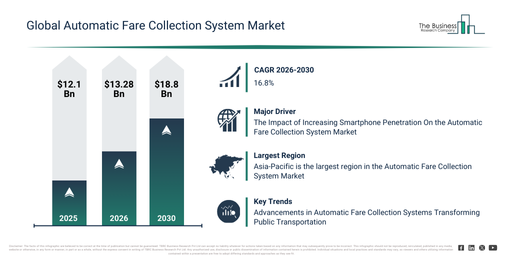
The automatic fare collection system market size has grown strongly in recent years. It will grow from $12.1 billion in 2025 to $13.28 billion in 2026 at a compound annual growth rate (CAGR) of 9.7%. The growth in the historic period can be attributed to public transport digitization, urban rail expansion, reduction of cash handling, adoption of smart cards, fare leakage reduction.
The automatic fare collection system market size is expected to see strong growth in the next few years. It will grow to $18.8 billion in 2030 at a compound annual growth rate (CAGR) of 9.1%. The growth in the forecast period can be attributed to smart city initiatives, mobile payment adoption, interoperable fare systems, AI-driven passenger analytics, cloud-based transit platforms. Major trends in the forecast period include shift toward contactless payments, integration of mobile ticketing, deployment of cloud-based afc platforms, expansion of smart card systems, use of real-time fare analytics.
Get A Free Sample Report With In-Depth Market Insights:
Automatic Fare Collection System Market Industry Drivers: What’s Behind The Revenue Growth?
Increasing smartphone penetration is expected to propel the growth of the automatic fare collection system market going forward. A smartphone is a mobile device that combines the functions of a traditional cell phone with those of a computer. Smartphones are used in automatic fare collection (AFC) systems to facilitate cashless and contactless transactions and enhance the efficiency, convenience, and user experience of public transportation. For instance, in March 2024, according to ConsumerAffairs, a US-based consumer news and advocacy organization, American ownership of smartphones increased to 92% in 2023 from 86% in 2022. Additionally, it was estimated that in 2024, American adults will, on average, spend more than 4.5 hours on their mobile devices each day. Therefore, the increasing smartphone penetration is driving the growth of the automatic fare collection system market.
Automatic Fare Collection System Market Segments: Where Is Growth Concentrated?
The automatic fare collection system market covered in this report is segmented –
1) By Component: Hardware, Software
2) By Technology: Smart Card, Near-Field Communication (NFC)
3) By Application: Railways And Transportation, Parking
Subsegments:
1) By Hardware: Ticket Vending Machines, Turnstiles, Mobile Payment Devices, Fare Gates
2) By Software: Fare Management Software, Reporting And Analytics Software, Integration Software, Cloud-Based Software Solutions
Automatic Fare Collection System Market Trends: What’s Defining The Industry’s Next Phase?
Major companies operating in the automatic fare collection system market are focusing on advancements, such as automatic fare collection systems, to enhance operational efficiency, improve passenger experience, and generate additional revenue streams. Automatic Fare Collection (AFC) systems are technological solutions implemented in public transportation systems to automate the process of fare payment by passengers. For instance, in October 2023, the Metropolitan Atlanta Rapid Transit Authority (MARTA), a Georgia-based metro system, announced the launch of its new automated fare collection system. The new system allows passengers to pay using debit and credit cards, as well as mobile wallets, directly at the fare gate, eliminating the need to use traditional vending machines. It offers several features aimed at improving the passenger experience and optimizing operational efficiency, including multiple payment options and contactless payment integration.
Automatic Fare Collection System Market Key Participants And Competitive Landscape
Major companies operating in the automatic fare collection system market report include Sony Corporation, Siemens AG, Thales Group, Atos SE, Singapore Technologies Engineering Ltd, OMRON Corporation, KML Technology Group Ltd, Indra Sistemas, S.A., Cubic Corporation, NIPPON SIGNAL CO., LTD, Dormakaba Holding AG, Vix Technology, Scheidt & Bachmann GmbH, LECIP HOLDINGS CORPORATION, Trapeze Group, GRGBanking, Masabi Ltd, Seiko Epson Corporation, NXP Semiconductors, SATO Holdings Corporation, Star Micronics Co., Ltd, TSC Auto ID Technology Co., Ltd, Advanced Card Systems Ltd
View The Full Automatic Fare Collection System Market Report:
Automatic Fare Collection System Market Geographic Landscape: Which Region Leads Industry Growth?
Asia-Pacific was the largest region in the automatic fare collection (AFC) system market in 2025. The regions covered in the automatic fare collection system market report include Asia-Pacific, South East Asia, Western Europe, Eastern Europe, North America, South America, Middle East, Africa.
Reach Out To Our Team:
The Business Research Company: https://www.thebusinessresearchcompany.com/
Americas: +1 310-496-7795
Asia: +44 7882 955267 & +91 8897263534
Europe: +44 7882 955267
Email us at: marketing@tbrc.info
Follow us on:
LinkedIn: https://in.linkedin.com/company/the-business-research-company
YouTube: https://www.youtube.com/channel/UC24_fI0rV8cR5DxlCpgmyFQ
Global Market Model: https://www.thebusinessresearchcompany.com/global-market-model

Wasay has over a decade of experience in market research, data modelling, and analytics, with prior experience at GlobalData and Decision Tree Consulting Services. At The Business Research Company , he leads research operations across syndicated studies, customized consulting engagements, and the Global Market Model platform. His professional experience includes supporting organizations such as Boston Consulting Group, KPMG, and Ernst & Young. Wasay holds a degree in Electronics and Communications Engineering, postgraduate management qualifications from International Management Institute Belgium and Indian School of Business and Entrepreneurship, and completed the Integrated Program in Business Analytics from Indian Institute of Management Indore.