Built to provide research that’s more actionable and strategically valuable, The Business Research Company’s 2026 market reports include market attractiveness analysis, total addressable market sizing, company benchmarking matrices, interactive Excel dashboards, broader supply chain intelligence, emerging startup tracking, and in-depth product insights.
#Automotive Elastomers Market Set To Climb From $38.26 Billion In 2026 To $46.83 Billion By 2030#_x000D_
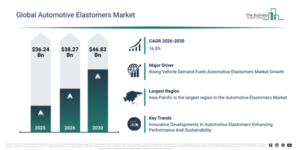
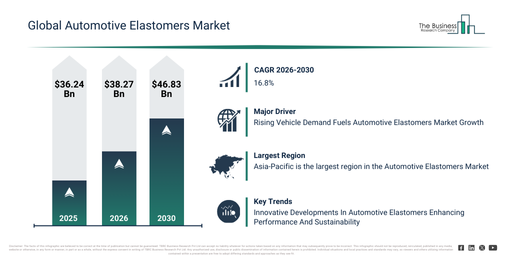
The automotive elastomers market size has grown strongly in recent years. It will grow from $36.24 billion in 2025 to $38.27 billion in 2026 at a compound annual growth rate (CAGR) of 5.6%. The growth in the historic period can be attributed to automotive production growth, rubber component standardization, tire manufacturing expansion, sealing requirements, vibration control needs._x000D_
_x000D_
The automotive elastomers market size is expected to see strong growth in the next few years. It will grow to $46.83 billion in 2030 at a compound annual growth rate (CAGR) of 5.2%. The growth in the forecast period can be attributed to electric vehicle growth, demand for high-temperature materials, lightweight vehicle design, sustainability-driven material selection, advanced polymer development. Major trends in the forecast period include increasing use of advanced elastomers, demand for heat and chemical resistance, lightweight and durable material adoption, growth in under-the-hood applications, focus on noise and vibration control._x000D_
_x000D_
#Get A Free Sample Report With In-Depth Market Insights:#_x000D_
_x000D_
#Automotive Elastomers Market Opportunity Drivers: What’s Unlocking New Revenue Potential?#_x000D_
The increasing demand for new vehicles is expected to propel the growth of the automotive elastomers market going forward. The rise in demand for new vehicles is driven by increased consumer confidence, economic recovery, and advancements in automotive technology. Vehicles use automotive elastomers for sealing, vibration isolation, and flexible components in various parts, such as seals, gaskets, tires, and suspension systems. For instance, in July 2023, according to the International Energy Agency, a France-based autonomous intergovernmental organization, over 2.3 million electric cars had been sold in the first quarter of 2023, marking a 25% increase compared to the same period in 2022. By the end of 2023, sales were expected to reach 14 million, representing a 35% year-on-year increase, with growth accelerating during the second half of the year. Therefore, the increasing demand for new vehicles is driving the growth of the automotive elastomers market_x000D_
_x000D_
#Automotive Elastomers Market Segment Analysis: What Are The Core Market Categories?#_x000D_
The automotive elastomers market covered in this report is segmented – _x000D_
_x000D_
1) By Type: Natural Rubbers (NR), Butyl Elastomers (IIR), Butadiene (BR) (Polybutadiene) Elastomers, Ethylene-Propylene (EPM Or EPDM) Elastomers, Polyisoprene (IR) Elastomers, Nitrile (NBR) Elastomers, Silicones (Q), Polychloroprene (CR) (Neoprene) Elastomers, Acrylic (ACM) Elastomers, Other Types_x000D_
2) By Vehicle Type: Passenger Cars, Light Commercial Vehicles, Medium And Heavy Commercial Vehicles_x000D_
3) By Application: Tire, Interior, Exterior, Under The Hood_x000D_
_x000D_
Subsegments:_x000D_
1) By Natural Rubbers (NR): Solid Natural Rubber, Liquid Natural Rubber _x000D_
2) By Butyl Elastomers (IIR): High-Cis Butyl Elastomers, Bromobutyl Elastomers _x000D_
3) By Butadiene (BR) (Polybutadiene) Elastomers: High-Polymer Polybutadiene, Low-Polymer Polybutadiene _x000D_
4) By Ethylene-Propylene (EPM or EPDM) Elastomers: EPM Elastomers, EPDM Elastomers _x000D_
5) By Polyisoprene (IR) Elastomers: Synthetic Polyisoprene Elastomers, Natural Polyisoprene Elastomers _x000D_
6) By Nitrile (NBR) Elastomers: Carboxylated Nitrile Elastomers, Hydrogenated Nitrile Elastomers _x000D_
7) By Silicones (Q): Solid Silicones, Liquid Silicones _x000D_
8) By Polychloroprene (CR) (Neoprene) Elastomers: Chloroprene Rubber (CR), Neoprene Rubber (CR) _x000D_
9) By Acrylic (ACM) Elastomers: Acrylic-Modified Elastomers, Cross-Linked ACM Elastomers _x000D_
10) By Other Types: Fluoroelastomers, Thermoplastic Elastomers (TPEs)_x000D_
_x000D_
#Automotive Elastomers Market Innovation Trends Shaping Future Development#_x000D_
Major companies in the automotive elastomers market are focused on developing advanced solutions, such as electrically conductive thermoplastic elastomers, to enhance functionality and meet evolving industry demands. Electrically conductive thermoplastic elastomers refer to materials that combine the flexibility of elastomers with the electrical conductivity typically found in metals or conductive polymers, used in applications requiring both mechanical flexibility and electrical conductivity. For instance, in November 2023, KRAIBURG TPE, a Germany-based thermoplastic elastomer manufacturer, launched THERMOLAST R RC/UV/AP, a TPE compound series for automotive exteriors that incorporates recycled materials and offers improved weather resistance for enhanced durability. It is designed for various exterior applications in vehicles, including cowl gaskets, window seals, underbody components, handles, and functional design elements._x000D_
_x000D_
#Automotive Elastomers Market Top Companies Driving Competitive Growth#_x000D_
Major companies operating in the automotive elastomers market report include BASF SE, ExxonMobil Chemical Company, Saudi Basic Industries Corporation (SABIC), Continental AG, LG Chem Ltd., Covestro AG, Asahi Kasei Corporation, Evonik Industries AG, DuPont de Nemours Inc., Arkema Group, Mitsui Chemicals Crop & Life Solutions Inc., Celanese Us Holdings LLC, Lanxess AG, Huntsman International LLC, Solvay S.A., Kuraray Co. Ltd., Trelleborg AB, Japan Synthetic Rubber Co. Ltd., Zeon Chemicals Asia Co. Ltd., Teknor Apex Elastomers Inc., Kraton Polymers LLC, Momentive Performance Materials Inc. _x000D_
_x000D_
#View The Full Automotive Elastomers Market Report:#_x000D_
_x000D_
#Automotive Elastomers Market Regional Analysis: Which Geography Leads On Revenue?#_x000D_
Asia-Pacific was the largest region in the automotive elastomers market in 2025. Europe is expected to be the fastest-growing region in the forecast period. The regions covered in the automotive elastomers market report include Asia-Pacific, South East Asia, Western Europe, Eastern Europe, North America, South America, Middle East, Africa._x000D_
_x000D_
#Reach Out To Our Team:#_x000D_
_x000D_
The Business Research Company: https://www.thebusinessresearchcompany.com/_x000D_
Americas: +1 310-496-7795_x000D_
Asia: +44 7882 955267 & +91 8897263534_x000D_
Europe: +44 7882 955267_x000D_
Email us at: marketing@tbrc.info_x000D_
_x000D_
#Follow us on:#_x000D_
_x000D_
LinkedIn: https://in.linkedin.com/company/the-business-research-company_x000D_
YouTube: https://www.youtube.com/channel/UC24_fI0rV8cR5DxlCpgmyFQ_x000D_
Global Market Model: https://www.thebusinessresearchcompany.com/global-market-model

Wasay has over a decade of experience in market research, data modelling, and analytics, with prior experience at GlobalData and Decision Tree Consulting Services. At The Business Research Company , he leads research operations across syndicated studies, customized consulting engagements, and the Global Market Model platform. His professional experience includes supporting organizations such as Boston Consulting Group, KPMG, and Ernst & Young. Wasay holds a degree in Electronics and Communications Engineering, postgraduate management qualifications from International Management Institute Belgium and Indian School of Business and Entrepreneurship, and completed the Integrated Program in Business Analytics from Indian Institute of Management Indore.