Featuring market attractiveness scoring, total addressable market sizing, company benchmarking matrices, interactive Excel dashboards, deeper supply chain intelligence, emerging startup tracking, and granular product-level insights, The Business Research Company’s 2026 market reports are built to deliver research that is both more actionable and more strategically valuable.
#Automotive Energy Recovery System Market Size Forecast: How Big Could The Market Get By 2030?#_x000D_
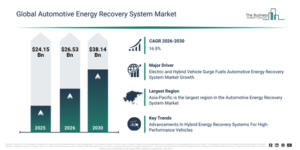
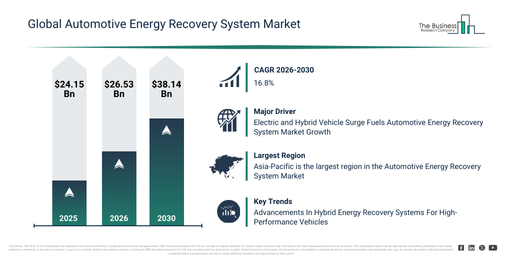
The automotive energy recovery system market size has grown strongly in recent years. It will grow from $24.15 billion in 2025 to $26.53 billion in 2026 at a compound annual growth rate (CAGR) of 9.8%. The growth in the historic period can be attributed to ice efficiency optimization, turbocharger adoption, fuel economy regulations, early hybrid vehicle penetration, automotive powertrain innovation._x000D_
_x000D_
The automotive energy recovery system market size is expected to see strong growth in the next few years. It will grow to $38.14 billion in 2030 at a compound annual growth rate (CAGR) of 9.5%. The growth in the forecast period can be attributed to ev adoption growth, energy efficiency mandates, battery optimization, integration with vehicle electronics, next-generation hybrid architectures. Major trends in the forecast period include integration of regenerative braking systems, advanced turbocharging technologies, energy recovery in hybrid vehicles, expansion of electric recovery systems, lightweight energy recovery components._x000D_
_x000D_
#Get A Free Sample Report With In-Depth Market Insights:#_x000D_
_x000D_
#Automotive Energy Recovery System Market Growth Factors: What’s Supporting Expansion?#_x000D_
The increasing demand for electric and hybrid vehicles is expected to propel the growth of the automotive energy recovery system market going forward. Electric vehicles (EVs) are vehicles that run solely on electricity stored in batteries. In contrast, hybrid vehicles combine an internal combustion engine with electric motors to optimize fuel efficiency and reduce emissions. The demand for electric and hybrid vehicles is due to advancements in battery technology, growing environmental awareness, government incentives, and the rising demand for fuel-efficient and low-emission transportation options. Automotive energy recovery systems in electric and hybrid vehicles capture and reuse energy from braking and other processes to enhance efficiency, extend range, and reduce overall energy consumption. For instance, in August 2024, according to the U.S. Energy Information Administration, a US-based government agency, in the second quarter of 2024 (2Q24), combined sales of hybrid vehicles, plug-in hybrid electric vehicles (PHEVs), and battery electric vehicles (BEVs) rose to 18.7% of total new light-duty vehicle (LDV) sales, up from 17.8% in 1Q24. This increase was driven mainly by hybrid electric vehicles (HEVs), whose share rose from 8.6% in 1Q24 to 9.6% in 2Q24; PHEV share increased modestly from 1.7% to 2.0%, while BEV share reached 7.1% of the LDV market roughly comparable to its share in 2Q23. Therefore, the increasing demand for electric and hybrid vehicles is driving the growth of the automotive energy recovery system market. _x000D_
_x000D_
#Automotive Energy Recovery System Market Segment Landscape And Growth Outlook#_x000D_
The automotive energy recovery system market covered in this report is segmented – _x000D_
_x000D_
1) By Subsystem: Turbocharger, Exhaust Gas Recirculation, Regenerative Braking System_x000D_
2) By Propulsion: Internal Combustion Engine (ICE), Electric_x000D_
3) By Key Technology: Camera, Fusion, Light Detection And Ranging (LiDAR), Radio Detection And Ranging (Radar)_x000D_
4) By Vehicle: Passenger Cars, Light Commercial Vehicles, Heavy Commercial Vehicles_x000D_
_x000D_
Subsegments:_x000D_
1) By Turbocharger: Single Turbocharger, Twin Turbocharger, Variable Geometry Turbocharger (VGT) _x000D_
2) By Exhaust Gas Recirculation (EGR): Low-Pressure EGR, High-Pressure EGR, EGR Coolers _x000D_
3) By Regenerative Braking System: Kinetic Energy Recovery Systems (KERS), Electric Regenerative Braking Systems, Hydraulic Regenerative Braking Systems _x000D_
_x000D_
#Automotive Energy Recovery System Market Industry Trends: What’s Reshaping Demand?#_x000D_
Major companies operating in the automotive energy recovery system market are focusing on developing innovative solutions, such as hybrid energy recovery and management systems, to meet the rising demand for energy-efficient and high-performance electric and hybrid vehicles. Hybrid energy recovery systems capture electrical energy from multiple sources, including kinetic energy from braking and thermal energy from exhausts, which can then be strategically deployed to boost performance or conserved to maximize energy harvesting, unlike traditional internal combustion systems that dissipate such energy as waste heat. For instance, in September 2023, Formula 1, a UK-based motorsport organization, launched the “Hybrid Energy System” graphic powered by AWS, an innovative visualization tool that tracks and displays the real-time usage and harvesting of electrical energy in F1 cars. The system identifies three driver behaviors neutral (balanced usage), recharging (maximizing energy recovery), and deploying (using harvested energy for performance boosts) enabling teams and broadcasters to understand energy strategy and optimize performance. This technology integrates real-time telemetry, energy balance computations, and cloud-based analytics to provide actionable insights for energy recovery management, demonstrating how advanced energy recovery systems can enhance vehicle efficiency and strategic decision-making. _x000D_
_x000D_
#Automotive Energy Recovery System Market Competitive Landscape: Who Leads The Industry?#_x000D_
Major companies operating in the automotive energy recovery system market report include Toyota Motor Corporation, General Motors Company, BMW Group, Robert Bosch GmbH, Hitachi Automotive Systems Ltd., Nissan Motor Co. Ltd., Audi AG, Panasonic Corporation, Denso Corporation, ZF Friedrichshafen AG, Continental AG, Hyundai Precision & Industries Corporation, Magna International Inc., Mitsubishi Electric Corporation, Honeywell International Inc., Aisin Seiki Co. Ltd., Cummins Inc., Valeo SA, Schaeffler AG, Parker Hannifin Corporation, BorgWarner Inc., GKN Automotive Ltd., Delphi Technologies Inc _x000D_
_x000D_
#View The Full Automotive Energy Recovery System Market Report:#_x000D_
_x000D_
#Automotive Energy Recovery System Market Geographic Analysis: Where Is Demand Rising Fastest?#_x000D_
Asia-Pacific was the largest region in the automotive energy recovery system market in 2025. The regions covered in the automotive energy recovery system market report include Asia-Pacific, South East Asia, Western Europe, Eastern Europe, North America, South America, Middle East, Africa._x000D_
_x000D_
#Reach Out To Our Team:#_x000D_
_x000D_
The Business Research Company: https://www.thebusinessresearchcompany.com/_x000D_
Americas: +1 310-496-7795_x000D_
Asia: +44 7882 955267 & +91 8897263534_x000D_
Europe: +44 7882 955267_x000D_
Email us at: marketing@tbrc.info_x000D_
_x000D_
#Follow us on:#_x000D_
_x000D_
LinkedIn: https://in.linkedin.com/company/the-business-research-company_x000D_
YouTube: https://www.youtube.com/channel/UC24_fI0rV8cR5DxlCpgmyFQ_x000D_
Global Market Model: https://www.thebusinessresearchcompany.com/global-market-model

Wasay has over a decade of experience in market research, data modelling, and analytics, with prior experience at GlobalData and Decision Tree Consulting Services. At The Business Research Company , he leads research operations across syndicated studies, customized consulting engagements, and the Global Market Model platform. His professional experience includes supporting organizations such as Boston Consulting Group, KPMG, and Ernst & Young. Wasay holds a degree in Electronics and Communications Engineering, postgraduate management qualifications from International Management Institute Belgium and Indian School of Business and Entrepreneurship, and completed the Integrated Program in Business Analytics from Indian Institute of Management Indore.