
Backed by market attractiveness analysis, total addressable market sizing, company benchmarking matrices, interactive Excel dashboards, wider supply chain intelligence, emerging startup coverage, and detailed product-level insights, The Business Research Company’s 2026 market reports are designed to offer research that is more actionable and strategically valuable than ever.
Automotive Interior Surface Materials Market Forecast: Value Set To Climb From $46.59 Billion To $56.29 Billion
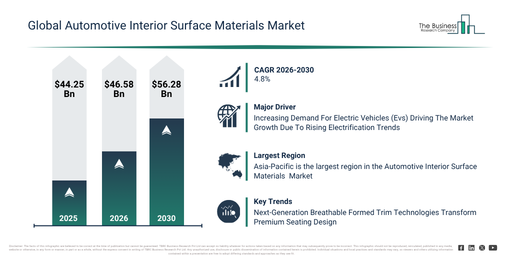
The automotive interior surface materials market size has seen substantial growth recently. It is forecast to expand from $44.25 billion in 2025 to $46.59 billion in 2026, achieving a compound annual growth rate (CAGR) of 5.3%. This historical growth can be attributed to factors such as an increase in automotive production volumes, a rising consumer preference for premium vehicle interiors, growing demand for durable interior materials, the expansion of passenger vehicle sales, and advancements in material engineering technologies.
The market for automotive interior surface materials is projected to experience consistent expansion in the coming years. This market is forecast to reach $56.29 billion by 2030, demonstrating a compound annual growth rate (CAGR) of 4.8%. This anticipated growth during the forecast period is driven by several factors, including an escalating need for sustainable interior materials, broader integration of smart surface technologies, a heightened call for lightweight automotive parts, the proliferation of electric vehicle manufacturing, and increased funding for innovative material developments. Key trends emerging in this period involve an amplified demand for lightweight interior surface materials, a greater move towards premium and bespoke interior finishes, an expanding inclination for materials that are wear-resistant and durable, the proliferation of soft-touch and comfort-centric interior surfaces, and an increased application of sophisticated decorative and aesthetic surface designs.
Get A Free Sample Report With In-Depth Market Insights:
Automotive Interior Surface Materials Market Industry Drivers: What’s Behind The Revenue Growth?
The expanding need for electric vehicles (EVs) is anticipated to fuel the expansion of the automotive interior surface materials market in the future. EVs are vehicles that run on electric motors, drawing power from rechargeable batteries rather than internal combustion engines. The increasing adoption of EVs stems from strict emission controls, as authorities worldwide implement tougher carbon reduction goals to address climate change. Automotive interior surface materials assist electric vehicles by fostering lightweight construction, boosting thermal and acoustic comfort, allowing for sustainable and low-emission cabin designs, and supporting general energy efficiency, which helps prolong the driving range. For instance, in January 2025, according to the Cox Automotive, a US-based system software company, full-year electric vehicle sales in 2024 reached 1.3 million, representing a 7.3% increase over the updated figures from 2023. Consequently, the growing consumer preference for electric vehicles (EVs) is a key factor propelling the expansion of the automotive interior surface materials market.
Automotive Interior Surface Materials Market Segment Analysis: What Are The Core Market Categories?
The automotive interior surface materials market covered in this report is segmented –
1) By Material Type: Plastics, Fabrics, Composites, Leather, Synthetic Leather, Metals, Vegan Leather
2) By Vehicle Type: Passenger Cars, Light Commercial Vehicles, Heavy Commercial Vehicles
3) By Surface Type: Soft Touch Surfaces, Hard Touch Surfaces, Decorative Surfaces, Smart Surfaces
4) By Application Type: Consoles And Dashboards, Seats, Door Panels, Steering Wheels, Floor Carpets And Flooring, Headliners And Roof Linings, Airbags And Seatbelts, Interior Trim Panels
5) By End User: Automotive Original Equipment Manufacturers, Aftermarkets
Subsegments:
1) By Plastics: Polypropylene, Polyurethane, Polyvinyl Chloride, Acrylonitrile Butadiene Styrene, Polycarbonate, Thermoplastic Elastomers
2) By Fabrics: Woven Fabrics, Non Woven Fabrics, Knitted Fabrics, Polyester Fabrics, Nylon Fabrics
3) By Composites: Fiber Reinforced Composites, Glass Fiber Composites, Carbon Fiber Composites, Natural Fiber Composites, Hybrid Composites
4) By Leather: Genuine Leather, Full Grain Leather, Top Grain Leather, Split Leather, Bonded Leather
5) By Synthetic Leather: Polyurethane Leather, Polyvinyl Chloride Leather, Microfiber Leather, Silicone Leather, Bio Based Synthetic Leather
6) By Metals: Aluminum, Steel, Magnesium, Stainless Steel, Decorative Metal Finishes
7) By Vegan Leather: Plant Based Leather, Mushroom Leather, Cork Leather, Apple Leather, Pineapple Leather
#Automotive Interior Surface Materials Market Growth Trends: What’s Shaping The Future Outlook?
Leading companies in the automotive interior surface materials market are concentrating on creating innovative solutions, such as breathable formed trim solutions, with the aim of optimizing premium aesthetic capabilities, decreasing interior assembly complexity, and improving material application yields during manufacturing. Breathable formed trim solutions denote sophisticated, multi-dimensional seating surface layers that utilize automated thermodynamic shaping rather than conventional multi-piece fabric stitching to create complex shapes and concavities while maintaining texturing or surface grain. As an illustration, in February 2026, Adient plc, an Ireland-based automotive seating and interior components company, unveiled Sculpted Soft Trim, its newest breakthrough surface engineering technology crafted for premium global vehicle seating. This product offers a single, integrated surface pattern that can directly substitute up to twelve distinct traditional cut-and-sew patterns, reduces production cycle times by approximately 50% compared to legacy hot-forming techniques, and allows manufacturers to easily emboss, deboss, or customize textural graphics directly into the tooling without compromising vinyl or fabric grain details.
Automotive Interior Surface Materials Market Top Companies Driving Competitive Growth
Major companies operating in the automotive interior surface materials market report are BASF SE, Continental AG, Magna International Incorporated, FORVIA SE, Lear Corporation, Adient PLC, Aunde Group, DRÄXLMAIER Group, Grupo Antolin, Toyobo Company Limited, Inteva Products Limited Liability Company, Mayco International Limited Liability Company, Tachi-S Company Limited, Seiren Company Limited, Nihon Plast Company Limited, Bader GmbH, Gen Phoenix, Toyota Boshoku Corporation, Yanfeng Automotive Interiors, Sage Automotive Interiors, The Woodbridge Group, GST AutoLeather Incorporated
View The Full Automotive Interior Surface Materials Market Report:
Automotive Interior Surface Materials Market Regional Breakdown: Where Is Demand Concentrated?
Asia-Pacific was the largest region in the automotive interior surface materials market in 2025. Asia-Pacific is expected to be the fastest-growing region in the forecast period. The regions covered in the automotive interior surface materials market report are Asia-Pacific, South East Asia, Western Europe, Eastern Europe, North America, South America, Middle East, Africa.
Reach Out To Our Team:
The Business Research Company: https://www.thebusinessresearchcompany.com/
Americas: +1 310-496-7795
Asia: +44 7882 955267 & +91 8897263534
Europe: +44 7882 955267
Email us at: marketing@tbrc.info
Follow us on:
LinkedIn: https://in.linkedin.com/company/the-business-research-company
YouTube: https://www.youtube.com/channel/UC24_fI0rV8cR5DxlCpgmyFQ
Global Market Model: https://www.thebusinessresearchcompany.com/global-market-model

Wasay has over a decade of experience in market research, data modelling, and analytics, with prior experience at GlobalData and Decision Tree Consulting Services. At The Business Research Company , he leads research operations across syndicated studies, customized consulting engagements, and the Global Market Model platform. His professional experience includes supporting organizations such as Boston Consulting Group, KPMG, and Ernst & Young. Wasay holds a degree in Electronics and Communications Engineering, postgraduate management qualifications from International Management Institute Belgium and Indian School of Business and Entrepreneurship, and completed the Integrated Program in Business Analytics from Indian Institute of Management Indore.