Backed by market attractiveness analysis, total addressable market sizing, company benchmarking matrices, interactive Excel dashboards, wider supply chain intelligence, emerging startup coverage, and detailed product-level insights, The Business Research Company’s 2026 market reports are designed to offer research that is more actionable and strategically valuable than ever.
Automotive Wire And Cable Material Market Size And Revenue Outlook Through 2030
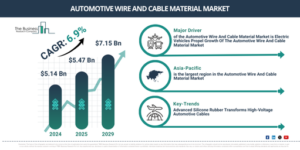
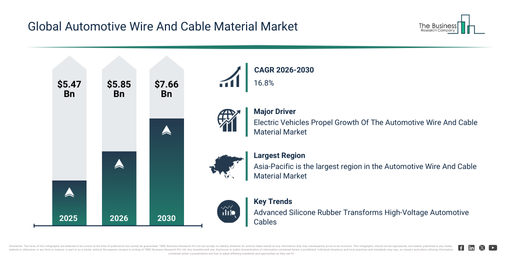
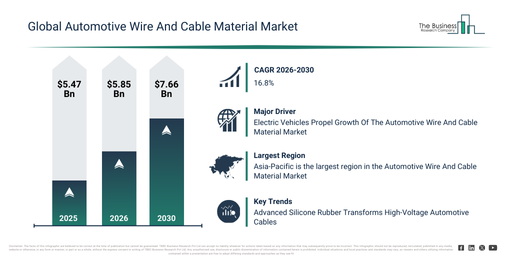
The automotive wire and cable material market size has grown strongly in recent years. It will grow from $5.47 billion in 2025 to $5.85 billion in 2026 at a compound annual growth rate (CAGR) of 6.9%. The growth in the historic period can be attributed to automotive electrification growth, pvc insulation dominance, wiring harness standardization, passenger vehicle demand, material availability.
The automotive wire and cable material market size is expected to see strong growth in the next few years. It will grow to $7.66 billion in 2030 at a compound annual growth rate (CAGR) of 7.0%. The growth in the forecast period can be attributed to electric vehicle penetration, advanced safety requirements, lightweight vehicle design, high-voltage wiring demand, smart vehicle connectivity. Major trends in the forecast period include growing demand for high-temperature materials, expansion of ev wiring systems, adoption of lightweight insulation materials, focus on fire-resistant cables, integration of data and power cables.
Get A Free Sample Report With In-Depth Market Insights:
Automotive Wire And Cable Material Market Growth Momentum: What Factors Are Shaping Demand?
The increase in demand for electric vehicles is expected to propel the growth of the automotive wire and cable material market going forward. Electric vehicles (EVs) refer to vehicles that are powered by electric motors and use energy stored in rechargeable batteries or another energy storage device. The demand for electric vehicles is increasing for several reasons, including government policies and incentives, improvements in battery technology, and growing awareness of climate change and pollution. Electric vehicles rely on automotive wires and cables to transmit power and data among batteries, motors, and electronic systems, ensuring smooth and safe functionality. For instance, in July 2023, according to the Internal Energy Agency, a France-based autonomous intergovernmental organization, over 2.3 million electric cars were sold in the first quarter of 2023, a 25% increase from the same period in 2022. By the end of 2023, sales are expected to reach 14 million, representing a 35% year-on-year increase. Therefore, the rise in demand for electric vehicles is driving the growth of the automotive wire and cable material market.
Automotive Wire And Cable Material Market Segments: Where Is Growth Concentrated?
The automotive wire and cable material market covered in this report is segmented –
1) By Type: Polyvinyl Chloride (PVC), Polypropylene (PP), Cross-Linked Polyethylene (XLPE), Thermoplastic Polyurethane (TPU), Polyphenylene Ether (PPE), Other Types
2) By Component: Conductors, Insulation Materials, Filler and Bedding Materials, Protective Coatings and Tapes
3) By Application: Passenger Vehicles, Light Commercial Vehicles, Heavy Commercial Vehicles
Subsegments:
1) By Polyvinyl Chloride (PVC): Flexible PVC For Wiring Insulation, Rigid PVC For Cable Sheath, Flame-Retardant PVC, PVC With UV Stabilization, PVC With High-Temperature Resistance, PVC For Automotive Power Cables
2) By Polypropylene (PP): PP For Low-Voltage Wire Insulation, High-Temperature Resistant Polypropylene, Flame-Retardant Polypropylene Cables, Reinforced Polypropylene Cables For Durability, PP For Automotive HVAC Systems And Control Wiring, Polypropylene For Automotive Connector Insulation
3) By Cross-Linked Polyethylene (XLPE): XLPE For High-Voltage Wire Insulation, Low-Smoke XLPE For Automotive Fire Safety, XLPE For High-Temperature Applications, Cross-Linked Polyethylene For Electric Vehicle (EV) Charging Cables, XLPE For Power Distribution Cables, XLPE With Enhanced Mechanical Properties
4) By Thermoplastic Polyurethane (TPU): TPU For Flexible Wiring Applications, TPU For Cable Sheathing In Harsh Environments, Oil-Resistant TPU Cables, TPU For Automotive Sensor And Data Cables, TPU With High Abrasion Resistance, TPU For High-Performance Automotive Wiring
5) By Polyphenylene Ether (PPE): PPE For Automotive Electrical Connectors, High-Temperature PPE For Power Cables, PPE For Flame-Retardant Applications, PPE For Lightweight Automotive Cables, PPE For Under-The-Hood Wiring, PPE For Hybrid And Electric Vehicle Wiring
6) By Other Types: Polyethylene (PE) For General Automotive Wiring, Fluoropolymers (E.G., PTFE) For High-Performance Cables, Silicone Rubber For High-Temperature Wiring, Nylon (PA) For Cable Sheath And Insulation, Ethylene Tetrafluoroethylene (ETFE) For Extreme Conditions, Thermoplastic Elastomers (TPE) For Flexible Wiring Solutions
Automotive Wire And Cable Material Market Trends Redefining Industry Growth
Major companies operating in automotive wire and cable material are innovating insulation covering material for high-voltage cables to enhance durability, improve thermal resistance, and increase overall efficiency in automotive electrical systems. Insulation material for high-voltage cables is a protective coating that safeguards the cables’ conductive parts, ensuring safe high-voltage electricity flow and shielding against external conditions. For instance, in March 2023, Shin-Etsu Chemical, a Japan-based chemical company, launched silicone rubber for molding that is optimal as an insulation covering material for onboard high-voltage automobile cables. Shin-Etsu Chemical’s new silicone rubber for molding, KE-5641-U, offers significant improvements in flexibility and lighter weight for high-voltage cables. Its top-level dielectric withstand voltage (DWV) of 40 kV per mm surpasses the current product’s 26 kV per mm, ensuring superior insulation even with thinner layers. Additionally, it combines exceptional heat and cold resistance, weather ability, flame retardancy, and long-term reliability, outperforming non-silicone insulation materials.
Automotive Wire And Cable Material Market Key Participants And Competitive Landscape
Major companies operating in the automotive wire and cable material market report include ExxonMobil Chemical Limited, Reliance Industries Limited, BASF SE, Saudi Basic Industries Corporation (SABIC), LyondellBasell Industries Holdings BV, LG Chem Ltd., INEOS Group Holdings S.A., Sumitomo Chemical Co. Ltd., Shin-Etsu Chemical Co. Ltd., Braskem S.A., Lotte Chemical Corporation, Westlake Chemical Corporation, DuPont de Nemours Inc., Mitsui Chemicals Inc., Celanese Corporation, IRPC Public Company Limited, Lubrizol Corporation, Kuraray Co. Ltd., Borealis AG, Teknor Apex Company
View The Full Automotive Wire And Cable Material Market Report:
Automotive Wire And Cable Material Market Geographic Spread And Regional Opportunities
Asia-Pacific was the largest region in the automotive wire and cable material market in 2025. The regions covered in the automotive wire and cable material market report include Asia-Pacific, South East Asia, Western Europe, Eastern Europe, North America, South America, Middle East, Africa.
Reach Out To Our Team:
The Business Research Company: https://www.thebusinessresearchcompany.com/
Americas: +1 310-496-7795
Asia: +44 7882 955267 & +91 8897263534
Europe: +44 7882 955267
Email us at: marketing@tbrc.info
Follow us on:
LinkedIn: https://in.linkedin.com/company/the-business-research-company
YouTube: https://www.youtube.com/channel/UC24_fI0rV8cR5DxlCpgmyFQ
Global Market Model: https://www.thebusinessresearchcompany.com/global-market-model

Wasay has over a decade of experience in market research, data modelling, and analytics, with prior experience at GlobalData and Decision Tree Consulting Services. At The Business Research Company , he leads research operations across syndicated studies, customized consulting engagements, and the Global Market Model platform. His professional experience includes supporting organizations such as Boston Consulting Group, KPMG, and Ernst & Young. Wasay holds a degree in Electronics and Communications Engineering, postgraduate management qualifications from International Management Institute Belgium and Indian School of Business and Entrepreneurship, and completed the Integrated Program in Business Analytics from Indian Institute of Management Indore.