Backed by market attractiveness analysis, total addressable market sizing, company benchmarking matrices, interactive Excel dashboards, wider supply chain intelligence, emerging startup coverage, and detailed product-level insights, The Business Research Company’s 2026 market reports are designed to offer research that is more actionable and strategically valuable than ever.
Autonomous Cars Market Revenue Growth On Track For A 11.9% CAGR Through 2030
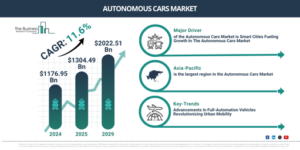
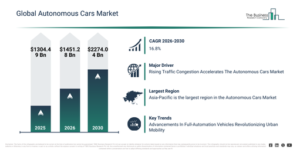
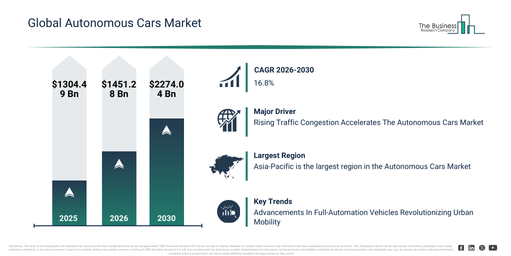
The autonomous cars market size has grown rapidly in recent years. It will grow from $1304.49 billion in 2025 to $1451.28 billion in 2026 at a compound annual growth rate (CAGR) of 11.3%. The growth in the historic period can be attributed to driver assistance regulations, automotive safety improvements, early semi-autonomous adoption, sensor cost reduction, connected vehicle infrastructure.
The autonomous cars market size is expected to see rapid growth in the next few years. It will grow to $2274.04 billion in 2030 at a compound annual growth rate (CAGR) of 11.9%. The growth in the forecast period can be attributed to full autonomy commercialization, ai algorithm advancements, electric autonomous vehicle rollout, smart city integration, shared mobility growth. Major trends in the forecast period include development of advanced driver assistance systems, integration of lidar and sensor fusion, growth of robo-taxi programs, expansion of autonomous software platforms, increased testing of level 4 vehicles.
Get A Free Sample Report With In-Depth Market Insights:
Autonomous Cars Market Growth Backed By Core Demand Fundamentals
The rising traffic congestion is expected to boost the growth of the autonomous cars market going forward. Traffic congestion refers to a situation in which more vehicles are queuing up on the road, slower speeds, and longer travel times. Autonomous cars can communicate with each other and with traffic infrastructure, enabling coordinated and efficient traffic flow. They can anticipate traffic patterns and make real-time adjustments to optimize the use of roadways. For instance, in January 2025, according to the Highways News, a UK-based daily news service, the UK experienced a significant increase in traffic congestion in 2024, with average congestion levels rising to 20.4%, a 9% year-on-year increase compared to 18.7% in 2023. Therefore, the rising traffic congestion is driving the growth of the autonomous cars market.
Autonomous Cars Market Segmentation And Category Overview
The autonomous cars market covered in this report is segmented –
1) By Product Type: Semi-Autonomous Vehicles, Fully-Autonomous Vehicles
2) By Deployment Model: Private Ownership, Shared Mobility Fleets, Subscription & Fleet-as-a-Service (FaaS)
3) By Application: Robo Taxi, Ride Hail And Ride Sharing
Subsegments:
1) By Semi-Autonomous Vehicles: Level 1 (Driver Assistance), Level 2 (Partial Automation), Level 3 (Conditional Automation)
2) By Fully-Autonomous Vehicles: Level 4 (High Automation), Level 5 (Full Automation)
Autonomous Cars Market Growth Trends Reshaping The Competitive Landscape
Major companies operating in the autonomous car market are focusing on developing full-automation vehicles capable of performing all driving functions without human intervention to enhance safety, efficiency, and urban mobility. These fully autonomous vehicles are being designed for applications such as Robo-taxis and next-generation public transportation, where advanced AI systems, high-definition mapping, and sensor technologies enable seamless navigation in complex environments. For instance, in May 2024, Renault Group, a France-based automobile manufacturer, prepared to introduce Level 4 autonomous vehicles for public transportation. These shuttles are designed to operate autonomously within designated areas and integrate smoothly with existing public transport networks. Leveraging cutting-edge hardware and software, the vehicles will independently navigate urban environments while prioritizing safety and reliability. This initiative is expected to enhance mobility in crowded cities and support future applications such as cargo transportation and emergency medical services.
Autonomous Cars Market Competitive Analysis Of Leading Industry Participants
Major companies operating in the autonomous cars market report include Toyota Motor Corporation, Volkswagen AG, The Mercedes-Benz Group AG, Ford Motor Company, General Motors Company, BMW AG, Honda Motor Co. Ltd., Nissan Motor Co. Ltd., Volvo Car Group, Tesla Inc., Hyundai Motor Company, Audi AG, PSA Group, Renault, Jaguar Land Rover, NIO, Kia, Haval, Chevrolet, Fiat
View The Full Autonomous Cars Market Report:
Autonomous Cars Market Geographic Landscape: Which Region Leads Industry Growth?
Asia-Pacific was the largest region in the autonomous cars market in 2025. Western Europe was the second largest region in the autonomous cars market share. The regions covered in the autonomous cars market report include Asia-Pacific, South East Asia, Western Europe, Eastern Europe, North America, South America, Middle East, Africa.
Reach Out To Our Team:
The Business Research Company: https://www.thebusinessresearchcompany.com/
Americas: +1 310-496-7795
Asia: +44 7882 955267 & +91 8897263534
Europe: +44 7882 955267
Email us at: marketing@tbrc.info
Follow us on:
LinkedIn: https://in.linkedin.com/company/the-business-research-company
YouTube: https://www.youtube.com/channel/UC24_fI0rV8cR5DxlCpgmyFQ
Global Market Model: https://www.thebusinessresearchcompany.com/global-market-model

Wasay has over a decade of experience in market research, data modelling, and analytics, with prior experience at GlobalData and Decision Tree Consulting Services. At The Business Research Company , he leads research operations across syndicated studies, customized consulting engagements, and the Global Market Model platform. His professional experience includes supporting organizations such as Boston Consulting Group, KPMG, and Ernst & Young. Wasay holds a degree in Electronics and Communications Engineering, postgraduate management qualifications from International Management Institute Belgium and Indian School of Business and Entrepreneurship, and completed the Integrated Program in Business Analytics from Indian Institute of Management Indore.