Through market attractiveness analysis, total addressable market evaluation, company benchmarking matrices, interactive Excel dashboards, expanded supply chain intelligence, emerging startup coverage, and detailed product insights, The Business Research Company’s 2026 market reports provide more actionable and strategically valuable research.
Autonomous Commercial Vehicle Market Expansion Outlook: What Revenue Opportunities Lie Ahead?
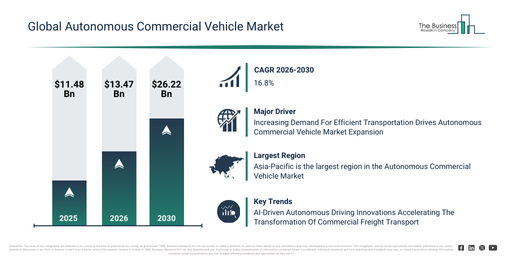
The market for autonomous commercial vehicles has experienced swift expansion in recent times. Projections indicate an increase from $11.48 billion in 2025 to $13.47 billion in 2026, representing a compound annual growth rate of 17.3%. This historical rise can be explained by factors such as the need for improved logistics efficiency, challenges related to driver shortages, initial trials of autonomous trucking, the digitization of fleets, and efforts to optimize fuel expenses.
The autonomous commercial vehicle market is anticipated to experience swift expansion over the upcoming years. By 2030, its value is projected to reach $26.22 billion, achieving a compound annual growth rate (CAGR) of 18.1%. This forecasted growth is driven by factors such as the scalability of autonomous logistics, the uptake of electric commercial vehicles, AI-powered fleet optimization, regulatory clearances, and the development of smart highway infrastructure. Key trends shaping this period include the widespread use of autonomous freight trucks, the integration of platooning technologies, the implementation of autonomous fleet management systems, the broadening of last-mile automation, and the rise of electric autonomous commercial vehicles.
Download A Free Sample Report For Comprehensive Market Insights:
https://www.thebusinessresearchcompany.com/sample.aspx?id=3193&type=smp
Autonomous Commercial Vehicle Market Expansion Supported By Key Demand Factors
The rising need for streamlined transport systems is anticipated to propel the expansion of the autonomous commercial vehicle sector in the coming period. Transport, commonly referred to as transportation, involves the deliberate movement of individuals, animals, and items between different places. Self-driving commercial vehicles can adjust their routes, speeds, and driving patterns to reduce fuel usage. This kind of efficiency not only saves money for fleet operators but also supports environmental mandates and sustainability objectives. Lower fuel expenses make automated vehicles an attractive choice for transportation firms. For example, in June 2025, data from the UK-based government agency, the Office for National Statistics, showed that total motor vehicle traffic in Great Britain increased by 1.6% in 2024 compared to 2023, reaching 336.2 billion vehicle miles. Consequently, the growing demand for efficient transportation is fueling the advancement of the autonomous commercial vehicle market.
Autonomous Commercial Vehicle Market Segment Analysis And Revenue Opportunities
The autonomous commercial vehicle market covered in this report is segmented –
1) By Vehicle: Truck, Trailer, Bus, Other Vehicle Types
2) By Automation Level: Driver Assistance, Partial Automation, Conditional Automation, High Automation, Full Automation
3) By Fuel Type: Conventional, Hybrid Vehicle, Electric Vehicle
Subsegments:
1) By Truck: Light Duty Trucks, Medium Duty Trucks, Heavy Duty Trucks
2) By Trailer: Flatbed Trailers, Refrigerated Trailers, Tanker Trailers, Container Trailers
3) By Bus: Autonomous Passenger Buses, Autonomous Shuttle Buses
4) By Other Vehicle Types: Autonomous Delivery Vans, Autonomous Service Vehicles, Autonomous Construction Vehicles
Autonomous Commercial Vehicle Market Innovation Trends Driving Future Development
Key players in the autonomous commercial vehicle market are prioritizing technological innovations, including AI-powered autonomous driving systems, to address the growing need for improved safety, greater efficiency, and lower labor expenses in logistics and transportation. These AI-driven systems employ sophisticated artificial intelligence algorithms alongside sensor fusion technologies like LiDAR, radar, and cameras, allowing vehicles to interpret their surroundings, make instant decisions, and operate without human drivers—setting them apart from conventional manually controlled vehicles. A notable example occurred in September 2025, when Kodiak Robotics, Inc., an American autonomous trucking firm, unveiled its Kodiak Driver-equipped autonomous truck, an advanced AI-powered driving system developed following 2022. This system incorporates modular, vehicle-agnostic hardware featuring proprietary SensorPods, an AI compute platform, a redundant Actuation Control Engine (ACE) safety computer, and sophisticated safety actuation components. The Kodiak Driver facilitates scalable implementation in commercial trucking by boosting operational efficiency, safety, and dependability in freight transport. The initial Roush-upfitted truck utilizing this technology was handed over to Atlas Energy Solutions, marking a significant milestone in the large-scale commercialization of autonomous trucking.
#Autonomous Commercial Vehicle Market Industry Leaders: Which Organizations Are Driving Competition?
Major companies operating in the autonomous commercial vehicle market report include Volkswagen AG, Daimler AG, Tesla Inc., Denso Corporation, Continental AG, Waymo LLC, Bayerische Motoren Werke Aktiengesellschaft, Isuzu Motors Limited, General Motors Company, AB Volvo, Beiqi Foton Motor Co. Ltd., Skywell New Energy Vehicles Group Co. Ltd., Dongfeng Motor Corporation, China National Heavy Duty Truck Group Co. Ltd. (SINOTRUK), FAW Jiefang Automobile Co. Ltd., Shaanxi Automobile Group Co. Ltd. (China Shaanqi), Beiben Trucks Group Co. Ltd. (Beiben Trucks), SAIC Iveco Hongyan Commercial Vehicle Co. Ltd. (SAIC Hongyan), Jiangling Motors Corporation Group (JMC), Zhengzhou Yutong Bus Co. Ltd. (Zhengzhou Yutong Bus), Xiamen King Long United Automotive Industry Co. Ltd. (King Long Bus), CRRC Electric Vehicle Co. Ltd. (CRRC Electric Vehicle), Xiamen Golden Dragon Bus Co. Ltd. (Xiamen Golden Dragon Bus), Anhui Ankai Automobile Co. Ltd. (Anhui Ankai Automobile), Plus.ai Inc. (Plus.ai), Embark Trucks Inc. (Embark Trucks), Daimler Trucks North America LLC (Daimler Trucks), NVIDIA Corporation, Zoox Inc., Luminar Technologies Inc.
Access The Complete Autonomous Commercial Vehicle Market Report:
https://www.thebusinessresearchcompany.com/report/autonomous-commercial-vehicle-global-market-report
Autonomous Commercial Vehicle Market Geographic Analysis: Where Is Demand Growing The Fastest?
Asia-Pacific was the largest region in the autonomous commercial vehicle market in 2025. North America was the second largest region in the autonomous commercial vehicle market. The regions covered in the autonomous commercial vehicle market report include Asia-Pacific, South East Asia, Western Europe, Eastern Europe, North America, South America, Middle East, Africa.
Access a Customized Autonomous Commercial Vehicle Market Report for Deeper Competitive Insights
https://www.thebusinessresearchcompany.com/sample.aspx?id=3193&type=smp
Get in touch with us:
The Business Research Company: https://www.thebusinessresearchcompany.com/
Americas: +1 310-496-7795
Asia: +44 7882 955267 & +91 8897263534
Europe: +44 7882 955267
Email us at: marketing@tbrc.info
Follow us on:
LinkedIn: https://in.linkedin.com/company/the-business-research-company
YouTube: https://www.youtube.com/channel/UC24_fI0rV8cR5DxlCpgmyFQ
Global Market Model: https://www.thebusinessresearchcompany.com/global-market-model

Wasay has over a decade of experience in market research, data modelling, and analytics, with prior experience at GlobalData and Decision Tree Consulting Services. At The Business Research Company , he leads research operations across syndicated studies, customized consulting engagements, and the Global Market Model platform. His professional experience includes supporting organizations such as Boston Consulting Group, KPMG, and Ernst & Young. Wasay holds a degree in Electronics and Communications Engineering, postgraduate management qualifications from International Management Institute Belgium and Indian School of Business and Entrepreneurship, and completed the Integrated Program in Business Analytics from Indian Institute of Management Indore.