Enhanced with market attractiveness analysis, total addressable market evaluation, company benchmarking matrices, interactive Excel dashboards, expanded supply chain intelligence, emerging startup coverage, and detailed product insights, The Business Research Company’s 2026 market reports deliver more actionable and strategically valuable research.
Autonomous Ships Market Expansion From $8.74 Billion In 2026 To $6.5 Billion In 2030
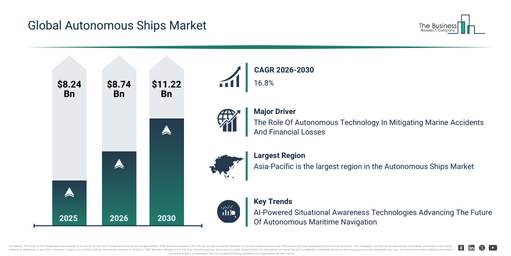
The autonomous ships market size has seen significant growth in recent years. It is anticipated to increase from $8.24 billion in 2025 to $8.74 billion in 2026, exhibiting a compound annual growth rate (CAGR) of 6.0%. The expansion observed in the past can be ascribed to initiatives like shipping automation trials, improvements in maritime safety, the need for enhanced fuel efficiency, the development of early autonomous navigation systems, and the adoption of digital maritime operations.
The autonomous ships market is projected to experience substantial growth over the coming years. This market is set to expand to $11.22 billion by 2030, achieving a compound annual growth rate (CAGR) of 6.5%. The expansion during the forecast period is driven by factors such as regulatory support for autonomous shipping, the advancement of smart port infrastructure, decarbonization goals, AI-based maritime analytics, and autonomous fleet optimization. Noteworthy trends anticipated in this period include the development of fully autonomous vessels, the adoption of remote fleet operations, the integration of AI collision avoidance technology, the rise of electric autonomous ships, and the broadening of smart ports.
Download A Free Sample Report For Comprehensive Market Insights:
Autonomous Ships Market Growth Drivers: What Factors Are Accelerating Expansion?
The rise in marine accidents stemming from human errors, resulting in substantial financial setbacks, is anticipated to serve as a significant impetus for the expansion of the autonomous ship market. Unmanned vessels or autonomous technologies are capable of preventing accidents caused by human errors, thereby holding greater potential for reducing incidents occurring onboard. For instance, in July 2023, a report from the Marine Accident Investigation Branch (MAIB), a UK-based government agency, revealed that nearly 700 marine pilots executed over 96,000 transfers using pilot ladders, which led to more than 400 incidents. Of these, 25% were linked to the use of shackles instead of rolling hitches for securing side ropes, 23% originated from the poor material condition of the ladders, and 13% happened because handhold stanchions were inadequate. Therefore, the deployment of autonomous ships to decrease the growing occurrence of accidents due to human error and associated financial losses is expected to stimulate demand for the autonomous ships market’s growth over the next few years.
Autonomous Ships Market Segment Outlook: Which Categories Are Expanding The Fastest?
The autonomous ships market covered in this report is segmented –
1) By Autonomy: Fully Autonomous, Remote Operations, Partial Autonomous
2) By Propulsion Type: Fully Electric, Hybrid
3) By End-User: Commercial, Defense
Subsegments:
1) By Fully Autonomous: Fully Automated Container Ships, Autonomous Bulk Carriers, Unmanned Surface Vessels (USVs)
2) By Remote Operations: Remotely Operated Cargo Ships, Remote-Controlled Ferries, Teleoperated Fishing Vessels
3) By Partial Autonomous: Assisted Navigation Ships, Autonomous Barges With Human Oversight, Semi-Autonomous Yachts
Autonomous Ships Market Trends: What Is Shaping Future Industry Growth?
Leading companies in the autonomous ships market are prioritizing technological advancements, including real-time AI-powered situational awareness and navigation systems, to fulfill the increasing demand for safer, more efficient, and regulation-compliant autonomous vessel operations. For instance, in September 2024, Seadronix, a South Korea-based developer of maritime AI and navigation solutions, unveiled NAVISS 2.0, an advanced “True-AI” ship monitoring and navigation system at the SMM 2024 maritime trade fair. This system integrates multiple onboard sensors (e.g., cameras, radar/LiDAR) to generate a seamless, 360-degree “around-view” of the ship’s surroundings, providing a real-time bird’s-eye aerial perspective. NAVISS 2.0 employs Seadronix’s proprietary VADAR (VaDA AI Detection and Ranging) technology, which identifies and classifies maritime objects (other vessels, obstacles, hazards), issues voice alerts and on-screen pop-ups when collision risks arise, and offers customizable viewing options to suit various vessels or navigation contexts. Compared to traditional navigation methods relying solely on human watch-standing, radar, or AIS (Automatic Identification System), this AI-driven solution reduces blind spots, minimizes human error, and improves safety, especially in busy port approaches, congested waterways, or poor visibility conditions. The introduction was characterized as a strategic response to the escalating demand for AI-driven situational awareness to support autonomous navigation and conform to forthcoming regulations like the IMO maritime autonomous surface ships code (MASS Code).
Autonomous Ships Market Key Companies And Competitive Benchmarking
Major companies operating in the autonomous ships market report include Mitsui E&S Holdings Co. Ltd., Siemens AG, General Electric Company, Hyundai Heavy Industries Co. Ltd., Northrop Grumman Corporation, Honeywell International Inc., ABB Ltd., BAE Systems plc, Nippon Yusen Kabushiki Kaisha, L3Harris Technologies Inc., Rolls-Royce Holding plc, L3 ASV Global Ltd., Wärtsilä Corporation, Wärtsilä Corporation Inc., Valmet Corporation, Daewoo Shipbuilding & Marine Engineering Co. Ltd., Kongsberg Gruppen AS, DNV GL AS, Fugro N.V., Vigor Industrial LLC, Rh Marine Ltd., Ocean GNS, ASV Global Limited, Praxis Automation Technology B.V., Automated Ships Ltd., SELSAN A.S., Autonomous Knight BV, Mapsea Corp. Ltd.
Access The Complete Autonomous Ships Market Report:
Autonomous Ships Market Geographic Distribution And Regional Opportunities
Asia-Pacific was the largest region in the autonomous ships market in 2025. Western Europe was the second largest region in the autonomous ships market share. The regions covered in the autonomous ships market report include Asia-Pacific, South East Asia, Western Europe, Eastern Europe, North America, South America, Middle East, Africa.
Get in touch with us:
The Business Research Company: https://www.thebusinessresearchcompany.com/
Americas: +1 310-496-7795
Asia: +44 7882 955267 & +91 8897263534
Europe: +44 7882 955267
Email us at: marketing@tbrc.info
Follow us on:
LinkedIn: https://in.linkedin.com/company/the-business-research-company
YouTube: https://www.youtube.com/channel/UC24_fI0rV8cR5DxlCpgmyFQ
Global Market Model: https://www.thebusinessresearchcompany.com/global-market-model

Wasay has over a decade of experience in market research, data modelling, and analytics, with prior experience at GlobalData and Decision Tree Consulting Services. At The Business Research Company , he leads research operations across syndicated studies, customized consulting engagements, and the Global Market Model platform. His professional experience includes supporting organizations such as Boston Consulting Group, KPMG, and Ernst & Young. Wasay holds a degree in Electronics and Communications Engineering, postgraduate management qualifications from International Management Institute Belgium and Indian School of Business and Entrepreneurship, and completed the Integrated Program in Business Analytics from Indian Institute of Management Indore.