Enhanced with market attractiveness analysis, total addressable market evaluation, company benchmarking matrices, interactive Excel dashboards, expanded supply chain intelligence, emerging startup coverage, and detailed product insights, The Business Research Company’s 2026 market reports deliver more actionable and strategically valuable research.
Autonomous Train Components Market Revenue Outlook: What CAGR Is Expected Through 2030?
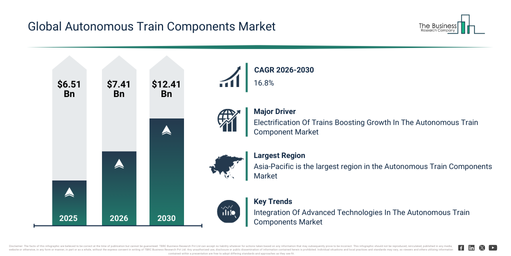
The market for autonomous train components has experienced swift expansion in recent times. Its value is projected to rise from $6.51 billion in 2025 to $7.41 billion in 2026, achieving a compound annual growth rate (CAGR) of 14.0%. This historical growth has been driven by factors such as the expansion of urban rail networks, the automation of signaling systems, a strong emphasis on minimizing human mistakes, the early implementation of autonomous trains, and the enforcement of rail safety regulations.
The autonomous train components market is anticipated to experience substantial expansion over the coming years, reaching $12.41 billion by 2030 with a compound annual growth rate (CAGR) of 13.8%. This projected growth during the forecast period is being driven by investments in smart rail infrastructure, the implementation of AI-based train control systems, the development of autonomous metro projects, the growing use of predictive maintenance, and the advancement of digital rail signaling. Key trends shaping the market in this period include the widespread adoption of GoA4 (Grade of Automation 4) technology, the integration of LiDAR and radar systems into train platforms, a rise in driverless metro initiatives, the expansion of sensor-rich train platforms, and a heightened demand for fail-safe control systems.
Download A Free Sample Report For Comprehensive Market Insights:
https://www.thebusinessresearchcompany.com/sample.aspx?id=14266&type=smp
Autonomous Train Components Market Opportunity Drivers: What Is Creating New Revenue Potential?
The increasing shift toward railway electrification is anticipated to boost the autonomous train components market in the coming period. Electrifying railways means moving from diesel-powered systems to electric operation, typically via overhead cables or third rails, which brings advantages such as lower emissions and improved efficiency. This trend is expanding because of its benefits, including greater energy efficiency, reduced pollution, enhanced performance, support for global sustainability targets, and transportation modernization. Autonomous train component systems fully capitalize on electrification by optimizing energy use, increasing safety, and boosting operational effectiveness. They employ various technologies to manage acceleration and braking, as well as to keep proper distances between trains, thus minimizing collisions, speeding incidents, and other safety concerns on electrified lines. For example, in November 2024, the Office of Rail and Road (ORR), a UK-based independent safety and economic regulator, reported that the total open route length in Great Britain was 15,849 km, with 6,130 km electrified—representing 39% electrification. Consequently, the growing electrification of railways is fueling the expansion of the autonomous train components market.
Autonomous Train Components Market Segment Landscape: Which Areas Lead Market Development?
The autonomous train components market covered in this report is segmented –
1) By Component: Radio Detection And Ranging (RADAR) Modules, Optical Sensor And Cameras, Odometers, Antennas, Light Detection And Ranging (LiDAR) Module, Infrared Cameras, Other Components
2) By Train Type: Long Distance Train, Suburban, Tram, Monorail, Subway
3) By Grade: Grades Of Automation (GoA)A1 + Grades Of Automation (GoA)A2, Grades Of Automation (GoA)A3, Grades Of Automation (GoA)A4
Subsegments:
1) By Radio Detection And Ranging (RADAR) Modules: Short-range RADAR, Long-range RADAR
2) By Optical Sensors And Cameras: Standard Cameras, 3D Imaging Cameras
3) By Odometers: Mechanical Odometers, Electronic Odometers
4) By Antennas: GPS Antennas, Communication Antennas
5) By Light Detection And Ranging (LiDAR) Module: 2D LiDAR, 3D LiDAR
6) By Infrared Cameras: Thermal Imaging Cameras, Near-Infrared Cameras
7) By Other Components: Control Units, Communication Modules
Autonomous Train Components Market Strategic Trends: What Is Defining The Next Phase Of Growth?
Leading players in the autonomous train component sector are increasingly prioritizing the adoption of cutting-edge technologies, like train control and supervision systems, as a strategy to secure a competitive advantage. These systems are specifically engineered for managing and overseeing train operations within rail-based transit networks. A notable example occurred in February 2023, when Bharat Electronics Limited, a state-owned aerospace and defense electronics firm headquartered in India, partnered with the Delhi Metro Rail Corporation (DMRC) to unveil the Indigenous-Automatic Train Supervision (i-ATS) system. This locally developed control and supervision solution is aimed at boosting both the operational efficiency and safety of train services. By implementing the i-ATS system, operational benchmarks and safety protocols across the railway infrastructure are being significantly raised. This technology is versatile enough to manage a wide variety of rail-based operations, with particular emphasis on Indian railways. Furthermore, i-ATS has been constructed to seamlessly interface with signaling systems from multiple vendors through suitable modifications.
Autonomous Train Components Market Competitive Landscape: Who Are The Leading Companies?
Major companies operating in the autonomous train components market report include Siemens AG, ZF Friedrichshafen AG, Mitsubishi Heavy Industries Ltd, Thales Group, Alstom SA, Kawasaki Heavy Industries, CRRC Corporation Limited, Wabtec Corporation, Bombardier Transportation, Construcciones y Auxiliar de Ferrocarriles, Ansaldo STS, CASCO Signal Ltd., Otiv BV, 4AI Systems Pty Ltd, Ingeteam Corporation SA, Electric & Hybrid Rail Technology, Infotrans Engineers Private Limited, Bahnen der Stadt Monheim GmbH, Navya SA, EasyMile SAS, Local Motors Inc., Yutong Bus Co. Ltd.
Access The Complete Autonomous Train Components Market Report:
https://www.thebusinessresearchcompany.com/report/autonomous-train-components-global-market-report
Autonomous Train Components Market Global Footprint: Which Region Holds Market Leadership?
Asia-Pacific was the largest region in the autonomous train components market in 2025. It is expected to be the fastest-growing region in the forecast period. The regions covered in the autonomous train components market report include Asia-Pacific, South East Asia, Western Europe, Eastern Europe, North America, South America, Middle East, Africa.
Access a Customized Autonomous Train Components Market Report for Deeper Competitive Insights
https://www.thebusinessresearchcompany.com/sample.aspx?id=14266&type=smp
Get in touch with us:
The Business Research Company: https://www.thebusinessresearchcompany.com/
Americas: +1 310-496-7795
Asia: +44 7882 955267 & +91 8897263534
Europe: +44 7882 955267
Email us at: marketing@tbrc.info
Follow us on:
LinkedIn: https://in.linkedin.com/company/the-business-research-company
YouTube: https://www.youtube.com/channel/UC24_fI0rV8cR5DxlCpgmyFQ
Global Market Model: https://www.thebusinessresearchcompany.com/global-market-model

Wasay has over a decade of experience in market research, data modelling, and analytics, with prior experience at GlobalData and Decision Tree Consulting Services. At The Business Research Company , he leads research operations across syndicated studies, customized consulting engagements, and the Global Market Model platform. His professional experience includes supporting organizations such as Boston Consulting Group, KPMG, and Ernst & Young. Wasay holds a degree in Electronics and Communications Engineering, postgraduate management qualifications from International Management Institute Belgium and Indian School of Business and Entrepreneurship, and completed the Integrated Program in Business Analytics from Indian Institute of Management Indore.