Through market attractiveness analysis, total addressable market evaluation, company benchmarking matrices, interactive Excel dashboards, expanded supply chain intelligence, emerging startup coverage, and detailed product insights, The Business Research Company’s 2026 market reports provide more actionable and strategically valuable research.
Autonomous Train Technology Market Size, Value And Growth Trends Through 2030
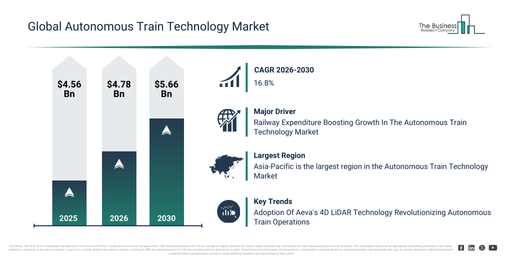
The market for autonomous train technology has demonstrated consistent expansion over recent years. It is projected to increase from $4.56 billion in 2025 to $4.78 billion in 2026, exhibiting a compound annual growth rate (CAGR) of 4.8%. The historical growth of this market can be attributed to factors like urban rail network expansion, the rising demand for operational safety, the implementation of automatic train control systems, the reduction of human error, and the modernization of public transport.
The market for autonomous train technology is anticipated to experience sustained growth in the coming years, with its size projected to reach $5.66 billion in 2030, driven by a compound annual growth rate (CAGR) of 4.3%. Key factors contributing to this growth during the projected timeframe include government investments in smart rail, AI-based traffic management, the demand for energy-efficient rail systems, the expansion of autonomous metros, and digital rail infrastructure. Furthermore, major trends in the forecast period are expected to involve the expansion of driverless metro projects, the integration of cbtc and ertms systems, the adoption of AI-based train control, the growth of sensor fusion technologies, and an emphasis on operational safety and reliability.
Download A Free Sample Report For Comprehensive Market Insights:
#Autonomous Train Technology Market Growth Factors: Which Forces Are Supporting Market Expansion?
Growing investment in railways is projected to stimulate the expansion of the autonomous train technology market moving forward. Railway expenditure signifies the financial resources allocated by governmental bodies or private organizations towards different facets of railway infrastructure, operations, and future development. Such spending on railways stems from the rising need for public transport, the drive for enhanced operational efficiency and market competitiveness, and the necessity to meet the evolving requirements of contemporary transportation. This allocation of funds leverages autonomous train technology to upgrade infrastructure, incorporate autonomous capabilities, and encourage progress, thereby leading to better efficiency, increased safety, and greater sustainability within rail transport networks. As an illustration, in November 2023, data from the Office of Rail and Road (ORR), a UK-based non-ministerial government department, revealed that the UK rail industry’s operational expenditure between April 2022 and March 2023 reached approximately $31.5 billion (£25.4 billion), marking a 1.0% rise compared to the preceding year. This total expenditure was distributed with $15.4 billion (£12.4 billion) going to Network Rail, $14.5 billion (£11.7 billion) to franchised train operators, and $1.6 billion (£1.3 billion) originating from other parts of the rail sector. Consequently, heightened spending on railways is propelling the growth of the autonomous train technology market.
Autonomous Train Technology Market Segment Analysis And Revenue Opportunities
The autonomous train technology market covered in this report is segmented –
1) By Component: Camera, Accelerometer, Odometer, Tachometer, Radio Set, Other Components
2) By Grade Of Automation: Grade Of Automation 1 (GOA 1), Grade Of Automation 2 (GOA 2), Grade Of Automation 3 (GOA 3), Grade Of Automation 4 (GOA 4)
3) By Technology: Communication-Based Train Control (CBTC), European Railway Traffic Management System (ERTMS), Automatic Train Control (ATC), Positive Train Control (PTC)
4) By Application: Passenger Train, Freight Train
Subsegments:
1) By Camera: 2D Cameras, 3D Cameras, Thermal Cameras
2) By Accelerometer: MEMS (Micro-Electro-Mechanical Systems) Accelerometers, Piezoelectric Accelerometers, Capacitive Accelerometers
3) By Odometer: Optical Odometers, Electromagnetic Odometers, Rotary Odometers
4) By Tachometer: Digital Tachometers, Optical Tachometers
5) By Radio Set: VHF (Very High Frequency) Radio, UHF (Ultra High Frequency) Radio, LTE Or 5G Radio, Satellite Radio
6) By Other Components: GPS Systems, LiDAR Sensors, Control Systems (including software), Power Supply And Battery Management Systems, Actuators And Motors, Communication Systems (Wi-Fi, Ethernet), Proximity Sensors And Infrared Sensors
Autonomous Train Technology Market Industry Trends: What Changes Are Reshaping Demand?
Leading companies active in the autonomous train technology market are increasingly focusing on adopting inventive technological solutions, such as Aeva’s 4D LiDAR technology, to maintain a competitive edge and ensure compliance with regulations in automatic train operation systems. This 4D LiDAR technology is revolutionizing autonomous systems by offering advanced perception capabilities that improve safety, efficiency, and reliability across various industries. For instance, in August 2023, Railergy, a leading Germany-based provider of railway automation solutions, incorporated Aeva’s 4D LiDAR technology to power autonomous train technology and enhance safety within its automatic train operation solution. This innovative technology supports the automation of trains for diverse applications, including shunting, main line, and last-mile operations in settings such as seaports, freight, and mining. Additionally, this technology offers instantaneous velocity data and high-resolution sensing abilities, which enables real-time obstacle detection and ensures the safe passage of autonomous locomotives.
Autonomous Train Technology Market Leading Players Shaping Industry Direction
Major companies operating in the autonomous train technology market report include China Railway Corporation, Hitachi Ltd, Siemens AG, Deutsche Bahn AG, General Electric Company, Mitsubishi Electric Corporation, ABB Group, Toshiba Corporation, Thales Group, Alstom SA, CSX Transportation, Kawasaki Heavy Industries, Japan Railways Group, WSP Global Inc, Huawei Technologies Co. Ltd, Wabtec Corporation, Tech Mahindra Ltd, MTR Corporation, Stadler Rail, CAF Signalling S.A.U, Hyundai Rotem, Itron Inc, PT Kereta Api Indonesia (Persero), Kyosan Electric Manufacturing Ltd, Mermec Corporation
Access The Complete Autonomous Train Technology Market Report:
#Autonomous Train Technology Market Largest Region: Which Geography Holds The Highest Market Share?
Asia-Pacific was the largest region in the autonomous train technology market in 2025. It is expected to be the fastest-growing region in the forecast period. The regions covered in the autonomous train technology market report include Asia-Pacific, South East Asia, Western Europe, Eastern Europe, North America, South America, Middle East, Africa.
Get in touch with us:
The Business Research Company: https://www.thebusinessresearchcompany.com/
Americas: +1 310-496-7795
Asia: +44 7882 955267 & +91 8897263534
Europe: +44 7882 955267
Email us at: marketing@tbrc.info
Follow us on:
LinkedIn: https://in.linkedin.com/company/the-business-research-company
YouTube: https://www.youtube.com/channel/UC24_fI0rV8cR5DxlCpgmyFQ
Global Market Model: https://www.thebusinessresearchcompany.com/global-market-model

Wasay has over a decade of experience in market research, data modelling, and analytics, with prior experience at GlobalData and Decision Tree Consulting Services. At The Business Research Company , he leads research operations across syndicated studies, customized consulting engagements, and the Global Market Model platform. His professional experience includes supporting organizations such as Boston Consulting Group, KPMG, and Ernst & Young. Wasay holds a degree in Electronics and Communications Engineering, postgraduate management qualifications from International Management Institute Belgium and Indian School of Business and Entrepreneurship, and completed the Integrated Program in Business Analytics from Indian Institute of Management Indore.