Backed by market attractiveness analysis, total addressable market sizing, company benchmarking matrices, interactive Excel dashboards, wider supply chain intelligence, emerging startup coverage, and detailed product-level insights, The Business Research Company’s 2026 market reports are designed to offer research that is more actionable and strategically valuable than ever.
Autonomous Vehicle Market Poised To Hit $277.49 Billion By 2030 With A 28.1% CAGR
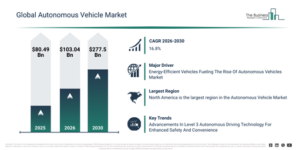
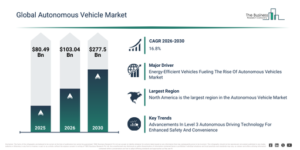
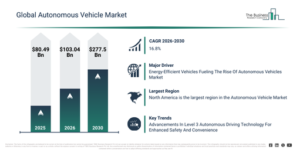
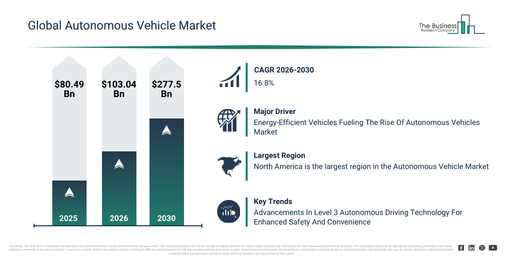
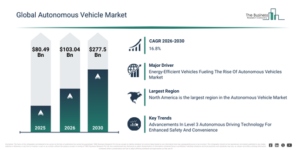
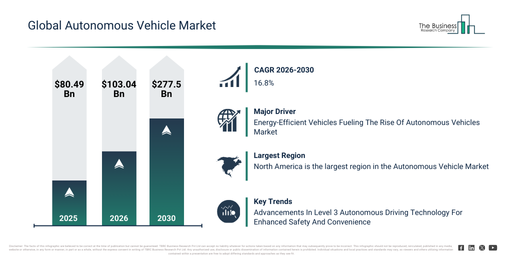
The autonomous vehicle market size has grown exponentially in recent years. It will grow from $80.49 billion in 2025 to $103.04 billion in 2026 at a compound annual growth rate (CAGR) of 28.0%. The growth in the historic period can be attributed to adas adoption, sensor cost reduction, automotive digitization, early autonomous pilot programs, demand for driver assistance.
The autonomous vehicle market size is expected to see exponential growth in the next few years. It will grow to $277.5 billion in 2030 at a compound annual growth rate (CAGR) of 28.1%. The growth in the forecast period can be attributed to ai algorithm advancements, electric autonomous vehicles growth, smart mobility policies, demand for logistics automation, connected vehicle infrastructure. Major trends in the forecast period include advancement of level 4 and level 5 vehicles, integration of advanced sensor suites, growth of autonomous logistics fleets, expansion of software-defined vehicles, focus on safety validation.
Get A Free Sample Report With In-Depth Market Insights:
Autonomous Vehicle Market Growth Drivers: What’s Behind The Acceleration?
The growing demand for energy-efficient vehicles is expected to propel the growth of the autonomous vehicle market going forward. Energy-efficient vehicles are designed to use less energy to perform the same tasks as their non-efficient counterparts. As governments worldwide intensify efforts to combat climate change and reduce greenhouse gas emissions, autonomous vehicles are predicted to reduce energy consumption. The development of connected and autonomous vehicles is being carried out with a focus on minimizing fuel and energy consumption, and energy-efficient vehicles play a crucial role in shaping the success of the autonomous vehicle market. For instance, in January 2024, according to a report published by Kelley Blue Book, a US-based Cox Automotive company, in 2023, a record 1.2 million car buyers in the United States chose electric vehicles, which accounted for 7.6% of the entire U.S. vehicle market, up from 5.9% in 2022. Therefore, the rise in demand for energy-efficient vehicles is driving the growth of the autonomous vehicle market.
Autonomous Vehicle Market Breakdown By Product Type And Application
The autonomous vehicle market covered in this report is segmented –
1) By Level of Automation: Driver Assistance, Partial Automation, Conditional Automation, High Automation, Full Automation
2) By Component: Hardware, Software, Service
3) By Application: Transportation and Logistics, Civil, Defense, Other Applications
Subsegments:
1) By Driver Assistance: Adaptive Cruise Control, Lane Keeping Assistance, Parking Assistance
2) By Partial Automation: Automated Steering, Automated Acceleration And Braking
3) By Conditional Automation: Highway Autopilot, Traffic Jam Pilot
4) By High Automation: Self-Parking Systems, Fully Autonomous Urban Driving
5) By Full Automation: Fully Autonomous Vehicles
Autonomous Vehicle Market Trends: What’s Defining The Industry’s Next Phase?
Major companies operating in the autonomous vehicle market are developing advanced solutions, such as drive pilot systems, to enhance safety, and convenience, and enable hands-free driving in controlled conditions. The Drive Pilot system is a Level 3 autonomous driving technology enabling hands-free driving in specific conditions while the vehicle monitors the surroundings. For instance, in April 2024, Mercedes-Benz Group AG, a Germany-based manufacturer of passenger cars and premium vans, launched The first level 3 self-driving car in the United States. The drive pilot system enables vehicles to operate autonomously but requires that the driver be ready to take control if needed. This is classified as Level 3 autonomy according to SAE International standards, which distinguishes it from Level 2 systems such as Tesla’s Autopilot, where constant driver engagement is mandatory.
Autonomous Vehicle Market Company Landscape And Competitive Strategy
Major companies operating in the autonomous vehicle market report include Volkswagen AG, Google LLC, Toyota Motor Corporation, Ford Motor Company, General Motors Company, Bayerische Motoren Werke AG, Honda Motor Co. Ltd., The Hyundai Motor Group, Tesla Inc., Nissan Motor Co. Ltd., Audi AG, Intel Corporation, AB Volvo, Groupe Renault, Denso Corporation, Mercedes-Benz Group AG, Uber Technologies Inc., NVIDIA Corporation, Baidu Inc., Waymo LLC, WeRide Corporation, Aurora Innovation Inc., Cruise LLC, AutoX Inc., Oxbotica Ltd.
View The Full Autonomous Vehicle Market Report:
Autonomous Vehicle Market Global Footprint: Which Region Leads The Market?
North America was the largest region in the autonomous vehicle market in 2025. Asia-Pacific is expected to be the fastest-growing region in the forecast period. The regions covered in the autonomous vehicle market report include Asia-Pacific, South East Asia, Western Europe, Eastern Europe, North America, South America, Middle East, Africa.
Reach Out To Our Team:
The Business Research Company: https://www.thebusinessresearchcompany.com/
Americas: +1 310-496-7795
Asia: +44 7882 955267 & +91 8897263534
Europe: +44 7882 955267
Email us at: marketing@tbrc.info
Follow us on:
LinkedIn: https://in.linkedin.com/company/the-business-research-company
YouTube: https://www.youtube.com/channel/UC24_fI0rV8cR5DxlCpgmyFQ
Global Market Model: https://www.thebusinessresearchcompany.com/global-market-model

Wasay has over a decade of experience in market research, data modelling, and analytics, with prior experience at GlobalData and Decision Tree Consulting Services. At The Business Research Company , he leads research operations across syndicated studies, customized consulting engagements, and the Global Market Model platform. His professional experience includes supporting organizations such as Boston Consulting Group, KPMG, and Ernst & Young. Wasay holds a degree in Electronics and Communications Engineering, postgraduate management qualifications from International Management Institute Belgium and Indian School of Business and Entrepreneurship, and completed the Integrated Program in Business Analytics from Indian Institute of Management Indore.