Delivering more actionable and strategically valuable research, The Business Research Company’s 2026 market reports feature market attractiveness analysis, total addressable market evaluation, company benchmarking matrices, interactive Excel dashboards, expanded supply chain intelligence, emerging startup coverage, and detailed product insights.
Autonomous Vehicles Market Revenue Growth Supported By A CAGR Of 216.15% Through 2030
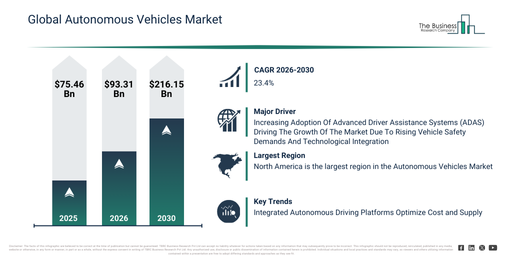
The autonomous vehicles market has experienced significant expansion in its size over recent years. It is anticipated to increase from $75.46 billion in 2025 to $93.31 billion in 2026, achieving a compound annual growth rate (CAGR) of 23.7%. The historical growth in this sector can be attributed to rising investment in artificial intelligence based mobility, the growing adoption of advanced automotive sensors, the progressive development of autonomous driving software, the broader expansion of transportation and logistics automation, and an increasing focus on road safety improvement.
The autonomous vehicles market is projected to experience substantial growth in the coming years, reaching $216.15 billion by 2030, driven by a compound annual growth rate (CAGR) of 23.4%. This expansion during the forecast period is attributed to factors such as increasing demand for autonomous ride-hailing services, the growing deployment of electric propulsion autonomous vehicles, a rising need for military and defense unmanned mobility, the expansion of autonomous construction and mining operations, and the increasing adoption of autonomous agriculture machinery. Major trends anticipated during this period include advancements in real-time computing architectures, innovations in perception and mapping technologies, the development of artificial intelligence decision-making models, continued research and development in sensor fusion systems, and progress in autonomous fleet management platforms.
Download A Free Sample Report For Comprehensive Market Insights:
#Autonomous Vehicles Market Demand Drivers Creating New Revenue Opportunities
The growing integration of advanced driver assistance systems (ADAS) is anticipated to drive forward the expansion of the autonomous vehicles market. These systems encompass a collection of electronic technologies designed to aid drivers with navigation and collision prevention, incorporating functionalities like adaptive cruise control, lane departure warning, and automatic emergency braking, thereby laying the technological groundwork for elevated levels of vehicle autonomy. The uptake of advanced driver assistance systems (ADAS) is increasing due to a greater emphasis from governments and consumers on enhancing road safety, mitigating traffic congestion, and improving driving comfort, a trend bolstered by advancements in sensor and AI technologies and supportive regulatory frameworks. Autonomous vehicles bolster advanced driver assistance systems through the utilization of sensors, cameras, and artificial intelligence, which collectively improve situational awareness and decision-making capabilities. They contribute to better road safety and driving efficiency by facilitating features such as adaptive cruise control, lane keeping assistance, and collision avoidance. For example, data from September 2024, provided by the Massachusetts Institute of Technology Research and Engineering (MITRE), a US-based research organization, indicates that by 2023, 10 of 14 advanced driver-assistance system (ADAS) features had surpassed 50% market penetration. Notably, five features, including forward collision warning, automatic emergency braking, pedestrian detection, and lane departure warning, achieved approximately 91–94% penetration in new vehicles. Consequently, the expanding incorporation of advanced driver assistance systems (ADAS) is stimulating the growth of the autonomous vehicles market.
Autonomous Vehicles Market Segment Analysis And Revenue Opportunities
The autonomous vehicles market covered in this report is segmented –
1) By Component: Hardware, Software, Services
2) By Vehicle Type: Passenger Vehicle, Commercial Vehicle
3) By Propulsion Type: Electric Propulsion, Hybrid Propulsion, Internal Combustion Engine Propulsion
4) By Level Of Autonomy: Level 1, Level 2, Level 3, Level 4 And 5
5) By Application: Transportation And Logistics, Military And Defense, Construction And Mining, Agriculture, Ride-Hailing And Robo-Taxis
Subsegments:
1) By Hardware: Perception Sensor Module, Light Detection And Ranging Unit, Radar Detection Unit, Camera Vision System, Onboard Computing System, Vehicle Control Unit, High Precision Global Navigation System, Actuator And Drive Control Mechanism
2) By Software: Autonomous Driving Software Platform, Perception And Mapping Software, Localization And Navigation Software, Path Planning Software, Decision Making Software, Simulation And Testing Software, Over The Air Update Management Software
3) By Services: System Integration Service, Testing And Validation Service
Autonomous Vehicles Market Trends Driving Strategic Industry Expansion
Major companies operating in the autonomous vehicles market are primarily directing their efforts towards technological advancements, including the creation of integrated autonomous driving platforms. This endeavor aims to lower system-level expenditures, enhance computational performance, and stabilize production on the supply side for extensive deployment. Integrated autonomous driving platforms are designed to combine specialized AI compute hardware, optimized sensor configurations, and scalable software stacks, thereby reducing reliance on expensive external components and providing manufacturers with increased authority over pricing and supply consistency. For example, in November 2024, Guangzhou Xiaopeng Motors Technology Co. Ltd., an automotive technology company based in China, introduced its proprietary Turing AI chip for autonomous driving. This chip features a 40-core processor, dual neural processing units (NPUs) for sophisticated perception capabilities, and 64 GB of high-speed LPDDR5x RAM to manage demanding computational workloads in its G7 models. The company also seeks to improve hardware cost-effectiveness, strengthen autonomous functionality, and boost supply predictability for mass production through this innovation.
Autonomous Vehicles Market Leading Players Shaping Industry Direction
Major companies operating in the autonomous vehicles market are Tesla Inc., NVIDIA Corporation, Mobileye Global Inc., Waymo LLC, Nuro Inc., Baidu Inc., Ouster Inc., Gatik AI Inc., EasyMile SAS, Luminar Technologies Inc., Pony AI Inc., Wayve Technologies Ltd., May Mobility Inc., Avride Inc., Arbe Robotics Ltd., Inceptio Technology (Shanghai) Co. Ltd., Applied Intuition Inc., Aeva Technologies Inc., NAVYA S.A., PlusAI Inc., Autonomous Driving Research Inc., Imagry Ltd.
Access The Complete Autonomous Vehicles Market Report:
Autonomous Vehicles Market Geographic Landscape: Which Region Dominates Industry Growth?
North America was the largest region in the autonomous vehicles market in 2025. Asia-Pacific is expected to be the fastest-growing region in the forecast period. The regions covered in the autonomous vehicles market report are Asia-Pacific, South East Asia, Western Europe, Eastern Europe, North America, South America, Middle East, Africa.
Get in touch with us:
The Business Research Company: https://www.thebusinessresearchcompany.com/
Americas: +1 310-496-7795
Asia: +44 7882 955267 & +91 8897263534
Europe: +44 7882 955267
Email us at: marketing@tbrc.info
Follow us on:
LinkedIn: https://in.linkedin.com/company/the-business-research-company
YouTube: https://www.youtube.com/channel/UC24_fI0rV8cR5DxlCpgmyFQ
Global Market Model: https://www.thebusinessresearchcompany.com/global-market-model

Wasay has over a decade of experience in market research, data modelling, and analytics, with prior experience at GlobalData and Decision Tree Consulting Services. At The Business Research Company , he leads research operations across syndicated studies, customized consulting engagements, and the Global Market Model platform. His professional experience includes supporting organizations such as Boston Consulting Group, KPMG, and Ernst & Young. Wasay holds a degree in Electronics and Communications Engineering, postgraduate management qualifications from International Management Institute Belgium and Indian School of Business and Entrepreneurship, and completed the Integrated Program in Business Analytics from Indian Institute of Management Indore.