Featuring market attractiveness scoring, total addressable market sizing, company benchmarking matrices, interactive Excel dashboards, deeper supply chain intelligence, emerging startup tracking, and granular product-level insights, The Business Research Company’s 2026 market reports are built to deliver research that is both more actionable and more strategically valuable.
Brake-By-Wire System Market Size, Value And Growth Trajectory Through 2030
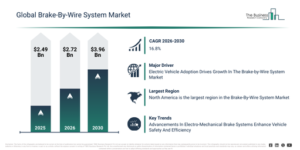
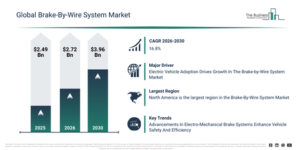
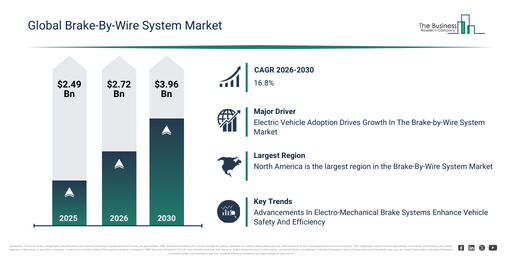
The brake-by-wire system market size has grown strongly in recent years. It will grow from $2.49 billion in 2025 to $2.72 billion in 2026 at a compound annual growth rate (CAGR) of 9.3%. The growth in the historic period can be attributed to advancement of electronic control units, early adoption in premium vehicles, braking system electrification, drive-by-wire development, vehicle safety innovation.
The brake-by-wire system market size is expected to see strong growth in the next few years. It will grow to $3.96 billion in 2030 at a compound annual growth rate (CAGR) of 9.8%. The growth in the forecast period can be attributed to autonomous vehicle deployment, electric vehicle platform growth, software-defined vehicles, demand for faster braking response, regulatory push for advanced safety. Major trends in the forecast period include adoption of electronic braking architectures, growth of electro-mechanical brakes, integration with autonomous driving systems, demand for redundant safety systems, expansion in ev platforms.
Get A Free Sample Report With In-Depth Market Insights:
Brake-By-Wire System Market Growth Factors Behind Sustained Expansion
The growing adoption of electric vehicles is expected to propel the growth of the brake-by-wire system market going forward. Electric vehicles (EVs) are automobiles operated by electric motors that run on electricity stored in batteries or other energy storage technologies. With growing environmental concerns, growing EV infrastructure development, and government incentives, there is a push towards EV adoption. Brake-by-wire systems use electronic controls for precise and responsive braking, enhancing vehicle handling and stability by removing hydraulic components. They reduce weight and improve overall efficiency and range. For instance, in 2024, according to the International Energy Agency, a France-based intergovernmental organization, electric car sales grew by an additional 3.5 million units in 2024 compared with the previous year. Therefore, the growing adoption of electric vehicles drives the brake-by-wire system market.
Brake-By-Wire System Market Segment Outlook: Which Categories Are Growing Fastest?
The brake-by-wire system market covered in this report is segmented –
1) By Type: Hydraulic Or Wet Type, Electronic Or Dry Type
2) By Sales Channel: Original Equipment Manufacturers (OEMs), Aftermarket
3) By Application: Passenger Vehicles, Commercial Vehicles
Subsegments:
1) By Hydraulic Or Wet Type: Electro-Hydraulic Brake (Ehb) Systems, Hydraulic Actuators And Modules
2) By Electronic Or Dry Type: Electro-Mechanical Brake (Emb) Systems, Electronic Actuators, Brake-By-Wire Control Modules
Brake-By-Wire System Market Industry Trends Fueling Future Revenue Growth
Major companies in the brake-by-wire system market are developing advanced braking technology such as electro-mechanical brake systems, to enhance vehicle safety and improve braking efficiency. An electro-mechanical brake system replaces traditional hydraulic components with electric actuators and mechanical linkages, using electronic controls for precise braking that reduces weight and improves overall efficiency. For instance, in November 2023, ZF Friedrichshafen AG, a Germany-based technology company supplying advanced mobility products, launched the ‘dry’ brake-by-wire system. It assures safety by duplicating all connections and systems for data transmission, processing, and motor power supply. It provides up to 9 meters shorter stopping distances during 100 km/h automatic emergency braking and up to 17% additional range for electric vehicles owing to improved brake energy recuperation. The dry brake-by-wire system also minimizes particle emissions from brake abrasion by limiting residual drag torques and removing the need to change brake fluids, lowering maintenance requirements.
Brake-By-Wire System Market Leading Companies And Competitive Benchmarking
Major companies operating in the brake-by-wire system market report include Robert Bosch GmbH, ZF Friedrichshafen AG, Continental AG, Hyundai Mobis Co. Ltd., Denso Corporation, Hitachi Astemo Ltd., Knorr-Bremse AG, Mando Corp., Brembo N.V., Advics Co. Ltd., Nissin Kogyo Co. Ltd., WABCO Holdings Inc., Haldex AB, Valeo SA, TRW Automotive Holdings Corp., Nidec Corporation, JTEKT Corporation, Bosch Engineering GmbH, Aisin Corporation, Chassis Autonomy SBA AB
View The Full Brake-By-Wire System Market Report:
Brake-By-Wire System Market Geographic Analysis: Where Is Demand Rising Fastest?
North America was the largest region in the brake-by-wire system market in 2025. The regions covered in the brake-by-wire system market report include Asia-Pacific, South East Asia, Western Europe, Eastern Europe, North America, South America, Middle East, Africa.
Reach Out To Our Team:
The Business Research Company: https://www.thebusinessresearchcompany.com/
Americas: +1 310-496-7795
Asia: +44 7882 955267 & +91 8897263534
Europe: +44 7882 955267
Email us at: marketing@tbrc.info
Follow us on:
LinkedIn: https://in.linkedin.com/company/the-business-research-company
YouTube: https://www.youtube.com/channel/UC24_fI0rV8cR5DxlCpgmyFQ
Global Market Model: https://www.thebusinessresearchcompany.com/global-market-model

Wasay has over a decade of experience in market research, data modelling, and analytics, with prior experience at GlobalData and Decision Tree Consulting Services. At The Business Research Company , he leads research operations across syndicated studies, customized consulting engagements, and the Global Market Model platform. His professional experience includes supporting organizations such as Boston Consulting Group, KPMG, and Ernst & Young. Wasay holds a degree in Electronics and Communications Engineering, postgraduate management qualifications from International Management Institute Belgium and Indian School of Business and Entrepreneurship, and completed the Integrated Program in Business Analytics from Indian Institute of Management Indore.