Built to provide research that’s more actionable and strategically valuable, The Business Research Company’s 2026 market reports include market attractiveness analysis, total addressable market sizing, company benchmarking matrices, interactive Excel dashboards, broader supply chain intelligence, emerging startup tracking, and in-depth product insights.
Connected Cars Market Revenue Outlook: What CAGR Lies Ahead Through 2030?
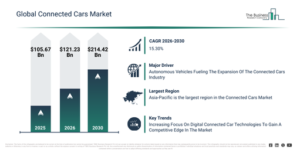
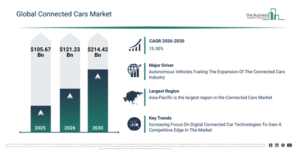
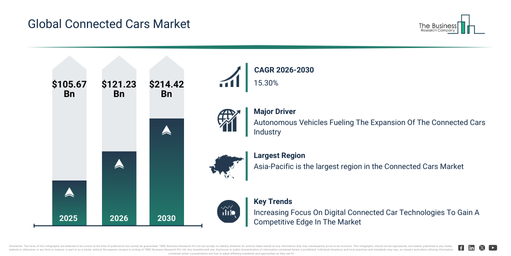
The connected cars market size has grown rapidly in recent years. It will grow from $105.67 billion in 2025 to $121.23 billion in 2026 at a compound annual growth rate (CAGR) of 14.7%. The growth in the historic period can be attributed to infotainment system adoption, smartphone integration demand, growth of vehicle sensors, telematics expansion, automotive digitization.
The connected cars market size is expected to see rapid growth in the next few years. It will grow to $214.42 billion in 2030 at a compound annual growth rate (CAGR) of 15.3%. The growth in the forecast period can be attributed to autonomous vehicle roadmap, smart mobility ecosystems, software-defined vehicles, electric vehicle connectivity needs, data-driven mobility services. Major trends in the forecast period include growth of embedded connectivity platforms, expansion of adas integration, demand for real-time vehicle diagnostics, rise of in-car digital services, adoption of v2x communication.
Get A Free Sample Report With In-Depth Market Insights:
Connected Cars Market Demand Drivers: What’s Powering Industry Growth?
Increasing autonomous vehicles are expected to propel the growth of the connected cars market going forward. Autonomous vehicles often referred to as self-driving cars or driverless vehicles are automobiles equipped with advanced sensors, artificial intelligence (AI) systems, and other technologies that enable them to operate and navigate without direct human control. Connected cars serve as an essential foundation for the development and operation of autonomous vehicles that facilitate data exchange, improve navigation, enhance safety, and provide essential support and infrastructure for self-driving cars to operate effectively and safely on the road. For instance, in 2023, according to National Academies Press, a US-based government press, self-driving vehicles are fast approaching commercialization in markets across the world and by 2035, 40% of new cars in the UK could have self-driving capabilities. Therefore, increasing autonomous vehicles drives the connected cars market.
Connected Cars Market Segment Landscape: Which Areas Lead Development?
The connected cars market covered in this report is segmented –
1) By Product Type: Embedded, Tethered, Integrated
2) By Application: Navigation, Infotainment, Telematics, Combination
3) By Services: Driver Assistance, Safety and Well-Being, Entertainment, Vehicle Management, Mobility Management, Other Services
Subsegments:
1) By Embedded: OEM Embedded Systems, Aftermarket Embedded Systems
2) By Tethered: Smartphone Tethering, Mobile Hotspot Tethering
3) By Integrated: Infotainment Systems, Advanced Driver-Assistance Systems (ADAS), Vehicle-to-Everything (V2X) Communication
Connected Cars Market Trends Shaping Long-Term Demand
Major companies operating in the connected cars market are focusing on developing technological advancements such as comprehensive digital vehicle profiles to enhance vehicle data transparency, ownership verification, and lifecycle management. Digital vehicle profiles are secure, centralized records that store a car’s complete history, including manufacturing details, maintenance records, accident history, and ownership transfers. For instance, in May 2025, Hyundai India, an India-based automotive manufacturer, launched a vehicle digital passport for its customers. The digital passport aims to improve vehicle data accessibility, ensure transparency in pre-owned vehicle transactions, enhance aftersales service efficiency, and foster trust between manufacturers, dealers, and owners, driving innovation and digital adoption in the automotive sector.
Connected Cars Market Industry Leaders And Competitive Landscape
Major companies operating in the connected cars market report include Volkswagen, Toyota Motor Corporation, General Motors, Daimler AG, BMW Group, Ford Motor Company, Honda Motor Co Ltd, Hyundai Motor Group, Tesla, Renault, Tata Motors Limited, Mahindra and Mahindra Ltd., NIO Inc., XPeng Inc., Geely Automobile Holdings Limited, Nissan Motor Co., Ltd., Mitsubishi Motor Corporation, Audi AG, Fiat Chrysler Automobiles, Mercedes-Benz, SAIC Motor, Dongfeng, FAW, Changan Automobile, Beijing Automotive Group, Brilliance Automotive, Guangzhou Automobile Group, Chery Automobile, Jianghuai Automobile Group (JAC), Stellantis, Jaguar Land Rover, Suzuki Auto South Africa, GAZ Group, Kamaz
View The Full Connected Cars Market Report:
Connected Cars Market Largest Region: Which Geography Holds The Biggest Share?
Asia-Pacific was the largest region in the connected cars market share in 2025. Western Europe was the second largest region in the global connected cars market. The regions covered in the connected cars market report include Asia-Pacific, South East Asia, Western Europe, Eastern Europe, North America, South America, Middle East, Africa.
Reach Out To Our Team:
The Business Research Company: https://www.thebusinessresearchcompany.com/
Americas: +1 310-496-7795
Asia: +44 7882 955267 & +91 8897263534
Europe: +44 7882 955267
Email us at: marketing@tbrc.info
Follow us on:
LinkedIn: https://in.linkedin.com/company/the-business-research-company
YouTube: https://www.youtube.com/channel/UC24_fI0rV8cR5DxlCpgmyFQ
Global Market Model: https://www.thebusinessresearchcompany.com/global-market-model

Wasay has over a decade of experience in market research, data modelling, and analytics, with prior experience at GlobalData and Decision Tree Consulting Services. At The Business Research Company , he leads research operations across syndicated studies, customized consulting engagements, and the Global Market Model platform. His professional experience includes supporting organizations such as Boston Consulting Group, KPMG, and Ernst & Young. Wasay holds a degree in Electronics and Communications Engineering, postgraduate management qualifications from International Management Institute Belgium and Indian School of Business and Entrepreneurship, and completed the Integrated Program in Business Analytics from Indian Institute of Management Indore.