
Backed by market attractiveness analysis, total addressable market sizing, company benchmarking matrices, interactive Excel dashboards, wider supply chain intelligence, emerging startup coverage, and detailed product-level insights, The Business Research Company’s 2026 market reports are designed to offer research that is more actionable and strategically valuable than ever.
Electric Two-Wheeler Market Size, Value And Growth Trajectory Through 2030
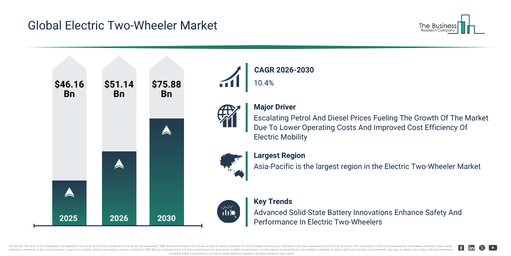
The electric two-wheeler market size has seen significant expansion in recent years. This market is forecast to grow from $46.16 billion in 2025 to $51.14 billion in 2026, advancing at a compound annual growth rate (CAGR) of 10.8%. Historically, this growth can be attributed to heightened environmental awareness among consumers, escalating fuel prices prompting the adoption of alternative mobility, increasing government incentives for electric vehicle uptake, rising urbanization and the demand for convenient transportation, and intensifying concerns regarding vehicle emissions and pollution.
The electric two-wheeler market is anticipated to experience substantial growth in the upcoming years, with projections indicating it will reach $75.88 billion by 2030, exhibiting a compound annual growth rate (CAGR) of 10.4%. This expansion during the forecast period can be attributed to factors such as the increasing demand for high-capacity battery systems, the expanding electric vehicle charging infrastructure, a rising adoption of smart and connected electric two-wheelers, growing investments in electric vehicle manufacturing facilities, and an increasing preference for sustainable personal mobility solutions. Key trends influencing this period include the wider adoption of advanced battery technologies, a growing demand for affordable electric two-wheelers, an increased focus on extended range and faster charging solutions, the development of lightweight electric vehicle components, and a continued preference for connected and smart electric two-wheelers.
Get A Free Sample Report With In-Depth Market Insights:
Electric Two-Wheeler Market Growth Backed By Core Demand Fundamentals
The anticipated future growth of the electric two-wheeler market is expected to be propelled by the increasing prices of petrol and diesel. These fuel prices represent the industry rates for vehicle fuel, which are determined by factors such as crude oil costs, taxation, refining expenses, and supply-demand conditions. The primary cause of escalating petrol and diesel prices is fluctuations in global crude oil prices, which directly influence fuel production costs. Higher crude oil prices subsequently increase the expense of refining and distributing transportation fuels, leading to elevated retail fuel prices. Electric two-wheelers provide a solution to reduce transportation costs during periods of rising petrol and diesel prices, as they operate on electricity, generally a more economical option than conventional fuels. For instance, in June 2024, according to the Department for Energy Security and Net Zero (DESNZ), a UK-based government energy statistics authority, the mid-month average retail petrol price reached 145.1 pence per liter, and the average retail diesel price reached 150.6 pence per liter, marking year-on-year increases of 1.7% and 3.5%, respectively, compared to June 2023. Consequently, the rising petrol and diesel prices are stimulating the expansion of the electric two-wheeler market.
Electric Two-Wheeler Market Segment Landscape: Which Areas Lead Development?
The electric two-wheeler market covered in this report is segmented –
1) By Vehicle: Electric Motorcycle, Electric Scooter, Electric Bikes, Electric Kick Scooter
2) By Battery: Sealed Lead Acid, Lithium Ion
3) By Motor Power: Below Three Point Five Kilowatts, Three Point Five Kilowatts To Six Point Five Kilowatts, Above Six Point Five Kilowatts
4) By Sales Channel: Online, Offline
5) By End Use: Personal, Commercial, Shared Mobility
Subsegments:
1) By Electric Motorcycle: Standard Electric Motorcycle Type, Sports Electric Motorcycle Type, Cruiser Electric Motorcycle Type, Touring Electric Motorcycle Type, Off Road Electric Motorcycle Type
2) By Electric Scooter: Standing Electric Scooter Type, Seated Electric Scooter Type, Smart Electric Scooter Type, High Speed Electric Scooter Type, Foldable Electric Scooter Type
3) By Electric Bikes: City Electric Bike Type, Mountain Electric Bike Type, Cargo Electric Bike Type, Trekking Electric Bike Type, Folding Electric Bike Type
4) By Electric Kick Scooter: Commuter Electric Kick Scooter Type, Foldable Electric Kick Scooter Type, Off Road Electric Kick Scooter Type, Three Wheel Electric Kick Scooter Type, Performance Electric Kick Scooter Type
Electric Two-Wheeler Market Growth Trends Reshaping The Competitive Landscape
Major companies in the electric two-wheeler market are concentrating on developing advanced battery technologies, such as solid-state battery conversion platforms. This effort aims to enhance vehicle safety, increase energy density, and accelerate the commercialization of next-generation electric mobility solutions. Solid-state battery conversion platforms represent a battery manufacturing method that transforms conventional lithium-ion batteries into quasi-solid or solid-state batteries, thereby reducing flammability and improving operational safety. For instance, in May 2025, Solidion Technology, Inc., a US-based battery technology company, announced a series of patented solid-state battery innovations. These innovations are capable of converting existing lithium-ion battery manufacturing facilities into producers of solid-state batteries. The technology utilizes an in-situ liquid-to-solid electrolyte conversion process, which significantly reduces battery flammability while enabling large-scale production using current manufacturing infrastructure. This innovation is intended for various electric mobility applications, including electric bikes, and is expected to support the broader adoption of safer and higher-performance electric two-wheelers.
Electric Two-Wheeler Market Industry Leaders And Competitive Landscape
Major companies operating in the electric two-wheeler market are AIMA Technology Group Co. Ltd., Ather Energy Limited, Bajaj Auto Limited, BMW AG, Gogoro Inc., Hero Vida, Honda Motor Co. Ltd., Jiangsu Xinri E-Vehicle Co. Ltd., Kawasaki Motors Corp., Matter Motor Works Private Limited, NIU International Co. Ltd., Ola Electric Mobility Limited, Piaggio & C. S.p.A., Segway-Ninebot, Suzuki Motorcycle India Private Limited, Tunwal E Motors Limited, Ultraviolette Automotive Private Limited, Yadea, Zero Motorcycles Inc.
View The Full Electric Two-Wheeler Market Report:
Electric Two-Wheeler Market Geographic Landscape: Which Region Leads Industry Growth?
Asia-Pacific was the largest region in the electric two-wheeler market in 2025. Europe is expected to be the fastest-growing region in the forecast period. The regions covered in the electric two-wheeler market report are Asia-Pacific, South East Asia, Western Europe, Eastern Europe, North America, South America, Middle East, Africa.
Reach Out To Our Team:
The Business Research Company: https://www.thebusinessresearchcompany.com/
Americas: +1 310-496-7795
Asia: +44 7882 955267 & +91 8897263534
Europe: +44 7882 955267
Email us at: marketing@tbrc.info
Follow us on:
LinkedIn: https://in.linkedin.com/company/the-business-research-company
YouTube: https://www.youtube.com/channel/UC24_fI0rV8cR5DxlCpgmyFQ
Global Market Model: https://www.thebusinessresearchcompany.com/global-market-model

Wasay has over a decade of experience in market research, data modelling, and analytics, with prior experience at GlobalData and Decision Tree Consulting Services. At The Business Research Company , he leads research operations across syndicated studies, customized consulting engagements, and the Global Market Model platform. His professional experience includes supporting organizations such as Boston Consulting Group, KPMG, and Ernst & Young. Wasay holds a degree in Electronics and Communications Engineering, postgraduate management qualifications from International Management Institute Belgium and Indian School of Business and Entrepreneurship, and completed the Integrated Program in Business Analytics from Indian Institute of Management Indore.