Featuring market attractiveness scoring, total addressable market sizing, company benchmarking matrices, interactive Excel dashboards, deeper supply chain intelligence, emerging startup tracking, and granular product-level insights, The Business Research Company’s 2026 market reports are built to deliver research that is both more actionable and more strategically valuable.
Electric Vehicle (EV) Supply Chain Management Market Growth Analysis: How Will Revenue Trend Over The Forecast Period?
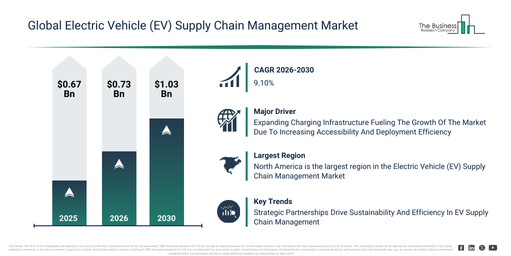
The electric vehicle (EV) supply chain management market size has grown strongly in recent years. It will grow from $0.67 billion in 2025 to $0.73 billion in 2026 at a compound annual growth rate (CAGR) of 9.3%. The growth in the historic period can be attributed to early ev manufacturing investments, battery raw material sourcing, globalization of automotive supply chains, logistics optimization, cost reduction initiatives.
The electric vehicle (EV) supply chain management market size is expected to see strong growth in the next few years. It will grow to $1.03 billion in 2030 at a compound annual growth rate (CAGR) of 9.1%. The growth in the forecast period can be attributed to resilient supply chain strategies, battery recycling integration, AI-driven supply planning, regional manufacturing mandates, sustainability compliance requirements. Major trends in the forecast period include localization of battery supply chains, integration of digital supply platforms, focus on sustainable sourcing, expansion of ev manufacturing hubs, adoption of predictive logistics.
Get A Free Sample Report With In-Depth Market Insights:
Electric Vehicle (EV) Supply Chain Management Market Growth Catalysts And Demand Drivers
The expanding charging infrastructure is expected to propel the growth in the electric vehicle (EV) supply chain management market going forward. Charging infrastructure comprises the integrated hardware and software systems that support electric vehicle (EV) battery charging across residential, commercial, and public settings. The rise in electric vehicle adoption is driving the expansion of charging infrastructure to meet the growing demand for convenient and reliable access. Expanding charging infrastructure helps in EV supply chain management by boosting consumer confidence and streamlining vehicle deployment. It reduces range anxiety and enables more efficient logistics and distribution across the EV ecosystem. For instance, in August 2023, according to GreenCars Inc., a US-based resource providing information on zero-emission vehicles, by the end of the first quarter of 2023, the United States had more than 68,000 charging stations and over 140,000 charging ports available. Therefore, the expanding charging infrastructures are driving the electric vehicle (EV) supply chain management market.
Electric Vehicle (EV) Supply Chain Management Market Segmentation And Category Overview
The electric vehicle (ev) supply chain management market covered in this report is segmented –
1) By Component: Batteries, Power Electronics, Motors, Chassis And Body Structure, Charging Infrastructure And Systems, Software And Connectivity Solutions
2) By Vehicle Type: Passenger Vehicles, Commercial Vehicles, Two-Wheelers And Three-Wheelers, Off-Highway Vehicles
3) By Stage: Upstream, Midstream, Downstream
4) By Deployment Mode: On-Premises, Cloud
5) By Organization Size: Small And Medium-Sized Enterprises (SMEs), Large Enterprises
Subsegments:
1) By Batteries: Lithium-Ion Cells, Battery Management Systems (BMS), Battery Packs, Battery Thermal Management Systems, Battery Recycling And Second-Life Applications
2) By Power Electronics: Inverters, Converters, On-Board Chargers, Control Units, Power Modules
3) By Motors: Permanent Magnet Synchronous Motors (PMSM), Induction Motors, Brushless Direct Current (DC) Motors, Switched Reluctance Motors, Motor Controllers
4) By Chassis And Body Structure: Lightweight Materials, Vehicle Frames And Subframes, Crash Structures, Suspension Components, Integration Modules
5) By Charging Infrastructure And Systems: Alternating Current (AC) Charging Stations, Direct Current (DC) Fast Charging Stations, Wireless Charging Systems, Battery Swapping Stations, Charging Management Software
6) By Software And Connectivity Solutions: Vehicle Telematics Systems, Fleet Management Software, Over-The-Air (OTA) Updates, Charging Network Integration Software, Predictive Maintenance And Diagnostic Tools
Electric Vehicle (EV) Supply Chain Management Market Industry Trends: What’s Reshaping Demand?
Major companies operating in the electric vehicle (EV) supply chain management market are focused on strategic partnerships to streamline production and distribution processes across the electric vehicle ecosystem. Strategic partnerships are collaborative agreements between companies to leverage each other’s strengths, resources, or technologies for mutual benefit. These alliances help improve EV supply chain efficiency, reduce costs, and enhance market competitiveness. For instance, in April 2025, Boots Retail Thailand, a Thailand-based pharmacy-led health and beauty retailer, partnered with DHL Supply Chain, a Germany-based logistics company, to launch a 100% electric vehicle (EV) fleet. This initiative aims to reduce carbon emissions by 74 metric tons annually, supporting Thailand’s efforts to improve air quality and aligning with Boots’ broader sustainability mission. The fleet will distribute products to over 250 Boots stores nationwide, setting a new benchmark for sustainable retail logistics and contributing to a cleaner environment. This collaboration underscores both companies’ commitment to environmental sustainability and ESG-aligned procurement and logistics strategies.
Electric Vehicle (EV) Supply Chain Management Market Competitive Analysis Of Leading Industry Participants
Major companies operating in the electric vehicle (ev) supply chain management market report include Tesla Inc., BYD Company Limited, Volkswagen AG, Toyota Motor Corporation, General Motors, Ford Motor Company, Hyundai Motor Company, Kia Corporation, Stellantis N.V., Renault Group, BMW AG, Mercedes-Benz Group AG, SAIC Motor Corporation Limited, Geely Automobile Holdings Limited, Tata Motors Limited, Mahindra & Mahindra Limited, NIO Inc., XPeng Inc., Rivian Automotive, Lucid Group, Shell plc, Siemens AG
View The Full Electric Vehicle (EV) Supply Chain Management Market Report:
Electric Vehicle (EV) Supply Chain Management Market Geographic Landscape: Which Region Leads Industry Growth?
North America was the largest region in the electric vehicle (EV) supply chain management market in 2025. The regions covered in the electric vehicle (ev) supply chain management market report include Asia-Pacific, South East Asia, Western Europe, Eastern Europe, North America, South America, Middle East, Africa.
Reach Out To Our Team:
The Business Research Company: https://www.thebusinessresearchcompany.com/
Americas: +1 310-496-7795
Asia: +44 7882 955267 & +91 8897263534
Europe: +44 7882 955267
Email us at: marketing@tbrc.info
Follow us on:
LinkedIn: https://in.linkedin.com/company/the-business-research-company
YouTube: https://www.youtube.com/channel/UC24_fI0rV8cR5DxlCpgmyFQ
Global Market Model: https://www.thebusinessresearchcompany.com/global-market-model

Wasay has over a decade of experience in market research, data modelling, and analytics, with prior experience at GlobalData and Decision Tree Consulting Services. At The Business Research Company , he leads research operations across syndicated studies, customized consulting engagements, and the Global Market Model platform. His professional experience includes supporting organizations such as Boston Consulting Group, KPMG, and Ernst & Young. Wasay holds a degree in Electronics and Communications Engineering, postgraduate management qualifications from International Management Institute Belgium and Indian School of Business and Entrepreneurship, and completed the Integrated Program in Business Analytics from Indian Institute of Management Indore.