Featuring market attractiveness scoring, total addressable market sizing, company benchmarking matrices, interactive Excel dashboards, deeper supply chain intelligence, emerging startup tracking, and granular product-level insights, The Business Research Company’s 2026 market reports are built to deliver research that is both more actionable and more strategically valuable.
Energy Logistics Market Size And Revenue Outlook Through 2030
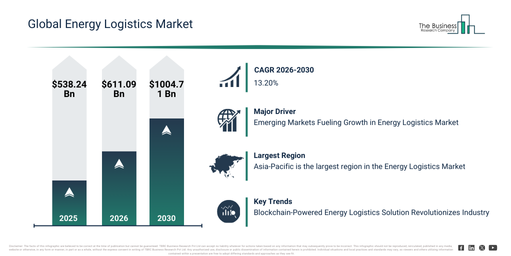
The energy logistics market size has grown rapidly in recent years. It will grow from $538.24 billion in 2025 to $611.09 billion in 2026 at a compound annual growth rate (CAGR) of 13.5%. The growth in the historic period can be attributed to global oil and gas trade growth, pipeline and tanker infrastructure expansion, demand for reliable energy supply, government energy projects, fossil fuel dependency.
The energy logistics market size is expected to see rapid growth in the next few years. It will grow to $1004.71 billion in 2030 at a compound annual growth rate (CAGR) of 13.2%. The growth in the forecast period can be attributed to growth of renewable energy distribution, smart grid expansion, digital tracking adoption, energy security initiatives, cross-border energy trade. Major trends in the forecast period include optimization of energy transportation networks, adoption of digital logistics platforms, growth of multimodal energy transport, expansion of renewable energy logistics, focus on supply chain resilience.
Get A Free Sample Report With In-Depth Market Insights:
Energy Logistics Market Growth Catalysts And Demand Drivers
The growing energy consumption in emerging markets is expected to propel the growth of the energy logistics market going forward. Growing energy consumption indicates an increase in the total amount of energy used within a specific geographic area, such as a country, region, or globally. Energy logistics are used in the transportation sector for management, transportation, and distribution of energy resources, where energy is consumed for moving people and goods to support economic growth, improve living standards, and mitigate environmental impacts. For instance, in April 2023, according to a report published by the United States Energy Information Administration (EIA), a US-based statistical agency, between 2022 and 2050, residential consumption of purchased electricity is projected to rise by approximately 14% to 22%, reaching 5.9 to 6.3 quads, while electricity purchased for transportation, driven by increased adoption of electric vehicles (EVs), is expected to surge from 0.1 quads in 2022 to between 0.6 and 1.3 quads in 2050, marking a substantial 900% to 2,000% increase across all scenarios. Therefore, the rise in energy consumption in emerging markets is driving the growth of the energy logistics market.
Energy Logistics Market Segment Landscape: Which Areas Lead Development?
The energy logistics market covered in this report is segmented –
1) By Mode Of Transport: Railways, Airways, Roadways, Waterways
2) By Application: Oil And Gas, Renewable Energy, Power Generation, Energy Mining
3) By End-User: Government Sector, Private Sector
Subsegments:
1) By Railways: Freight Trains, Tank Wagons, Container Trains
2) By Airways: Cargo Aircraft, Air Freight
3) By Roadways: Tanker Trucks, Fuel Delivery Trucks
4) By Waterways: Bulk Carriers, Tanker Ships, Container Ships
Energy Logistics Market Growth Trends Reshaping The Competitive Landscape
Major companies operating in the energy logistics market are concentrating on the development of automation solution, such as the commodity transport web3 field automation solution, to meet regulatory requirements, address environmental concerns, and satisfy customer demands. The solution automates transport process, reducing manual validation, slow communication, and discrepancies. For instance, in October 2023, Blockchain for Energy (B4E), a US-based non-profit organization, launched a blockchain energy logistics solution called commodity transport web3 field automation. This solution is exclusively available through the B4E network and platform. The solution leverages blockchain smart contracts to validate sensors, GPS, and other IoT data to digitize and automate previously manual processes, and it is flexible enough to support various types of commodities and requirements in different regions.
Energy Logistics Market Industry Leaders And Competitive Landscape
Major companies operating in the energy logistics market report include Saudi Aramco, Sinopec Group, PetroChina Company Limited, Exxon Mobil Corporation, Royal Dutch Shell plc, TotalEnergies SE, BP plc., Chevron Corporation, Phillips 66, Gazprom PJSC, Eni S.p.A., Energy Transfer LP, Rosneft Oil Company, CNOOC Limited, Enterprise Products Partners L.P., Qatar Petroleum, Enbridge Inc., Occidental Petroleum Corporation, Kinder Morgan, Inc., Williams Companies Inc.
View The Full Energy Logistics Market Report:
Energy Logistics Market Top Region: Where Does Most Revenue Come From?
Asia-Pacific was the largest region in the energy logistics market in 2025. The regions covered in the energy logistics market report include Asia-Pacific, South East Asia, Western Europe, Eastern Europe, North America, South America, Middle East, Africa.
Reach Out To Our Team:
The Business Research Company: https://www.thebusinessresearchcompany.com/
Americas: +1 310-496-7795
Asia: +44 7882 955267 & +91 8897263534
Europe: +44 7882 955267
Email us at: marketing@tbrc.info
Follow us on:
LinkedIn: https://in.linkedin.com/company/the-business-research-company
YouTube: https://www.youtube.com/channel/UC24_fI0rV8cR5DxlCpgmyFQ
Global Market Model: https://www.thebusinessresearchcompany.com/global-market-model

Wasay has over a decade of experience in market research, data modelling, and analytics, with prior experience at GlobalData and Decision Tree Consulting Services. At The Business Research Company , he leads research operations across syndicated studies, customized consulting engagements, and the Global Market Model platform. His professional experience includes supporting organizations such as Boston Consulting Group, KPMG, and Ernst & Young. Wasay holds a degree in Electronics and Communications Engineering, postgraduate management qualifications from International Management Institute Belgium and Indian School of Business and Entrepreneurship, and completed the Integrated Program in Business Analytics from Indian Institute of Management Indore.