Through market attractiveness analysis, total addressable market evaluation, company benchmarking matrices, interactive Excel dashboards, expanded supply chain intelligence, emerging startup coverage, and detailed product insights, The Business Research Company’s 2026 market reports provide more actionable and strategically valuable research.
Electronic Stability Control (ESC) Market Forecast Highlighting Growth From $43.31 Billion To $9.2 Billion
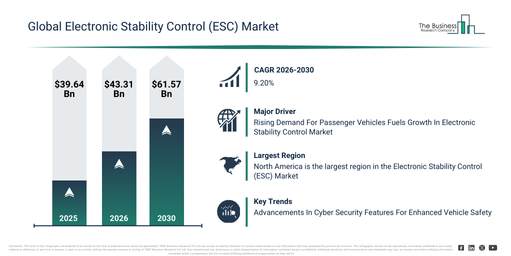
The electronic stability control (ESC) market has shown strong expansion over recent years. It is expected to grow from $39.64 billion in 2025 to $43.31 billion in 2026, at a compound annual growth rate (CAGR) of 9.2%. The market’s growth in the past was influenced by road safety regulations, increasing awareness about accidents, advancements in automotive electronics, the adoption of ABS, and vehicle safety mandates.
The electronic stability control (ESC) market is projected to experience substantial expansion in the coming years, with its size expected to reach $61.57 billion by 2030, demonstrating a compound annual growth rate (CAGR) of 9.2%. This growth throughout the forecast period is attributed to advancements in autonomous driving, increased ADAS penetration, the rise of software-driven safety systems, the electrification of vehicles, and the enforcement of stricter safety regulations. Major trends anticipated during this period include the mandatory adoption of vehicle safety systems, their integration with ADAS platforms, an expanded presence in electric and hybrid vehicles, a growing demand for advanced sensors, and the proliferation of centralized ECUs.
Download A Free Sample Report For Comprehensive Market Insights:
#Electronic Stability Control (ESC) Market Growth Drivers And Industry Catalysts
The rising demand for passenger vehicles is anticipated to boost the growth of the electronic stability control (ESC) market. This surge in passenger vehicle demand is influenced by factors such as higher disposable incomes, urbanization, advancements in automotive technology, increased environmental awareness driving a preference for electric vehicles, and improved transportation infrastructure. Electronic stability control (ESC) enhances safety in passenger vehicles by automatically adjusting brakes and engine power to maintain vehicle stability and prevent loss of control. For instance, in March 2024, the European Automobile Manufacturers’ Association (ACEA), a Belgium-based vehicle industry association, reported that global passenger vehicle production reached nearly 76 million units, an increase of 10.2% compared to the previous year. Thus, the escalating demand for passenger vehicles is propelling the electronic stability control (ESC) market forward.
Electronic Stability Control (ESC) Market Segment Breakdown: Which Categories Generate The Most Revenue?
The electronic stability control (esc) market covered in this report is segmented –
1) By Component: Wheels Speed Sensor, Yaw Rate Sensor, Electronic Control Unit, Antilock Braking System, Other Components
2) By Vehicle Type: Passenger Cars, Light Commercial Vehicles, Heavy Commercial Vehicles
3) By Vehicle Propulsion: Internal Combustion Engine, Electric And Hybrid
4) By End User: Original Equipment Manufacturer, Aftermarket
Subsegments:
1) By Wheel Speed Sensor: Single-Channel Wheel Speed Sensors, Multi-Channel Wheel Speed Sensors, Active Wheel Speed Sensors, Passive Wheel Speed Sensors
2) By Yaw Rate Sensor: 3D Yaw Rate Sensors, Digital Yaw Rate Sensors, MEMS-Based Yaw Rate Sensors, Gyroscopic Yaw Rate Sensors
3) By Electronic Control Unit (ECU): Centralized ECU For ESC Systems, Distributed ECU For ESC And Other Safety Systems, Dual-Processor ECUs For High-Performance Vehicles, ECU With Adaptive Control Algorithms
4) By Antilock Braking System (ABS): Integrated ESC And ABS Systems, ABS Sensors And Controllers For ESC, Full Function ABS With ESC Integration, Electromechanical ABS With ESC
5) By Other Components: Steering Angle Sensors, Brake Actuators, Hydraulic Control Units, Vehicle Dynamics Sensors, Communication Interfaces For ESC Integration
#Electronic Stability Control (ESC) Market Trends Influencing Long-Term Demand
Major companies in the electronic stability control (ESC) market are prioritizing the development of compact and efficient systems that include integrated cybersecurity features like cryptographic keys. This initiative aims to elevate vehicle safety, optimize performance in various driving conditions, and address the increasing demands for electrification and automation within the automotive industry. Cryptographic keys in ESC systems are essential for authenticating the system, encrypting data, securing boot processes, and safeguarding communication channels, thus ensuring the integrity and security of vehicle safety systems. For example, in May 2023, Continental AG, a Germany-based automotive parts manufacturing company, introduced the MK 120 ESC, an advanced electronic brake system designed for electronic stability control (ESC) applications. It boasts a lightweight and compact design, being approximately 5% lighter and 7% smaller than its previous model while maintaining performance. The system incorporates robust cybersecurity measures, including individual security keys for each unit, and supports over-the-air (OTA) functionality for software updates. It also integrates advanced cyber security with features such as embedded hardware protection, unique security keys, and secure boot to provide comprehensive vehicle safety.
Electronic Stability Control (ESC) Market Key Players And Strategic Industry Positioning
Major companies operating in the electronic stability control (esc) market report include Robert Bosch GmbH, Denso Corporation, ZF Friedrichshafen AG, Continental AG, Hyundai Mobis Co. Ltd., Aisin Corporation, Aptiv PLC, Hitachi Astemo Ltd., Autoliv Inc., Mando Corporation, Brembo S.p.A., Bendix Commercial Vehicle Systems LLC, STMicroelectronics N.V., Murata Manufacturing Co. Ltd., Analog Devices Inc., Renesas Electronics Corporation, JTEKT Corporation, Hella GmbH & Co. KGaA, Johnson Electric Holdings Limited, Nexteer Automotive
Access The Complete Electronic Stability Control (ESC) Market Report:
Electronic Stability Control (ESC) Market Regional Analysis And Leading Geography
North America was the largest region in the electronic stability control (ESC) market in 2025. The regions covered in the electronic stability control (esc) market report include Asia-Pacific, South East Asia, Western Europe, Eastern Europe, North America, South America, Middle East, Africa.
Get in touch with us:
The Business Research Company: https://www.thebusinessresearchcompany.com/
Americas: +1 310-496-7795
Asia: +44 7882 955267 & +91 8897263534
Europe: +44 7882 955267
Email us at: marketing@tbrc.info
Follow us on:
LinkedIn: https://in.linkedin.com/company/the-business-research-company
YouTube: https://www.youtube.com/channel/UC24_fI0rV8cR5DxlCpgmyFQ
Global Market Model: https://www.thebusinessresearchcompany.com/global-market-model

Wasay has over a decade of experience in market research, data modelling, and analytics, with prior experience at GlobalData and Decision Tree Consulting Services. At The Business Research Company , he leads research operations across syndicated studies, customized consulting engagements, and the Global Market Model platform. His professional experience includes supporting organizations such as Boston Consulting Group, KPMG, and Ernst & Young. Wasay holds a degree in Electronics and Communications Engineering, postgraduate management qualifications from International Management Institute Belgium and Indian School of Business and Entrepreneurship, and completed the Integrated Program in Business Analytics from Indian Institute of Management Indore.