Enhanced with market attractiveness analysis, total addressable market evaluation, company benchmarking matrices, interactive Excel dashboards, expanded supply chain intelligence, emerging startup coverage, and detailed product insights, The Business Research Company’s 2026 market reports deliver more actionable and strategically valuable research.
Electric Vehicle (EV) Battery Cell And Pack Materials Market Expansion Outlook: What Revenue Opportunities Lie Ahead?
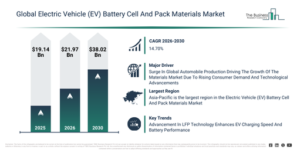
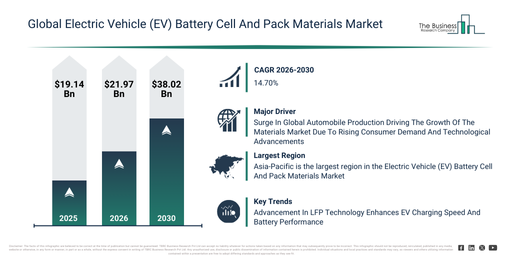
The electric vehicle (EV) battery cell and pack materials market has expanded rapidly in recent years. This market is projected to grow from $19.14 billion in 2025 to $21.97 billion in 2026, achieving a compound annual growth rate (CAGR) of 14.8%. The historical growth of this market can be linked to the increase in EV adoption, the strong presence of lithium-ion technology, the need for longer driving ranges, initial investments in battery gigafactories, and the influence from consumer electronics.
The electric vehicle (EV) battery cell and pack materials market size is anticipated to experience substantial growth in the upcoming years, with projections indicating it will reach $38.02 billion by 2030, exhibiting a compound annual growth rate (CAGR) of 14.7%. This expansion is largely driven by factors such as solid-state battery commercialization, raw material diversification, ongoing battery cost reduction efforts, the implementation of recycling mandates, and incentives aimed at domestic battery manufacturing. Noteworthy trends emerging in this timeframe encompass a shift toward advanced battery chemistries, a rising demand for high-energy-density cells, the localization of battery supply chains, an increase in solid-state research, and the broader expansion of EV battery recycling initiatives.
Download A Free Sample Report For Comprehensive Market Insights:
Electric Vehicle (EV) Battery Cell And Pack Materials Market Expansion Supported By Key Demand Factors
The increasing output of automobiles is projected to fuel the expansion of the electric vehicle (EV) battery cell and pack materials market moving ahead. Automobile production refers to the comprehensive process of designing, manufacturing, and assembling motor vehicles, including passenger cars, commercial trucks, and other transport vehicles. This rise in automotive production is primarily attributed to growing global consumer demand, rapid technological advancements in manufacturing processes, and supportive government policies and incentives. As more individuals become capable of affording vehicles, the escalating consumer demand encourages manufacturers to boost production to satisfy the expanding market, thereby driving up overall automobile output. Furthermore, the growth in EV production fosters innovation in battery technologies, prompting manufacturers to invest in superior, more efficient battery materials to meet the higher energy demands of electric vehicles. For instance, the Organisation Internationale des Constructeurs d’Automobiles (OICA), a France-based international association of automobile manufacturers, stated that in 2023, the global automotive industry experienced substantial expansion, with vehicle production reaching 93.55 million units, an increase from 85.02 million units in 2022. Consequently, the surge in automobile production is propelling the growth of the electric vehicle (EV) battery cell and pack materials market.
Electric Vehicle (EV) Battery Cell And Pack Materials Market Segment Landscape: Which Areas Lead Market Development?
The electric vehicle (ev) battery cell and pack materials market covered in this report is segmented –
1) By Vehicle Electrification Type: Battery Electric Vehicles (BEVs), Hybrid Electric Vehicles (HEVs), Plug-in Hybrid Electric Vehicles (PHEVs)
2) By Cell Material Type: Lithium-Ion Batteries, Lithium Iron Phosphate (LFP) Batteries, Nickel Manganese Cobalt (NMC) Batteries, Nickel Cobalt Aluminum (NCA) Batteries, Nickel-Metal Hydride (NiMH) Batteries, Sodium-Ion Batteries, Solid-State Batteries
3) By Battery Pack Material Type: Cathode Materials, Anode Materials, Electrolytes, Separators, Current Collectors, Battery Casings & Enclosures, Thermal Management Materials
4) By Application: Electric Passenger Vehicles, Electric Commercial Vehicles, Electric Two-Wheelers & Three-Wheelers
Subsegments:
1) By Battery Electric Vehicles (BEVs): Lithium Iron Phosphate (LFP) Battery Cells, Nickel Manganese Cobalt (NMC) Battery Cells, Nickel Cobalt Aluminum (NCA) Battery Cells, Solid-State Battery Cells
2) By Hybrid Electric Vehicles (HEVs): Nickel-Metal Hydride (NiMH) Battery Cells, Lithium-Ion Battery Cells
3) By Plug-in Hybrid Electric Vehicles (PHEVs): Lithium-Ion Battery Cells, Nickel Manganese Cobalt (NMC) Battery Cells, Lithium Polymer (Li-Po) Battery Cells
Electric Vehicle (EV) Battery Cell And Pack Materials Market Growth Trends Influencing Competitive Dynamics
Leading companies in the electric vehicle (EV) battery cell and pack materials market are prioritizing the development of innovative technologies, such as LFP technology, to improve battery safety, durability, and cost-efficiency. LFP (lithium iron phosphate) technology is a battery chemistry recognized for its superior safety, extended lifespan, thermal stability, and economic viability in both electric vehicles and energy storage applications. For instance, in August 2023, Contemporary Amperex Technology Co. Limited (CATL), a China-based battery manufacturer and technology firm, unveiled Shenxing, the world’s first 4C superfast charging lithium iron phosphate (LFP) battery. This battery allows electric vehicles to achieve a 400 km driving range with just a 10-minute charge and offers over 700 km on a full charge. It is engineered to alleviate concerns regarding charging speed, making EVs more practical for daily use. Shenxing incorporates advanced LFP technology to enhance safety, efficiency, and longevity. This innovation signifies a major progression in rapid-charging solutions for the electric vehicle industry.
Electric Vehicle (EV) Battery Cell And Pack Materials Market Industry Leaders And Market Competition
Major companies operating in the electric vehicle (ev) battery cell and pack materials market report include Ford Motor Company, BYD Company Limited, Panasonic Industry Co. Ltd., SK Innovation Co. Ltd., Contemporary Amperex Technology Co. Ltd., LG Chem Ltd., EVE Energy Co. Ltd., Gotion High-Tech Co. Ltd., Envision AESC Group Ltd., Samsung SDI Co. Ltd., Northvolt AB, QuantumScape Corporation, Farasis Energy (Ganzhou) Co. Ltd., Microvast Holdings Inc., ProLogium Technology Co. Ltd., Grepow Battery Co. Ltd., China Aviation Lithium Battery Co. Ltd., Solid Power Inc., StoreDot Ltd., Imperium3 (iM3) Consortium, Amperex Technology Limited (ATL), SVOLT Energy Technology Co. Ltd.
Access The Complete Electric Vehicle (EV) Battery Cell And Pack Materials Market Report:
Electric Vehicle (EV) Battery Cell And Pack Materials Market Geographic Analysis: Where Is Demand Growing The Fastest?
Asia-Pacific was the largest region in the electric vehicle (EV) battery cell and pack materials market in 2025. The regions covered in the electric vehicle (ev) battery cell and pack materials market report include Asia-Pacific, South East Asia, Western Europe, Eastern Europe, North America, South America, Middle East, Africa.
Get in touch with us:
The Business Research Company: https://www.thebusinessresearchcompany.com/
Americas: +1 310-496-7795
Asia: +44 7882 955267 & +91 8897263534
Europe: +44 7882 955267
Email us at: marketing@tbrc.info
Follow us on:
LinkedIn: https://in.linkedin.com/company/the-business-research-company
YouTube: https://www.youtube.com/channel/UC24_fI0rV8cR5DxlCpgmyFQ
Global Market Model: https://www.thebusinessresearchcompany.com/global-market-model

Wasay has over a decade of experience in market research, data modelling, and analytics, with prior experience at GlobalData and Decision Tree Consulting Services. At The Business Research Company , he leads research operations across syndicated studies, customized consulting engagements, and the Global Market Model platform. His professional experience includes supporting organizations such as Boston Consulting Group, KPMG, and Ernst & Young. Wasay holds a degree in Electronics and Communications Engineering, postgraduate management qualifications from International Management Institute Belgium and Indian School of Business and Entrepreneurship, and completed the Integrated Program in Business Analytics from Indian Institute of Management Indore.