Featuring market attractiveness scoring, total addressable market sizing, company benchmarking matrices, interactive Excel dashboards, deeper supply chain intelligence, emerging startup tracking, and granular product-level insights, The Business Research Company’s 2026 market reports are built to deliver research that is both more actionable and more strategically valuable.
Fleet Charging Market Size Forecast: How Big Could The Market Get By 2030?
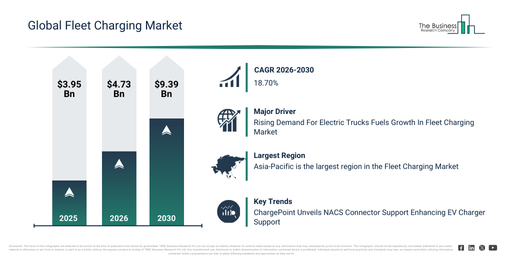
The fleet charging market size has grown rapidly in recent years. It will grow from $3.95 billion in 2025 to $4.73 billion in 2026 at a compound annual growth rate (CAGR) of 19.9%. The growth in the historic period can be attributed to initial adoption of electric fleets, government ev incentives, early charging infrastructure development, pilot fleet electrification projects, utility partnerships.
The fleet charging market size is expected to see rapid growth in the next few years. It will grow to $9.39 billion in 2030 at a compound annual growth rate (CAGR) of 18.7%. The growth in the forecast period can be attributed to fleet electrification mandates, smart grid integration, demand for cost optimization, renewable energy integration, expansion of last-mile delivery. Major trends in the forecast period include deployment of smart charging systems, expansion of dc fast charging for fleets, integration with energy management software, growth of depot-based charging, demand from logistics fleets.
Get A Free Sample Report With In-Depth Market Insights:
Fleet Charging Market Growth Catalysts And Demand Drivers
The increase in demand for electric trucks is expected to propel the growth of the fleet charging market going forward. An electric truck is a battery-powered vehicle designed for transporting goods, carrying specialized loads, or performing utilitarian tasks. The demand for electric trucks is increasing due to growing environmental concerns, stricter emissions regulations, and advancements in battery technology. Fleet charging for electric trucks enables efficient and cost-effective recharging, optimizing energy use and reducing downtime for large-scale logistics operations. For instance, in June 2024, according to International Energy Agency, a France-based autonomous intergovernmental organization, Sales of electric trucks increased by 35 % in 2023 compared to 2022, reaching around 54,000 units globally. Therefore, the increase in demand for electric trucks is driving the growth of the fleet charging market.
Fleet Charging Market Segments: Where Is Growth Concentrated?
The fleet charging market covered in this report is segmented –
1) By Type: Alternating Current (AC) Charging Station, Direct Current (DC) Charging Station
2) By Installation Type: Fixed, Portable
3) By End User: Service And Last Mile Companies, Trucking Companies, Public Transportation, Other End Users
Subsegments:
1) By Alternating Current (Ac) Charging Station: Level 1 Ac Charging Station, Level 2 Ac Charging Station
2) By Direct Current (Dc) Charging Station: Dc Fast Charging (Dcfc) Station, Ultra-Fast Dc Charging Station
Fleet Charging Market Trends Shaping Long-Term Demand
Major companies operating in the fleet charging market are focusing on technological advancements, such as EV charger support, to better serve customers. EV charger support refers to the technical assistance and maintenance provided by manufacturers or service providers to ensure the proper functioning of electric vehicle charging equipment. For instance, in June 2023, ChargePoint Holdings Inc., a US-based company that provides charging stations of different capacities, released a new North American Charging Standard (NACS) connector support for its AC and DC charging solutions. It includes technical assistance and maintenance for its AC and DC charging solutions, offering cable conversion kits for existing DC fast chargers and native DC connectors compatible with Tesla vehicles, ensuring seamless charging operations for EV owners. ChargePoint’s lineup of NACS solutions bolsters the company’s commitment to delivering a seamless charging experience for drivers of all EV makes and models by being the first in the charging industry to ship a native DC connector that is compatible with Tesla vehicles. The lineup offers AC solutions as well, negating the need for a cumbersome adapter to charge.
Fleet Charging Market Key Participants And Competitive Landscape
Major companies operating in the fleet charging market report include Royal Dutch Shell plc, BMW Group, Enel Group, Robert Bosch GmbH, Tesla Inc., Renault Group, Schneider Electric SE, Eaton Corporation Plc, Phihong Technology Co. Ltd., Delta Electronics EMEA, Tata Power, EVBox, ChargePoint Holdings Inc., EFACEC Power Solutions SGPS, Allego Inc., Tritium DCFC Ltd, Electrify America LLC, EVgo Inc., Xcharge, Virta Global, Servotech Power Systems Ltd., Kazam EV Tech. Pvt. Ltd., HyperVolt, Charzer, Greenlots
View The Full Fleet Charging Market Report:
Fleet Charging Market Regional Split: Which Areas Are Fueling Growth?
Asia-Pacific was the largest region in the fleet charging market in 2025. The regions covered in the fleet charging market report include Asia-Pacific, South East Asia, Western Europe, Eastern Europe, North America, South America, Middle East, Africa.
Reach Out To Our Team:
The Business Research Company: https://www.thebusinessresearchcompany.com/
Americas: +1 310-496-7795
Asia: +44 7882 955267 & +91 8897263534
Europe: +44 7882 955267
Email us at: marketing@tbrc.info
Follow us on:
LinkedIn: https://in.linkedin.com/company/the-business-research-company
YouTube: https://www.youtube.com/channel/UC24_fI0rV8cR5DxlCpgmyFQ
Global Market Model: https://www.thebusinessresearchcompany.com/global-market-model

Wasay has over a decade of experience in market research, data modelling, and analytics, with prior experience at GlobalData and Decision Tree Consulting Services. At The Business Research Company , he leads research operations across syndicated studies, customized consulting engagements, and the Global Market Model platform. His professional experience includes supporting organizations such as Boston Consulting Group, KPMG, and Ernst & Young. Wasay holds a degree in Electronics and Communications Engineering, postgraduate management qualifications from International Management Institute Belgium and Indian School of Business and Entrepreneurship, and completed the Integrated Program in Business Analytics from Indian Institute of Management Indore.