Delivering more actionable and strategically valuable research, The Business Research Company’s 2026 market reports feature market attractiveness analysis, total addressable market evaluation, company benchmarking matrices, interactive Excel dashboards, expanded supply chain intelligence, emerging startup coverage, and detailed product insights.
Fuel Cards Market Value Expansion And Long-Term Growth Outlook
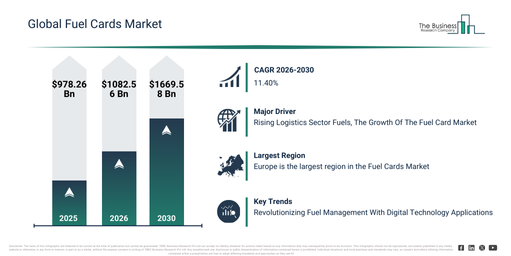
The fuel cards market has seen considerable growth in recent times. Its valuation is anticipated to rise from $978.26 billion in 2025 to $1082.56 billion in 2026, advancing at a compound annual growth rate (CAGR) of 10.7%. This historical expansion is attributable to several factors, including the demand for monitoring fleet fuel costs, an expansion in commercial vehicle fleets, the uptake of cashless transactions, escalating fuel price instability, and initial endeavors in fleet digitization.
The fuel cards market size is set for substantial expansion in the coming years, projected to reach $1669.58 billion by 2030, driven by a compound annual growth rate (CAGR) of 11.4%. This anticipated growth during the forecast period is primarily due to the expansion of corporate fleets, the rising demand for real-time fuel analytics, increasing smart card adoption, the integration with EV charging payments, and a greater emphasis on cost transparency. Significant trends expected in this period involve digital fuel payment solutions, enhanced expense tracking tools, integration with fleet management systems, advanced fraud detection and spending controls, and comprehensive multi-service payment capabilities.
Download A Free Sample Report For Comprehensive Market Insights:
Fuel Cards Market Development Factors: Which Trends Are Supporting Demand?
The future expansion of the logistics sector is anticipated to stimulate the development of the fuel card market. This sector encompasses gathering, producing, and distributing materials and goods to their appropriate locations and in correct quantities. Fuel cards enable operators to facilitate careful financial management, monitor driver spending, and oversee fueling behaviors. For instance, in June 2023, according to the Council of Supply Chain Management Professionals (CSCMP), a US-based prominent organization within the logistics and supply chain management sectors, the total expenditure on corporate logistics in the US reached an unprecedented $2.3 trillion in 2023. This marks an increase from $1.85 trillion in 2022, constituting 9.1% of the nation’s GDP, its highest proportion to date. Thus, the growing logistics sector acts as a catalyst for the fuel card market.
Fuel Cards Market Segment Analysis And Revenue Opportunities
The fuel cards market covered in this report is segmented –
1) By Type: Branded, Universal, Merchant
2) By Technology: Smart Cards, Standard Cards
3) By Application: Fuel Refill, Parking, Vehicle Service, Toll Charges, Other Applications
4) By Vehicle: Heavy Fleet, Light Fleet
Subsegments:
1) By Branded: Specific Fuel Station Cards, Fleet Programs With Brand Loyalty
2) By Universal: Multi-Brand Acceptance Cards, Cards Usable At Various Fuel Stations
3) By Merchant: Cards Issued By Retailers Or Merchants, Loyalty Programs Associated With Merchants
Fuel Cards Market Transformation Trends: Which Innovations Are Driving Change?
Major companies in the fuel card market are prioritizing the development of advanced solutions, including digital fuel technology applications. Digital Fuel Technology applications encompass a spectrum of digital tools and systems designed to optimize and streamline various aspects of fuel management and consumption. For instance, in April 2023, Transflo, a US-based software company, and Comdata Inc., a US-based company specializing in commercial payment solutions, launched the ‘Transflo Wallet’. This is a mobile-app-based, cardless fuel payment solution that enables freight brokers to send digital fuel to drivers and carriers. By combining Transflo’s cutting-edge mobile app technology with Comdata’s exclusive virtual card capabilities, the solution delivers the most secure and user-friendly fuel payment experience available in the industry.
Fuel Cards Market Leading Players Shaping Industry Direction
Major companies operating in the fuel cards market report include Exxon Mobil Corporation, TotalEnergies SE, Chevron Corporation, BP plc, Valero Energy Corporation, Repsol S.A., Suncor Energy Inc., Shell plc, U.S. Bancorp, Libya Oil Holdings Ltd., Puma Energy Holdings Pte Ltd., FirstRand Limited, Absa Bank Limited, Fleetcor Technologies Inc., Comdata Inc., WEX Inc., First National Bank, Fuel Genie Systems, CSI Voyager Fleet, W. A. G. Payment Solutions plc, Singapore Petroleum Company Limited, Wilhelm Hoyer GmbH & Co. KG, Edenred Essentials, Engen Petroleum Ltd., Fuelman Inc.
Access The Complete Fuel Cards Market Report:
Fuel Cards Market Geographic Analysis: Where Is Demand Growing The Fastest?
Europe was the largest region in the fuel card market in 2025. The regions covered in the fuel cards market report include Asia-Pacific, South East Asia, Western Europe, Eastern Europe, North America, South America, Middle East, Africa.
Get in touch with us:
The Business Research Company: https://www.thebusinessresearchcompany.com/
Americas: +1 310-496-7795
Asia: +44 7882 955267 & +91 8897263534
Europe: +44 7882 955267
Email us at: marketing@tbrc.info
Follow us on:
LinkedIn: https://in.linkedin.com/company/the-business-research-company
YouTube: https://www.youtube.com/channel/UC24_fI0rV8cR5DxlCpgmyFQ
Global Market Model: https://www.thebusinessresearchcompany.com/global-market-model

Wasay has over a decade of experience in market research, data modelling, and analytics, with prior experience at GlobalData and Decision Tree Consulting Services. At The Business Research Company , he leads research operations across syndicated studies, customized consulting engagements, and the Global Market Model platform. His professional experience includes supporting organizations such as Boston Consulting Group, KPMG, and Ernst & Young. Wasay holds a degree in Electronics and Communications Engineering, postgraduate management qualifications from International Management Institute Belgium and Indian School of Business and Entrepreneurship, and completed the Integrated Program in Business Analytics from Indian Institute of Management Indore.