Backed by market attractiveness analysis, total addressable market sizing, company benchmarking matrices, interactive Excel dashboards, wider supply chain intelligence, emerging startup coverage, and detailed product-level insights, The Business Research Company’s 2026 market reports are designed to offer research that is more actionable and strategically valuable than ever.
Fuel Cell Vehicle Market Growth Potential: How Will Market Size Shift Through 2030?
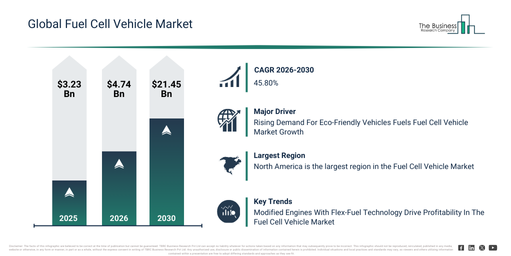
The fuel cell vehicle market size has grown exponentially in recent years. It will grow from $3.23 billion in 2025 to $4.74 billion in 2026 at a compound annual growth rate (CAGR) of 46.9%. The growth in the historic period can be attributed to automotive emission regulations, early hydrogen vehicle pilots, public sector fleet trials, fuel cell technology maturation, investment by global automakers.
The fuel cell vehicle market size is expected to see exponential growth in the next few years. It will grow to $21.45 billion in 2030 at a compound annual growth rate (CAGR) of 45.8%. The growth in the forecast period can be attributed to hydrogen infrastructure expansion, increasing commercial vehicle adoption, declining fuel cell system costs, supportive government incentives, cross industry hydrogen partnerships. Major trends in the forecast period include rising commercial deployment of fcevs, growing focus on long range zero emission vehicles, expansion of hydrogen refueling compatibility, increasing adoption in public transport, improvement in fuel cell durability.
Get A Free Sample Report With In-Depth Market Insights:
Fuel Cell Vehicle Market Industry Drivers: What’s Behind The Revenue Growth?
The increased demand for fuel-efficient, high-performance, and low-emission cars is expected to propel the growth of the fuel-cell vehicle market going forward. Electric vehicles are vehicles that consist of a motor that is powered by electricity stored in batteries. Additionally, with defense against COVID-19 and aspirations to achieve net-zero emissions, EV and hybrid vehicles are suddenly adopted. These vehicles are more environmentally friendly and efficient than standard combustion-powered engines, which raises demand for the low-emission cars market. For instance In April 2024, according to International Energy Agency, a France-based intergovernmental organization, Almost 14 million new electric cars were registered globally in 2023, bringing their total number on the roads to 40 million, closely tracking the sales forecast from the 2023. Therefore, the increased demand for fuel-efficient, high-performance, and low-emission cars is driving the growth of the fuel cell vehicle market.
Fuel Cell Vehicle Market Segment Landscape And Growth Outlook
The fuel cell vehicle market covered in this report is segmented –
1) By Vehicle Type: Passenger Vehicle, Commercial Vehicle
2) By Technology: Proton Exchange Membrane Fuel Cells (PEMFC), Solid Oxide Fuel Cells (SOFC), Direct Methanol Fuel Cells (DMFC), Phosphoric Acid Fuel Cells (PAFC), Molten Carbonate Fuel Cells (MCFC)
3) By End-User: Private, Commercial
Subsegments:
1) By Passenger Vehicle: Sedans, SUVs, Hatchbacks
2) By Commercial Vehicle: Light Commercial Vehicles (LCVs), Heavy-Duty Trucks, Buses, Vans
#Fuel Cell Vehicle Market Growth Trends: What’s Shaping The Future Outlook?
Major companies operating in the fuel cell vehicle market are developing modified engines with flex-fuel technology to increase their profitability in the market. Modified engines refer to internal combustion engines that have been altered or customized from their original factory specifications to enhance performance, power output, or other characteristics. For instance, in August 2023, Toyota Motor Corporation, a Japan-based automotive manufacturer, launched the electrified flex-fuel Innova HyCross car in India, the world’s first fully ethanol-powered car equipped with a flex-fuel engine. The flex-fuel engine is a modified 2.0-liter, four-cylinder engine that runs on E85 fuel, which is a blend of 85% ethanol and 15% gasoline. The Innova HyCross is a modified version of the standard Innova HyCross hybrid MPV, which can generate 181 bhp of power and offer a fuel economy of 23.24 km. The Innova HyCross flex-fuel model is expected to offer a fuel economy of up to 30% better than the standard Innova HyCross hybrid due to its use of E85 fuel. Additionally, the Innova HyCross flex-fuel has a self-charging lithium-ion battery that can be used to power the vehicle in electric mode, providing a more environmentally friendly and fuel-efficient transportation option.
Fuel Cell Vehicle Market Competitive Landscape: Who Leads The Industry?
Major companies operating in the fuel cell vehicle market report include Toyota Motor Corporation, Honda Motor Co. Ltd., Hyundai Motor Company, Volvo AB, General Motors, Bayerische Motoren Werke Aktiengesellschaft AG, Audi AG, Ford Motor Company, Ballard Power Systems Inc., Nikola Corporation, SAIC Motor Corporation Limited, Mercedes-Benz Group, Daimler Truck, Beiqi Foton Motor Co. Ltd., Dongfeng Motor Corporation, Great Wall Motor, Hyzon Motors, Riversimple, Symbio.one, Tata Motors, VDL Bus & Coach, Wrightbus, Yutong Group, Proton Motor Fuel Cell GmbH, PowerCell Sweden AB, Intelligent Energy
View The Full Fuel Cell Vehicle Market Report:
Fuel Cell Vehicle Market Geographic Landscape: Which Region Leads Industry Growth?
North America was the largest region in the fuel cell vehicle market in 2025. Asia-Pacific is expected to be the fastest-growing region in the fuel cell vehicle market during the forecast period. The regions covered in the fuel cell vehicle market report include Asia-Pacific, South East Asia, Western Europe, Eastern Europe, North America, South America, Middle East, Africa.
Reach Out To Our Team:
The Business Research Company: https://www.thebusinessresearchcompany.com/
Americas: +1 310-496-7795
Asia: +44 7882 955267 & +91 8897263534
Europe: +44 7882 955267
Email us at: marketing@tbrc.info
Follow us on:
LinkedIn: https://in.linkedin.com/company/the-business-research-company
YouTube: https://www.youtube.com/channel/UC24_fI0rV8cR5DxlCpgmyFQ
Global Market Model: https://www.thebusinessresearchcompany.com/global-market-model

Wasay has over a decade of experience in market research, data modelling, and analytics, with prior experience at GlobalData and Decision Tree Consulting Services. At The Business Research Company , he leads research operations across syndicated studies, customized consulting engagements, and the Global Market Model platform. His professional experience includes supporting organizations such as Boston Consulting Group, KPMG, and Ernst & Young. Wasay holds a degree in Electronics and Communications Engineering, postgraduate management qualifications from International Management Institute Belgium and Indian School of Business and Entrepreneurship, and completed the Integrated Program in Business Analytics from Indian Institute of Management Indore.