Delivering more actionable and strategically valuable research, The Business Research Company’s 2026 market reports feature market attractiveness analysis, total addressable market evaluation, company benchmarking matrices, interactive Excel dashboards, expanded supply chain intelligence, emerging startup coverage, and detailed product insights.
Golf Cart Market Growth Potential: How Will Market Size Change Through 2030?
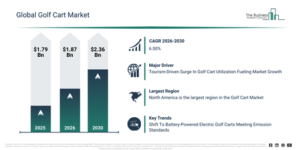
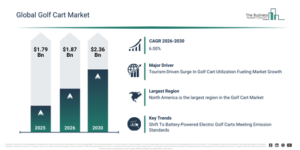
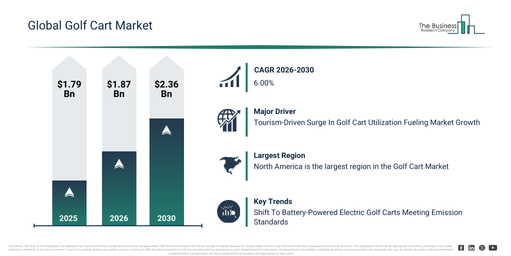
The golf cart market has demonstrated steady expansion in recent years. It is anticipated to increase from $1.79 billion in 2025 to $1.87 billion in 2026, achieving a compound annual growth rate (CAGR) of 4.9%. The growth observed in the historic period stems from the growth of golf tourism, rising golf course development, demand for convenient mobility, increasing leisure activities, and the availability of affordable models.
The golf cart market is anticipated to show considerable expansion over the next few years, projected to reach $2.36 billion by 2030, with a compound annual growth rate (CAGR) of 6.0%. This growth during the forecast period is influenced by the increasing scope of the resort and hospitality sector, the rise of environmentally friendly transport options, the need for personal mobility vehicles, their expanding application in gated communities, and improvements in battery technology. Prominent trends for this period encompass a surge in the embrace of electric golf carts, enhanced personalization and comfort elements, the broader utilization of golf carts beyond golf courses, the spread of solar-powered golf carts, and the incorporation of intelligent monitoring systems.
Download A Free Sample Report For Comprehensive Market Insights:
Golf Cart Market Development Factors: Which Trends Are Supporting Demand?
The increasing use of golf carts in tourism is anticipated to propel the expansion of the golf cart market moving forward. Tourism refers to travel activities that often encompass commercial aspects. Due to their comfort, affordability, and environmental friendliness, golf carts are frequently employed by tourists as a mode of transport for visiting various attractions, including hotels, theme parks, zoos, and museums. Hence, the growing utilization of golf carts in tourism will elevate demand in the golf cart market. Golf carts are a favored mode of transportation for tourists. For instance, in February 2024, the United Nations World Tourism Organization (UNWTO), a Spain-based specialized agency of the United Nations, reported a global estimate of 1,286 billion international tourists in 2023, marking a 34% increase over 2022. Therefore, the heightened deployment of golf carts in tourism is a key driver for the growth of the golf cart market.
Golf Cart Market Segmentation And Category Breakdown
The golf cart market covered in this report is segmented –
1) By Product Type: Push-Pull Golf Cart, Gasoline Golf Cart, Electric Golf Cart, Solar Powered Golf Cart
2) By Operation: Manual, Powered
3) By Ownership: Rented, Fully Owned
4) By Application: Golf Course Use, Personal Use, Commercial Use
Subsegments:
1) By Push-Pull Golf Cart: Manual Push Carts, Pull Carts
2) By Gasoline Golf Cart: Standard Gasoline Golf Carts, High-Performance Gasoline Golf Carts
3) By Electric Golf Cart: Standard Electric Golf Carts, High-Speed Electric Golf Carts
4) By Solar Powered Golf Cart: Solar-Assisted Electric Golf Carts, Fully Solar-Powered Golf Carts
Golf Cart Market Transformation Trends: Which Innovations Are Driving Change?
Companies operating in the golf cart market are concentrating on innovations in electric mobility, such as high-capacity lithium-ion batteries, to enhance driving range and support environmentally friendly transportation. High-capacity lithium-ion batteries are advanced rechargeable power units that store more energy and deliver extended performance compared to traditional lead-acid batteries. For instance, in May 2023, Mansory Design & Holding GmbH, a Germany-based automaker specializing in luxury and specialty vehicle manufacturing, launched an electric golf cart. This cart is approved for use on public roads in both the United States of America and Europe. A 10.24-kilowatt-hour lithium-ion battery pack powers the cart, providing a range of over 50 miles (80 km) on a single charge. Its electric motor produces 10.7 horsepower (8 kilowatts).
Golf Cart Market Competitive Analysis Of Major Industry Participants
Major companies operating in the golf cart market report include Textron Inc., Yamaha Motor Co., Ltd., Club Car, LLC, Marshell Green Power Co., Ltd., Guangdong Lvtong Electric Vehicle Co., Ltd., Suzhou Eagle Electric Vehicle Co., Ltd., HDK EV Co., Ltd., Dongguan Excar Electric Vehicle Co., Ltd., STAR EV Pvt. Ltd., Kandi Technologies Group, Inc., Borcart Golf Cars, Garia A/S, Stewart Golf Cars, Melex Electric Vehicles, Icon Golf Cart, CCE Golf Cars, Mission Golf Cars, King of Carts, Golf Car Worx, Evo Motors
Access The Complete Golf Cart Market Report:
Golf Cart Market Regional Analysis And Leading Geography
North America was the largest region in the golf cart market in 2025. The regions covered in the golf cart market report include Asia-Pacific, South East Asia, Western Europe, Eastern Europe, North America, South America, Middle East, Africa.
Get in touch with us:
The Business Research Company: https://www.thebusinessresearchcompany.com/
Americas: +1 310-496-7795
Asia: +44 7882 955267 & +91 8897263534
Europe: +44 7882 955267
Email us at: marketing@tbrc.info
Follow us on:
LinkedIn: https://in.linkedin.com/company/the-business-research-company
YouTube: https://www.youtube.com/channel/UC24_fI0rV8cR5DxlCpgmyFQ
Global Market Model: https://www.thebusinessresearchcompany.com/global-market-model

Wasay has over a decade of experience in market research, data modelling, and analytics, with prior experience at GlobalData and Decision Tree Consulting Services. At The Business Research Company , he leads research operations across syndicated studies, customized consulting engagements, and the Global Market Model platform. His professional experience includes supporting organizations such as Boston Consulting Group, KPMG, and Ernst & Young. Wasay holds a degree in Electronics and Communications Engineering, postgraduate management qualifications from International Management Institute Belgium and Indian School of Business and Entrepreneurship, and completed the Integrated Program in Business Analytics from Indian Institute of Management Indore.