
Featuring market attractiveness scoring, total addressable market sizing, company benchmarking matrices, interactive Excel dashboards, deeper supply chain intelligence, emerging startup tracking, and granular product-level insights, The Business Research Company’s 2026 market reports are built to deliver research that is both more actionable and more strategically valuable.
Hybrid And Electric Vehicles (EV) Market Revenue Outlook: What CAGR Lies Ahead Through 2030?
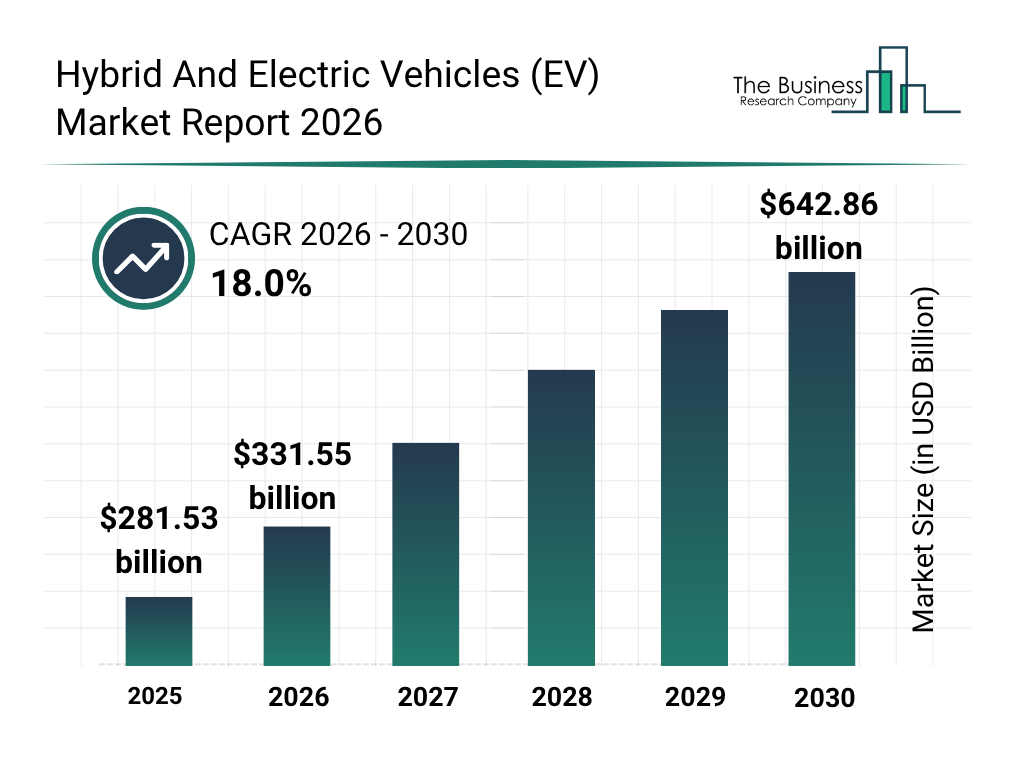
The hybrid and electric vehicles (EV) market size has experienced swift expansion over recent years. It is anticipated to increase from $281.53 billion in 2025 to $331.55 billion in 2026, exhibiting a compound annual growth rate (CAGR) of 17.8%. The historical development can be ascribed to elements like escalating fuel costs and environmental concerns, governmental encouragement for the uptake of hybrid and EV, breakthroughs in battery innovations, a surge in urbanization and the need for mobility, along with an increase in both passenger and commercial vehicle sectors.
The hybrid and electric vehicles (EV) market size is anticipated to experience substantial growth in the upcoming years. It is expected to grow to $642.86 billion by 2030 at a compound annual growth rate (CAGR) of 18.0%. The expansion during the forecast period is attributable to the growth of EV charging networks, the integration of smart mobility solutions, increasing investment in battery recycling and second-life applications, the adoption of connected vehicle technologies, and the rise in commercial fleet electrification. Prominent trends for the forecast period include the increasing adoption of advanced battery management systems, a rising demand for regenerative braking technologies, greater integration of hybrid and electric powertrains, the expansion of EV charging infrastructure and solutions, and an increasing focus on energy efficiency and emission reduction.
Get A Free Sample Report With In-Depth Market Insights:
Hybrid And Electric Vehicles (EV) Market Growth Factors: What’s Supporting Expansion?
Mounting environmental worries concerning carbon emissions are anticipated to fuel the expansion of the hybrid and electric vehicle (EV) market in the future. These environmental concerns specifically pertain to a growing public and regulatory focus on decreasing greenhouse gas emissions, especially CO2 originating from transport, given their detrimental effects on climate change and air quality. The intensification of these worries stems from the substantial impact of vehicle emissions on climate goals, prompting both consumers and policymakers to embrace more sustainable mobility options. The hybrid and electric vehicle (EV) market facilitates this transition by offering low- and zero-emission alternatives, thereby lowering CO2 output linked to transport and aligning with broader sustainability objectives. For example, data from 2023, provided by the European Environment Agency (EEA), an EU environmental body, showed that electric vehicles, encompassing battery electric and plug-in hybrid variants, comprised 23.6% of new passenger car registrations in Europe, an increase from 23.0% in 2022. Consequently, the escalating environmental apprehensions regarding carbon emissions are indeed propelling the expansion of the hybrid and electric vehicle (EV) market.
Hybrid And Electric Vehicles (EV) Market Segment Analysis: What Are The Core Market Categories?
The hybrid and electric vehicles (EV) market covered in this report is segmented –
1) By Vehicle Type: Hybrid Electric Vehicles, Plug In Hybrid Electric Vehicles, Battery Electric Vehicles
2) By Component: Battery, Electric Motor, Transmission, On Board Charger, Other Components
3) By Powertrain: Series, Parallel, Combined
4) By Charging Station Type: Alternating Current Charging, Direct Current Charging
5) By End User: Private, Commercial, Public Transport
Subsegments:
1) By Hybrid Electric Vehicles: Full Hybrid Electric Vehicles, Mild Hybrid Electric Vehicles, Series Hybrid Electric Vehicles, Parallel Hybrid Electric Vehicles, Series Parallel Hybrid Electric Vehicles
2) By Plug In Hybrid Electric Vehicles: Passenger Plug In Hybrid Electric Vehicles, Sport Utility Plug In Hybrid Electric Vehicles, Luxury Plug In Hybrid Electric Vehicles, Light Commercial Plug In Hybrid Electric Vehicles, Performance Plug In Hybrid Electric Vehicles
3) By Battery Electric Vehicles: Passenger Battery Electric Vehicles, Sport Utility Battery Electric Vehicles, Light Commercial Battery Electric Vehicles, Heavy Commercial Battery Electric Vehicles, Luxury Battery Electric Vehicles
Hybrid And Electric Vehicles (EV) Market Industry Trends: What’s Reshaping Demand?
Leading firms within the hybrid and electric vehicles (EV) market are concentrating on creating sophisticated plug-in hybrid electric vehicle (PHEV) innovations, including integrated PHEV propulsion systems, aimed at boosting electric-only driving performance, expanding vehicle range, and optimizing overall energy efficiency. These PHEV systems integrate rechargeable lithium-ion batteries with internal combustion engines, facilitating low-emission travel by utilizing electric-only power for shorter journeys and hybrid functionality for longer trips, thereby supporting both ecological goals and user adaptability. As an illustration, in December 2024, Toyota Motor Corporation, an automotive manufacturer from Japan, unveiled its Alphard and Vellfire plug-in hybrid electric vehicle models, which are outfitted with a 2.5-liter PHEV system. These specific models provide an electric driving range of approximately 73 km, permit rapid charging to approximately 80% in about 38 minutes, and incorporate vehicle-to-home (V2H) functionality, enabling the vehicle’s battery to provide power to homes during critical situations. Such innovations contribute to greater energy efficiency, boost the adoption of electrification, and elevate the overall functionality of vehicles.
Hybrid And Electric Vehicles (EV) Market Competitive Landscape: Which Companies Lead The Industry?
Major companies operating in the hybrid and electric vehicles (EV) market are Toyota Motor Corporation, Bayerische Motoren Werke AG, Mercedes-Benz Group AG, Hyundai Motor Company, SAIC Motor Corporation Limited, Nissan Motor Co. Ltd., BYD Company Limited, Kia Corporation, Tata Motors Limited, Li Auto Inc., NIO Inc., Zeekr Automotive Co. Ltd., Rivian Automotive Inc., XPeng Inc., Polestar Automotive Holding UK Ltd., Leapmotor Technology Co. Ltd., VinFast, EKA Mobility Private Limited, Faraday Future Inc., Lucid Group Inc., Ola Electric Mobility Pvt. Ltd., Arrival Ltd., Fisker Inc., Hero Electric Vehicles Pvt. Ltd., Ather Energy Private Limited.
View The Full Hybrid And Electric Vehicles (EV) Market Report:
Hybrid And Electric Vehicles (EV) Market Regional Breakdown: Where Is Demand Concentrated?
North America was the largest region in the hybrid and electric vehicles (EV) market in 2025. Asia-Pacific is expected to be the fastest-growing region in the forecast period. The regions covered in the hybrid and electric vehicles (EV) market report are Asia-Pacific, South East Asia, Western Europe, Eastern Europe, North America, South America, Middle East, Africa.
Reach Out To Our Team:
The Business Research Company: https://www.thebusinessresearchcompany.com/
Americas: +1 310-496-7795
Asia: +44 7882 955267 & +91 8897263534
Europe: +44 7882 955267
Email us at: marketing@tbrc.info
Follow us on:
LinkedIn: https://in.linkedin.com/company/the-business-research-company
YouTube: https://www.youtube.com/channel/UC24_fI0rV8cR5DxlCpgmyFQ
Global Market Model: https://www.thebusinessresearchcompany.com/global-market-model

Wasay has over a decade of experience in market research, data modelling, and analytics, with prior experience at GlobalData and Decision Tree Consulting Services. At The Business Research Company , he leads research operations across syndicated studies, customized consulting engagements, and the Global Market Model platform. His professional experience includes supporting organizations such as Boston Consulting Group, KPMG, and Ernst & Young. Wasay holds a degree in Electronics and Communications Engineering, postgraduate management qualifications from International Management Institute Belgium and Indian School of Business and Entrepreneurship, and completed the Integrated Program in Business Analytics from Indian Institute of Management Indore.