
Enhanced with market attractiveness analysis, total addressable market evaluation, company benchmarking matrices, interactive Excel dashboards, expanded supply chain intelligence, emerging startup coverage, and detailed product insights, The Business Research Company’s 2026 market reports deliver more actionable and strategically valuable research.
Optical Fiber In-Vehicle Network Market Growth Potential: How Will Market Size Change Through 2030?
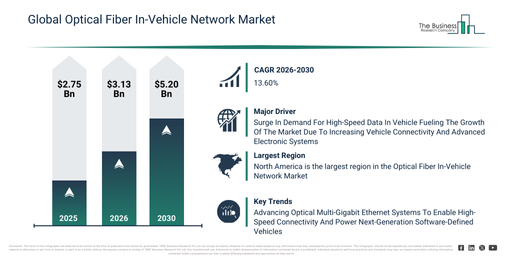
The optical fiber in-vehicle network market has experienced rapid expansion recently. It is projected to grow from $2.75 billion in 2025 to $3.13 billion in 2026, demonstrating a compound annual growth rate (CAGR) of 13.8%. The historical growth can be attributed to several factors, including the increasing demand for high-speed data transmission, the growing adoption of electric vehicles, the rising need for vehicle safety systems, the expansion of infotainment features, and the increasing complexity of vehicle electronics.
The optical fiber in-vehicle network market is anticipated to experience significant expansion in the coming years. This market is projected to reach a value of $5.20 billion by 2030, exhibiting a compound annual growth rate (CAGR) of 13.6%. The upward trend during the forecast period is primarily driven by the increasing adoption of autonomous vehicles, the broader integration of Ethernet and most-based networks, escalating investments in smart transportation systems, the expansion of connected vehicle platforms, and the rising need for interference-free in-vehicle networks. Prominent trends expected in this period include technological improvements in optical fiber materials, breakthroughs in high-speed communication protocols, the development of compact and lightweight network components, dedicated research and development in ADAS and safety systems, and advancements in vehicle-to-everything (V2X) communication.
Download A Free Sample Report For Comprehensive Market Insights:
Optical Fiber In-Vehicle Network Market Expansion Supported By Key Demand Factors
The rising need for high-speed data within vehicles is projected to drive the expansion of the optical fiber in-vehicle network market in the coming years. High-speed in-vehicle data transmission refers to the requirement for rapid, high-bandwidth data exchange among sensors, control units, infotainment systems, cameras, and communication modules within vehicles, reflecting the increasing complexity of modern automotive electronic architectures. This surge in demand for high-speed data in vehicles is attributed to the growing integration of advanced driver assistance systems and connected vehicle technologies that necessitate low-latency and high-bandwidth communication. The optical fiber in-vehicle network supports high-speed data in vehicle by providing high-bandwidth, low-latency, and interference-free data transfer essential for seamless vehicle system communication. For instance, in March 2024, according to the International Telecommunication Union, a Switzerland-based specialized agency of the United Nations for information and communication technologies, China recorded a 78.31% vehicle network connection penetration rate for new passenger cars in 2023, with vehicles equipped with 5G modules rising sharply to 1,737,300 from 466,400 in 2022 and those fitted with Long Term Evolution Vehicle to Everything (LTE-V2X) PC5 modules increasing to 311,300 from 170,000 year on year. Consequently, the escalating demand for high-speed data in vehicles is fueling the growth of the optical fiber in-vehicle network market. The increasing prevalence of electric and autonomous vehicles is anticipated to drive the expansion of the optical fiber in-vehicle network market in the future. Electric and autonomous vehicles are automobiles that rely on electric powertrains and advanced self-driving technologies, requiring complex electronic architectures and real-time data processing. The growth in electric and autonomous vehicles stems from increasing pressure to reduce emissions and enhance road safety via more environmentally friendly and intelligent transport methods. Optical fiber in-vehicle networks assist these vehicles by facilitating swift, low-latency, and uninterrupted data flow among cameras, sensors, control units, and infotainment systems, which is vital for secure and effective vehicle functioning. For instance, in May 2025, data from the International Energy Agency (IEA), a France-based intergovernmental organization, showed that global electric car sales surpassed 17 million in 2024, making up over 20 percent of all car sales, with 3.5 million more electric cars sold compared to 2023. Furthermore, sales in 2025 are projected to exceed 20 million worldwide, representing more than one-quarter of cars sold, after a 35 percent year-on-year increase in the first quarter across all significant markets. Thus, the proliferation of electric and autonomous vehicles is propelling the growth of the optical fiber in-vehicle network market.
Optical Fiber In-Vehicle Network Market Segment Breakdown: Which Categories Generate The Most Revenue?
The optical fiber in-vehicle network market covered in this report is segmented –
1) By Product Type: Optical Fiber Cables, Optical Transceivers, Fiber Connectors, Network Control Modules, Optical Signal Amplifiers
2) By Material Type: Plastic Optical Fiber (POF), Glass Optical Fiber (GOF)
3) By Vehicle Type: Passenger Cars, Commercial Vehicles, Electric Vehicles, Autonomous Vehicles
4) By Mode: Multi-Mode Fiber (MMF), Single-Mode Fiber (SMF)
5) By Application End Use Function: Advanced Driver Assistance Systems, High Resolution Sensor Data Transmission, Real Time Data Processing, Infotainment Systems, High Definition Video And Audio Streaming, Telematics And Navigation, Safety And Security Systems
Subsegments:
1) By Optical Fiber Cables: Single Mode Optical Fiber Cable, Multi Mode Optical Fiber Cable, Plastic Optical Fiber Cable, Armored Optical Fiber Cable, Ribbon Optical Fiber Cable
2) By Optical Transceivers: Bidirectional Optical Transceiver, Unidirectional Optical Transceiver, Wavelength Division Multiplexed Optical Transceiver, Small Form Factor Optical Transceiver, High Speed Optical Transceiver
3) By Fiber Connectors: LC Fiber Connector, SC Fiber Connector, ST Fiber Connector, MTP Fiber Connector, FC Fiber Connector
4) By Network Control Modules: Optical Switch Module, Media Converter Module, Network Management Module, Data Multiplexer Module, Signal Routing Module
5) By Optical Signal Amplifiers: Erbium Doped Optical Amplifier, Raman Optical Amplifier, Semiconductor Optical Amplifier, Fiber Line Optical Amplifier, Booster Optical Amplifier
Optical Fiber In-Vehicle Network Market Key Players And Strategic Industry Positioning
Major companies operating in the optical fiber in-vehicle network market are Sumitomo Electric Industries Ltd., Toray Industries Inc., Prysmian S.p.A., TE Connectivity Ltd., Yazaki Corporation, Corning Incorporated, Amphenol Corporation, Molex LLC, Nexans S.A., Furukawa Electric Co., Hengtong Group Co. Ltd., Leoni AG, Fujikura Ltd., Rosenberger Hochfrequenztechnik GmbH & Co. KG, Belden Inc., Yangtze Optical Fibre and Cable Joint Stock Limited Company (YOFC), BizLink Holding Inc., HUBER+SUHNER AG, Acome Group, ZTT Group, Hitachi Cable
Access The Complete Optical Fiber In-Vehicle Network Market Report:
Optical Fiber In-Vehicle Network Market Regional Analysis And Leading Geography
North America was the largest region in the optical fiber in-vehicle network market in 2025. Asia-Pacfic is expected to be the fastest-growing region in the forecast period. The regions covered in the optical fiber in-vehicle network market report are Asia-Pacific, South East Asia, Western Europe, Eastern Europe, North America, South America, Middle East, Africa.
Get in touch with us:
The Business Research Company: https://www.thebusinessresearchcompany.com/
Americas: +1 310-496-7795
Asia: +44 7882 955267 & +91 8897263534
Europe: +44 7882 955267
Email us at: marketing@tbrc.info
Follow us on:
LinkedIn: https://in.linkedin.com/company/the-business-research-company
YouTube: https://www.youtube.com/channel/UC24_fI0rV8cR5DxlCpgmyFQ
Global Market Model: https://www.thebusinessresearchcompany.com/global-market-model

Wasay has over a decade of experience in market research, data modelling, and analytics, with prior experience at GlobalData and Decision Tree Consulting Services. At The Business Research Company , he leads research operations across syndicated studies, customized consulting engagements, and the Global Market Model platform. His professional experience includes supporting organizations such as Boston Consulting Group, KPMG, and Ernst & Young. Wasay holds a degree in Electronics and Communications Engineering, postgraduate management qualifications from International Management Institute Belgium and Indian School of Business and Entrepreneurship, and completed the Integrated Program in Business Analytics from Indian Institute of Management Indore.