Featuring market attractiveness scoring, total addressable market sizing, company benchmarking matrices, interactive Excel dashboards, deeper supply chain intelligence, emerging startup tracking, and granular product-level insights, The Business Research Company’s 2026 market reports are built to deliver research that is both more actionable and more strategically valuable.
Propulsion Systems Market Value Analysis: What Growth Lies Ahead Over The Forecast Period?
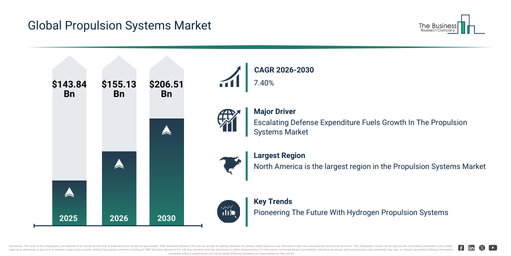
The propulsion systems market size has grown strongly in recent years. It will grow from $143.84 billion in 2025 to $155.13 billion in 2026 at a compound annual growth rate (CAGR) of 7.8%. The growth in the historic period can be attributed to expansion of space exploration programs, growth in satellite deployment activities, increased defense spending on missile systems, advancements in propulsion material science, rising investments in aerospace research.
The propulsion systems market size is expected to see strong growth in the next few years. It will grow to $206.51 billion in 2030 at a compound annual growth rate (CAGR) of 7.4%. The growth in the forecast period can be attributed to increasing commercialization of space missions, rising demand for small satellite launch systems, expansion of deep space exploration initiatives, growing focus on sustainable propulsion fuels, increasing adoption of electric propulsion for spacecraft. Major trends in the forecast period include increasing development of advanced rocket and spacecraft engines, rising adoption of electric and hybrid propulsion technologies, growing focus on high-thrust and fuel-efficient systems, expansion of reusable launch vehicle propulsion, enhanced integration of digital simulation and testing.
Get A Free Sample Report With In-Depth Market Insights:
Propulsion Systems Market Growth Factors: What’s Supporting Expansion?
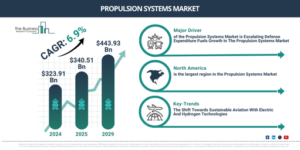
Rising defense expenditure is expected to propel the growth of the propulsion systems market going forward. Defense expenditure refers to the amount that a country spends on military measures or resources. Increasing defense expenditure is expected to boost demand for propulsion systems, as they play an integral role in various products such as rockets, unmanned aerial vehicles, satellite rockets, aircraft, and others. For instance, in April 2024, according to the Stockholm International Peace Research Institute (SIPRI), a Sweden based defense think tank, global military expenditure rose to US$ 2,443 billion in 2023, a 6.8% increase compared with 2022. Therefore, rising defense expenditure is expected to boost demand for the propulsion systems market during the forecast period.
Propulsion Systems Market Segments: Where Is Growth Concentrated?
The propulsion systems market covered in this report is segmented –
1) By Type: Air Breathing, Non-Air Breathing
2) By Application: Airplanes, Missiles, Unnamed Aerial Vehicles, Spacecraft
3) By End-User: Commercial, Government & Military
Subsegments:
1) By Air Breathing: Turbojet, Turbofan, Ramjet, Scramjet
2) By Non-Air Breathing: Liquid Propellant, Solid Propellant, Hybrid Propellant, Electric Propulsion
Propulsion Systems Market Industry Trends: What’s Reshaping Demand?
Major companies operating in the propulsion systems market are increasing their focus on introducing hydrogen propulsion systems to gain a competitive edge in the market. Hydrogen propulsion systems use hydrogen as a fuel source to generate power for driving various types of machinery and vehicles. For instance, in December 2023, Marelli Europe S.p.A., an Italy-based company, launched an advanced hydrogen propulsion system. This new system includes specific injectors with patented designs and an advanced engine control unit that is specifically designed for hydrogen engines. These engines are similar to traditional endothermic engines but use hydrogen as fuel, resulting in no CO2 emissions. The Marelli fuel system meets the strict requirements of these engines, ensuring precision, efficiency, performance, easy integration, and complexity reduction.
Propulsion Systems Market Key Participants And Competitive Landscape
Major companies operating in the propulsion systems market report include General Electric Company, Raytheon Technologies Corporation, The Boeing Company, Airbus SE, Northrop Grumman Corporation, Honeywell International Inc., Mitsubishi Heavy Industries Ltd., Safran S.A., L3Harris Technologies Inc., Rolls-Royce Holdings plc, Thales Alenia Space, IHI Corporation, Space Exploration Technologies Corp, Rafael Advanced Defense Systems Ltd., Moog Inc., Aerojet Rocketdyne Holdings Inc., OHB System AG, VACCO Industries Inc., Sitael S.p.A., CFM International, MSNW LLC, Busek Co Inc., Ad Astra Rocket Company, 3W International GmbH, Accion Systems Inc., CU Aerospace LLC, Ariane Group
View The Full Propulsion Systems Market Report:
Propulsion Systems Market Regional Analysis: Which Geography Leads On Revenue?
North America was the largest region in the propulsion systems market in 2025. Asia-Pacific is expected to be the fastest-growing region in the forecast period. The regions covered in the propulsion systems market report include Asia-Pacific, South East Asia, Western Europe, Eastern Europe, North America, South America, Middle East, Africa.
Reach Out To Our Team:
The Business Research Company: https://www.thebusinessresearchcompany.com/
Americas: +1 310-496-7795
Asia: +44 7882 955267 & +91 8897263534
Europe: +44 7882 955267
Email us at: marketing@tbrc.info
Follow us on:
LinkedIn: https://in.linkedin.com/company/the-business-research-company
YouTube: https://www.youtube.com/channel/UC24_fI0rV8cR5DxlCpgmyFQ
Global Market Model: https://www.thebusinessresearchcompany.com/global-market-model

Wasay has over a decade of experience in market research, data modelling, and analytics, with prior experience at GlobalData and Decision Tree Consulting Services. At The Business Research Company , he leads research operations across syndicated studies, customized consulting engagements, and the Global Market Model platform. His professional experience includes supporting organizations such as Boston Consulting Group, KPMG, and Ernst & Young. Wasay holds a degree in Electronics and Communications Engineering, postgraduate management qualifications from International Management Institute Belgium and Indian School of Business and Entrepreneurship, and completed the Integrated Program in Business Analytics from Indian Institute of Management Indore.