
Delivering more actionable and strategically valuable research, The Business Research Company’s 2026 market reports feature market attractiveness analysis, total addressable market evaluation, company benchmarking matrices, interactive Excel dashboards, expanded supply chain intelligence, emerging startup coverage, and detailed product insights.
Reach Stacker Market Growth Potential: How Will Market Size Change Through 2030?
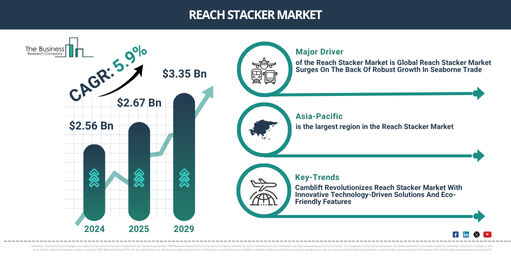
The reach stacker market has experienced robust growth in recent years. It is anticipated to increase from $2.67 billion in 2025 to $2.82 billion in 2026, showing a compound annual growth rate (CAGR) of 5.7%. In the past, this growth was driven by the expansion of containerized trade volumes, the development of port and terminal infrastructure, rising demand for intermodal logistics, increasing utilization of heavy-duty material handling equipment, and the availability of diesel-powered reach stackers.
The reach stacker market is anticipated to experience substantial growth in the forthcoming years. It is projected to expand to $3.56 billion by 2030, exhibiting a compound annual growth rate (CAGR) of 6.0%. This expansion over the forecast period is primarily driven by increasing investments in smart ports, the rising adoption of low-emission terminal equipment, the expansion of inland container depots, a growing demand for automation in yards, and an increasing focus on reducing operational costs. Key trends observed in this period include the rising adoption of electric and hybrid reach stackers, increasing integration of telematics and fleet monitoring, a growing demand for high-capacity container handling, the expansion of automated port operations, and an enhanced emphasis on fuel efficiency.
Download A Free Sample Report For Comprehensive Market Insights:
Reach Stacker Market Demand Drivers: What Is Fueling Industry Growth?
The global surge in seaborne trade is poised to boost the reach stacker market moving forward. Seaborne trade refers to the shipment of goods by sea, with the trade balance reflecting the disparity between the quantities of goods loaded and discharged, a factor intrinsically linked to the transit policies, businesses, and infrastructure of other nations. Reach stacker vehicles are utilized at sea terminals and ports for transporting intermodal cargo containers and facilitating seaborne trade. The expanding utilization of reach stackers benefits consumers worldwide through reduced freight expenses, enhanced efficiency in shipping logistics, and greater economic openness. For example, in October 2023, the United Nations Conference on Trade and Development (UNCTAD), an international organization based in Switzerland, reported a projected 2.4% growth in maritime trade volume for 2023, recovering from a 0.4% contraction in 2022. Hence, the worldwide growth in seaborne trade is a significant driver for the reach stacker market.
Reach Stacker Market Segments: Where Are The Largest Growth Opportunities?
The reach stacker market covered in this report is segmented –
1) By Capacity: Below 30 Ton, 30-45 Ton, Above 45 Ton
2) By Propulsion: Internal Combustion Engine, Electric, Hybrid
3) By Application: Sea Port Or Terminal, Yards Or Landside, Industrial
Subsegments:
1) By Below 30 Ton: Small Reach Stackers, Compact Models
2) By 30-45 Ton: Medium Reach Stackers, Standard Models
3) By Above 45 Ton: Heavy-Duty Reach Stackers, Specialized Models For Industrial Use
Reach Stacker Market Innovation Trends: Which Developments Are Transforming The Industry?
Leading companies within the reach stacker market are prioritizing innovative offerings, such as reach stackers, to enhance their revenue. This specialized industrial vehicle serves the purpose of handling and moving intermodal containers across shipping yards, ports, and various logistics facilities. An illustrative example is Konecranes PLC, a Finnish entity recognized for its expertise in producing lifting equipment and services, which introduced its reach stacker product in March 2023. The Liftace range of reach stackers is designed with compatibility for modern drive technology and advanced control systems in mind. Their considerable loading capacity and rapid operational speeds make them suitable for application in ports, railroads, intermodal terminals, container stackyards, and similar logistical environments. These reach stackers are constructed to endure the demands of professional freight handling, offering a lifting range between 10 to 46 tons. They are well-regarded for their superior quality, robust construction, and consistent dependability.
Reach Stacker Market Major Participants And Competitive Dynamics
Major companies operating in the reach stacker market report include Cargotec Corporation, Komatsu Ltd., Dalian Forklift Co. Ltd., Hoist Material Handling Inc., Hyster-Yale Group Inc., Konecranes Oyj, Liebherr Group, Linde Material Handling GmbH, CVS ferrari S.P.A, SANY Group, Task Forklift, Hangcha Forklift, CTR Manufacturing Industries Private Limited, Toyota Material Handling Group, Kalmar, Terex Corporation, Taylor Machine Works Inc., Anhui Heli Co. Ltd., Lonking Holdings Limited, Manitou Group, Doosan Corporation Industrial Vehicle, Hyundai Heavy Industries Co. Ltd., Jungheinrich AG
Access The Complete Reach Stacker Market Report:
Reach Stacker Market Geographic Analysis: Where Is Demand Growing The Fastest?
Asia-Pacific was the largest region in the reach stacker market in 2025. The regions covered in the reach stacker market report include Asia-Pacific, South East Asia, Western Europe, Eastern Europe, North America, South America, Middle East, Africa.
Get in touch with us:
The Business Research Company: https://www.thebusinessresearchcompany.com/
Americas: +1 310-496-7795
Asia: +44 7882 955267 & +91 8897263534
Europe: +44 7882 955267
Email us at: marketing@tbrc.info
Follow us on:
LinkedIn: https://in.linkedin.com/company/the-business-research-company
YouTube: https://www.youtube.com/channel/UC24_fI0rV8cR5DxlCpgmyFQ
Global Market Model: https://www.thebusinessresearchcompany.com/global-market-model

Wasay has over a decade of experience in market research, data modelling, and analytics, with prior experience at GlobalData and Decision Tree Consulting Services. At The Business Research Company , he leads research operations across syndicated studies, customized consulting engagements, and the Global Market Model platform. His professional experience includes supporting organizations such as Boston Consulting Group, KPMG, and Ernst & Young. Wasay holds a degree in Electronics and Communications Engineering, postgraduate management qualifications from International Management Institute Belgium and Indian School of Business and Entrepreneurship, and completed the Integrated Program in Business Analytics from Indian Institute of Management Indore.