
Enhanced with market attractiveness analysis, total addressable market evaluation, company benchmarking matrices, interactive Excel dashboards, expanded supply chain intelligence, emerging startup coverage, and detailed product insights, The Business Research Company’s 2026 market reports deliver more actionable and strategically valuable research.
Regenerative Braking Systems Market Size Outlook: How Fast Will Revenue Grow Through 2030?
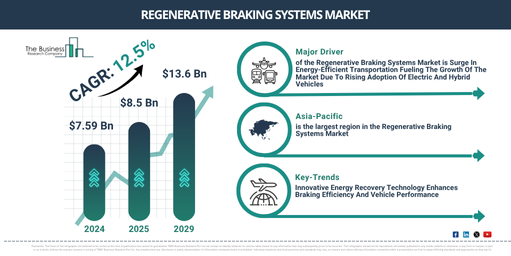
The regenerative braking systems market has experienced rapid expansion in recent years. It is forecast to rise from $8.5 billion in 2025 to $9.56 billion in 2026, at a compound annual growth rate (CAGR) of 12.5%. This growth in the historic period can be ascribed to the expansion of electric vehicle production, an increasing demand for energy-efficient vehicle systems, enhancements in battery technologies, the adoption of hybrid vehicles, and advancements in power electronics.
The regenerative braking systems market is anticipated to experience substantial growth in the coming years, with its size projected to reach $15.3 billion by 2030, demonstrating a compound annual growth rate (CAGR) of 12.5%. This expansion during the forecast period can be attributed to factors such as the increasing widespread use of electric mobility, a growing demand for extended vehicle range, the broadening of autonomous vehicle platforms, increasing investments in the electrification of vehicles, and an enhanced focus on optimizing energy efficiency. Key trends expected over this period include advancements in energy recovery efficiency, the integration with sophisticated battery management systems, a rising adoption in electric and hybrid vehicles, the development of high-performance power electronics, and improved software-based braking control.
Download A Free Sample Report For Comprehensive Market Insights:
Regenerative Braking Systems Market Growth Drivers: What Factors Are Accelerating Expansion?
The increasing need for energy-efficient transportation methods is expected to boost the regenerative braking systems market. These transportation solutions refer to vehicles and systems designed to consume less energy during travel, thereby reducing fuel consumption and emissions. Common examples include electric vehicles, hybrid vehicles, electric buses, and electric trains. This escalating demand is primarily driven by heightened environmental concerns and the rising costs of fossil fuels. As awareness regarding climate change and air pollution grows, individuals and governments are increasingly seeking ways to lessen carbon emissions and their ecological footprint, leading to a shift towards cleaner, energy-efficient transport options. Regenerative braking systems contribute to energy-efficient transportation by capturing and converting the kinetic energy, typically lost as heat during braking, into electrical energy. For instance, in March 2025, the International Energy Agency, a France-based intergovernmental organization monitoring global energy use, reported that global electric car sales exceeded 17 million in 2024, marking a substantial increase compared to 2023, largely attributed to the embrace of energy-efficient transportation solutions. Ultimately, the expanding demand for energy-efficient transportation solutions is a primary driver behind the growth of the regenerative braking systems market.
Regenerative Braking Systems Market Segment Breakdown: Which Categories Generate The Most Revenue?
The regenerative braking systems market covered in this report is segmented –
1) By Component: Battery, Motor, Electronic Control Unit (ECU), Flywheel
2) By Propulsion: Battery Electric Vehicle (BEV), Plug-In Hybrid Electric Vehicle (PHEV), Fuel Cell Electric Vehicle (FCEV)
3) By Vehicle Type: Passenger Car (PC), Light Commercial Vehicle (LCV), Heavy Commercial Vehicle (HCV)
Subsegments:
1) By Battery: Lithium-Ion Battery, Nickel-Metal Hydride Battery, Lead Acid Battery, Solid-State Battery
2) By Motor: Permanent Magnet Synchronous Motor (PMSM), Induction Motor, Switched Reluctance Motor, Axial Flux Motor
3) By Electronic Control Unit (ECU): Motor Control Electronic Control Unit (ECU), Battery Management Electronic Control Unit (ECU), Integrated Control Electronic Control Unit (ECU), Adaptive Control Electronic Control Unit (ECU)
4) By Flywheel: Composite Flywheel, Steel Flywheel, Carbon Fiber Flywheel, High-Speed Flywheel
Regenerative Braking Systems Market Trends: What Is Shaping Future Industry Growth?
Prominent companies within the regenerative braking systems market are channeling their efforts into developing inventive technological products, such as sophisticated energy recovery technology, with the aim of improving both braking efficiency and the regeneration of energy. Sophisticated energy recovery technology is a mechanism that collects and repurposes energy typically lost during braking, thereby enhancing overall efficiency. It offers advantages such as conserving vehicle power, extending the potential driving range, and minimizing brake wear. For instance, in September 2024, Cummins Inc., a US-based public manufacturing company, unveiled the integrated brake chopper & resistor (iBCR), which is a new endurance braking system designed to bolster the safety and operational efficiency of commercial electric vehicles. This pioneering system optimized braking capabilities by embedding advanced energy recovery technology, enabling vehicles to capture and reuse braking energy with greater effectiveness.
Regenerative Braking Systems Market Key Players And Strategic Industry Positioning
Major companies operating in the regenerative braking systems market report include Volkswagen AG, General Motors Company, Honda Motor Co Ltd, SAIC Motor Corporation Limited, Hyundai Motor Company, Robert Bosch GmbH, Tesla Inc, Nissan Motor Co Ltd, Kia Corporation, BYD Company Limited, Tata Motors Limited, Renault Group, Volvo Group, Denso Corporation, Continental AG, Mitsubishi Electric Corporation, Mazda Motor Corporation, Suzuki Motor Corporation, Subaru Corporation, Aisin Corporation, Geely Automobile Holdings Limited, Mitsubishi Motors Corporation, Stellantis NV, Toyota Motor Corporation, Mahindra and Mahindra Limited, BorgWarner Inc, Hitachi Astemo Ltd
Access The Complete Regenerative Braking Systems Market Report:
Regenerative Braking Systems Market Geographic Analysis: Where Is Demand Growing The Fastest?
Asia-Pacific was the largest region in the regenerative braking systems market in 2025. North America is expected to be the fastest-growing region in the forecast period. The regions covered in the regenerative braking systems market report include Asia-Pacific, South East Asia, Western Europe, Eastern Europe, North America, South America, Middle East, Africa.
Get in touch with us:
The Business Research Company: https://www.thebusinessresearchcompany.com/
Americas: +1 310-496-7795
Asia: +44 7882 955267 & +91 8897263534
Europe: +44 7882 955267
Email us at: marketing@tbrc.info
Follow us on:
LinkedIn: https://in.linkedin.com/company/the-business-research-company
YouTube: https://www.youtube.com/channel/UC24_fI0rV8cR5DxlCpgmyFQ
Global Market Model: https://www.thebusinessresearchcompany.com/global-market-model

Wasay has over a decade of experience in market research, data modelling, and analytics, with prior experience at GlobalData and Decision Tree Consulting Services. At The Business Research Company , he leads research operations across syndicated studies, customized consulting engagements, and the Global Market Model platform. His professional experience includes supporting organizations such as Boston Consulting Group, KPMG, and Ernst & Young. Wasay holds a degree in Electronics and Communications Engineering, postgraduate management qualifications from International Management Institute Belgium and Indian School of Business and Entrepreneurship, and completed the Integrated Program in Business Analytics from Indian Institute of Management Indore.