Enhanced with market attractiveness analysis, total addressable market evaluation, company benchmarking matrices, interactive Excel dashboards, expAnded supply chain intelligence, emerging startup coverage, And detailed product insights, The Business Research Company’s 2026 market reports deliver more actionable And strategically valuable research.
Robo Taxis Market Growth Potential: How Will Market Size Change Through 2030?
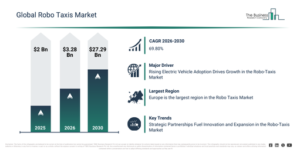
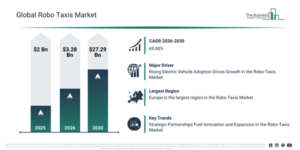
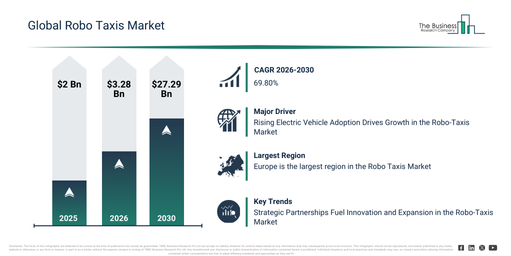
The robo taxis market has seen its size expAnd exponentially over recent years. The market is forecast to increase from $2 billion in 2025 to reach $3.28 billion in 2026, demonstrating a compound annual growth rate (CAGR) of 64.4%. Key drivers for this historical growth include progress in autonomous driving technologies, the development of shared mobility platforms, the mounting challenges of urban congestion, the accessibility of ADAS-enabled vehicles, And the broader expansion of electric vehicle infrastructure.
The robo taxis market is projected for significant expansion in the coming years, anticipated to reach $27.29 billion by 2030, demonstrating a robust compound annual growth rate (CAGR) of 69.8%. This growth during the forecast period stems from increasing regulatory approvals for autonomous transport, rising investments in autonomous fleet operations, the expansion of smart city mobility programs, a growing demAnd for cost-efficient urban transport, And increasing integration of v2x communication systems. Prominent trends expected during this period involve more pilot deployments of autonomous ride-hailing services, rising integration of advanced sensor fusion systems, a growing adoption of electric robo-taxi fleets, the expansion of urban mobility-as-a-service models, And an enhanced focus on passenger safety And redundancy.
Download A Free Sample Report For Comprehensive Market Insights:
Robo Taxis Market Growth Momentum: Which Factors Are Influencing DemAnd?
The expansion of the robo-taxis market is projected to be propelled by an increase in the manufacturing And sales of electric vehicles moving forward. Electric vehicles are motor-driven conveyances that draw power from a battery, rechargeable from an external source. The integration of EVs into the robo-taxi sector contributes positively to environmental sustainability, mitigates air pollution, And encourages the wider adoption of connected-car features. For example, according to a report from January 2024, published by Kelley Blue Book, a US-based Cox Automotive company, a record 1.2 million car buyers in the United States chose electric vehicles in 2023, representing 7.6% of the entire U.S. vehicle market, an increase from 5.9% in 2022. Thus, the growing production And sales of electric vehicles are driving the growth of the robo-taxis market.
Robo Taxis Market Segment Analysis And Revenue Opportunities
The robo taxis market covered in this report is segmented –
1) By Component Type: Camera, Radar, LiDAR, Ultrasonic Sensors, Other Component Types
2) By Service Type: Car Rental, Station Based
3) By Propulsion: Electric, Hybrid
4) By Application: Goods Transportation, Passenger Transportation
Subsegments:
1) By Camera: Monocular Cameras, Stereo Cameras, Thermal Cameras
2) By Radar: Short-Range Radar, Long-Range Radar
3) By LiDAR: 2D LiDAR, 3D LiDAR
4) By Ultrasonic Sensors: Proximity Sensors, Parking Assist Sensors
5) By Other Component Types: GPS And Navigation Systems, Inertial Measurement Units (IMUs), Communication Modules (V2X), Processing Units (ECUs)
Robo Taxis Market Trends Reshaping Industry Growth
Major companies in the robo-taxis market are forming strategic alliances to enhance their market position And expAnd their geographic presence. Strategic partnerships are collaborative arrangements established between two or more organizations to achieve specific business objectives or goals. Such partnerships among key industry players are stimulating innovation And widening the adoption of robo-taxis. For instance, in August 2023, Pony.ai, a leading global autonomous driving technology company, entered into a joint venture with Toyota Motor Investment Co Ltd (TMCI), a Japan-based automotive manufacturer, And GAC Toyota Motor Co Ltd. (GTMC), a China-based automobile manufacturing company, to accelerate the mass production And deployment of driverless robotaxis. Under this agreement, GTMC will supply Pony.ai with Toyota-brAnded battery electric vehicles suitable for Level 4 autonomous driving. These vehicles will be equipped with Pony.ai’s autonomous driving technology And will operate on its PonyPilot+ robotaxi network platform.
Robo Taxis Market Leading Players Shaping Industry Direction
Major companies operating in the robo taxis market report include Waymo LLC, AutoX Inc., Tesla Inc., Baidu Inc., General Motors Company, Lyft Inc., Nissan Motor Corporation, NAVYA Group, Ford Motor Company, Mercedes-Benz Group AG, Bayerische Motoren Werke AG, Volkswagen AG, EasyMile SAS, Ridecell Inc., Nvidia Corporation, AB Volvo, Uber Technologies Inc., Aptiv plc, Beijing Xiaoju Technology Co. Ltd., MOIA GmbH, Zoox Inc., Aurora Innovation Inc., May Mobility Inc., Optimus Ride Inc., Voyage Auto Inc., Pony ai Inc., Nuro Inc., FiveAI Inc., Oxbotica Ltd.
Access The Complete Robo Taxis Market Report:
Robo Taxis Market Geographic LAndscape: Which Region Dominates Industry Growth?
Europe was the largest region in the robo taxis market in 2025. Asia-Pacific is expected to be the fastest-growing region in the robo taxis market during the forecast period. The regions covered in the robo taxis market report include Asia-Pacific, South East Asia, Western Europe, Eastern Europe, North America, South America, Middle East, Africa.
Get in touch with us:
The Business Research Company: https://www.thebusinessresearchcompany.com/
Americas: +1 310-496-7795
Asia: +44 7882 955267 & +91 8897263534
Europe: +44 7882 955267
Email us at: marketing@tbrc.info
Follow us on:
LinkedIn: https://in.linkedin.com/company/the-business-research-company
YouTube: https://www.youtube.com/channel/UC24_fI0rV8cR5DxlCpgmyFQ
Global Market Model: https://www.thebusinessresearchcompany.com/global-market-model

Wasay has over a decade of experience in market research, data modelling, and analytics, with prior experience at GlobalData and Decision Tree Consulting Services. At The Business Research Company , he leads research operations across syndicated studies, customized consulting engagements, and the Global Market Model platform. His professional experience includes supporting organizations such as Boston Consulting Group, KPMG, and Ernst & Young. Wasay holds a degree in Electronics and Communications Engineering, postgraduate management qualifications from International Management Institute Belgium and Indian School of Business and Entrepreneurship, and completed the Integrated Program in Business Analytics from Indian Institute of Management Indore.