Enhanced with market attractiveness analysis, total addressable market evaluation, company benchmarking matrices, interactive Excel dashboards, expanded supply chain intelligence, emerging startup coverage, and detailed product insights, The Business Research Company’s 2026 market reports deliver more actionable and strategically valuable research.
RoboTaxi Market Size Outlook: How Fast Will Revenue Grow Through 2030?
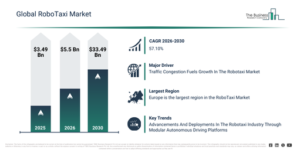
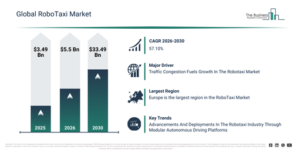
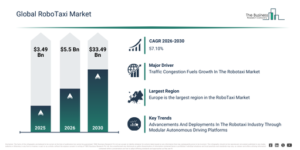
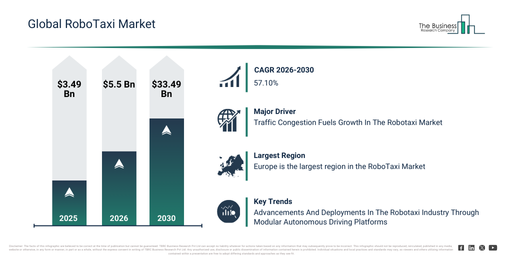
The robotaxi market has expanded at an exponential rate in recent years. Its valuation is projected to rise from $3.49 billion in 2025 to $5.5 billion in 2026, reflecting a compound annual growth rate of 57.4%. This historical growth has been driven by pilot rollouts of autonomous ride-hailing services, improvements in autonomous driving software, the expansion of electric vehicle platforms, growing urban mobility issues, and increased funding for smart city initiatives.
The robotaxi market is projected to experience remarkable expansion over the coming years. By 2030, its value is anticipated to reach $33.49 billion, reflecting a compound annual growth rate (CAGR) of 57.1%. This forecasted growth is driven by the scaling of commercial robotaxi operations, growing public trust in autonomous mobility, the development of smarter urban infrastructure, an increased demand for shared self-driving transport, and clearer regulations for driverless taxis. Key trends shaping this period include the broadening of geo-fenced autonomous ride services, the growing use of AI-driven passenger management systems, a shift toward electric robotaxi fleets, a heightened emphasis on urban autonomous mobility, and the implementation of improved safety validation and redundancy mechanisms.
Download A Free Sample Report For Comprehensive Market Insights:
https://www.thebusinessresearchcompany.com/sample.aspx?id=16180&type=smp
RoboTaxi Market Growth Momentum: Which Factors Are Influencing Demand?
The rising challenge of traffic congestion is anticipated to accelerate the expansion of the robotaxi market in the coming years. Traffic congestion refers to a condition on road networks where the demand for travel exceeds the capacity of the roads available. This phenomenon is frequently triggered by a mix of factors, including high volumes of vehicles, poor road infrastructure, ineffective traffic control, and disruptions such as accidents or road work, all of which reduce roadway capacity and lengthen travel times for drivers. By offering on-demand ride services, enhancing route efficiency, and decreasing the number of personal cars on the streets, robotaxis can help ease congestion, thus improving overall traffic flow and minimizing delays. For example, according to the Federal Highway Administration, a government body in the United States, travel on all roads and streets in January 2023 rose by 5.6% (an increase of 13.2 billion vehicle miles) compared to January 2022, reaching an estimated total of 247.3 billion vehicle miles for the month. The seasonally adjusted figure for vehicle miles traveled in January 2023 stood at 272.5 billion miles, marking a 4.5% rise (up 11.6 billion vehicle miles) from January 2022 and a 3.1% increase (adding 8.1 billion vehicle miles) relative to December 2022. Consequently, the escalating problem of traffic congestion is fueling growth in the robotaxi market.
RoboTaxi Market Segment Analysis: What Are The Major Market Categories?
The robotaxi market covered in this report is segmented –
1) By Type: L4 Robo-Taxi, L5 Robo-Taxi
2) By Component Type: Light Detection And Ranging (LiDAR), Radio Detection And Ranging (RADAR), Camera, Sensor
3) By Service: Rental-Based, Station-Based
4) By Propulsion Type: Electric Vehicle, Hybrid Electric Vehicle, Fuel Cell Vehicle
Subsegments:
1) By L4 Robo-Taxi: Fully Autonomous Robo-Taxis, Geo-Fenced Urban Robo-Taxi Services, Urban And Suburban Robo-Taxi Operations, Robo-Taxis With Remote Assistance
2) By L5 Robo-Taxi: Fully Autonomous Robo-Taxis, Fully Autonomous For All Environmental Conditions, All-weather, All-Terrain Robo-Taxis, Passenger-Only Robo-Taxi Service
RoboTaxi Market Transformation Trends: Which Innovations Are Driving Change?
Key players in the robotaxi market are increasingly dedicating their efforts to the creation of cutting-edge systems, particularly modular autonomous driving platforms that enable the seamless incorporation of sensors and computational components, along with scenario-specific tuning tailored for diverse urban settings, and these platforms integrate with ride-hailing applications to facilitate routing and fleet management. A modular autonomous driving platform is defined as a flexible framework for self-driving cars that divides the overall system into distinct modules, each responsible for a specific task involving sensors, software, or vehicle control, thus eliminating the requirement to redesign the entire vehicle. For example, in November 2025, WeRide Holdings Limited, a Chinese firm specializing in autonomous mobility, teamed up with Uber, a US-based technology company, to initiate fully driverless robotaxi trials in Abu Dhabi, United Arab Emirates; this deployment utilizes a Level 4 autonomous vehicle platform that functions without a safety driver present onboard, and the service is linked with the Uber app, allowing passengers to request trips through standard options like UberX or Uber Comfort, or via a dedicated autonomous choice for completely driverless journeys. Furthermore, it delivers autonomous driving capabilities for commercial fleets and self-driving shuttle services, capitalizing on its modular hardware and software architecture to ensure safety and enable real-time decision-making.
RoboTaxi Market Leading Players Shaping Industry Direction
Major companies operating in the robotaxi market report include Amazon.com Inc., Toyota Motor Corporation, Mercedes-Benz Group AG, Ford Motor Company, BMW AG, Hyundai Motor Group, Tesla Inc., ZF Friedrichshafen AG, Volvo Personvagnar AB, Uber Technologies Inc., Zhejiang Geely Holding Group Co. Ltd., Baidu Inc., Aptiv PLC, Lyft Inc., Cruise LLC, Waymo LLC, Motional Inc., Pony.AI, EasyMile, MOIA, AutoX Inc., Navya, Didi Chuxing Technology Co. Ltd., GAC Aion New Energy Automobile Co. Ltd.
Access The Complete RoboTaxi Market Report:
https://www.thebusinessresearchcompany.com/report/robotaxi-global-market-report
RoboTaxi Market Global Footprint: Which Region Holds Market Leadership?
Europe was the largest region in the robotaxi market in 2025. Asia-Pacific is expected to be the fastest growing region in the market. The regions covered in the robotaxi market report include Asia-Pacific, South East Asia, Western Europe, Eastern Europe, North America, South America, Middle East, Africa.
Access a Customized RoboTaxi Market Report for Deeper Competitive Insights
https://www.thebusinessresearchcompany.com/sample.aspx?id=16180&type=smp
Get in touch with us:
The Business Research Company: https://www.thebusinessresearchcompany.com/
Americas: +1 310-496-7795
Asia: +44 7882 955267 & +91 8897263534
Europe: +44 7882 955267
Email us at: marketing@tbrc.info
Follow us on:
LinkedIn: https://in.linkedin.com/company/the-business-research-company
YouTube: https://www.youtube.com/channel/UC24_fI0rV8cR5DxlCpgmyFQ
Global Market Model: https://www.thebusinessresearchcompany.com/global-market-model

Wasay has over a decade of experience in market research, data modelling, and analytics, with prior experience at GlobalData and Decision Tree Consulting Services. At The Business Research Company , he leads research operations across syndicated studies, customized consulting engagements, and the Global Market Model platform. His professional experience includes supporting organizations such as Boston Consulting Group, KPMG, and Ernst & Young. Wasay holds a degree in Electronics and Communications Engineering, postgraduate management qualifications from International Management Institute Belgium and Indian School of Business and Entrepreneurship, and completed the Integrated Program in Business Analytics from Indian Institute of Management Indore.