Featuring market attractiveness scoring, total addressable market sizing, company benchmarking matrices, interactive Excel dashboards, deeper supply chain intelligence, emerging startup tracking, and granular product-level insights, The Business Research Company’s 2026 market reports are built to deliver research that is both more actionable and more strategically valuable.
Smart Vehicle Architecture Market Size Outlook: How Quickly Will Revenue Expand Through 2030?
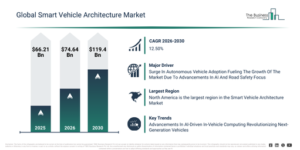
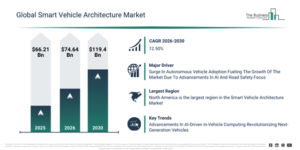
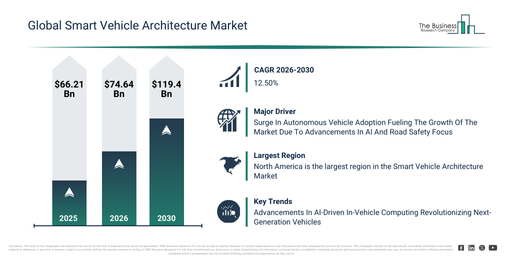
The smart vehicle architecture market size has grown rapidly in recent years. It will grow from $66.21 billion in 2025 to $74.64 billion in 2026 at a compound annual growth rate (CAGR) of 12.7%. The growth in the historic period can be attributed to increasing complexity of in-vehicle electronics, growth of connected vehicle technologies, rising adoption of adas systems, expansion of digital cockpit solutions, advancements in automotive electronics architecture.
The smart vehicle architecture market size is expected to see rapid growth in the next few years. It will grow to $119.4 billion in 2030 at a compound annual growth rate (CAGR) of 12.5%. The growth in the forecast period can be attributed to increasing investments in autonomous driving platforms, rising demand for scalable vehicle architectures, expansion of electric vehicle production, growing focus on cybersecurity in vehicles, increasing integration of cloud-based vehicle services. Major trends in the forecast period include increasing adoption of software-defined vehicle platforms, rising shift toward zonal and centralized architectures, growing integration of ota update capabilities, expansion of v2x communication frameworks, enhanced focus on modular vehicle design.
Get A Free Sample Report With In-Depth Market Insights:
Smart Vehicle Architecture Market Expansion Drivers: What’s Shaping Future Growth?
The rising adoption of autonomous vehicles is expected to fuel the growth of the smart vehicle architecture market going forward. Autonomous vehicles are self-driving or driverless vehicles equipped with advanced sensors, artificial intelligence, and automated systems that enable them to navigate and operate without human intervention. The rising adoption of autonomous vehicles is due to advancements in artificial intelligence (AI) and the growing focus on road safety, leading to fewer collisions, better traffic flow, and a safer driving experience, making autonomous technology an attractive solution for the future of transportation. Autonomous vehicles rely heavily on sensors, LiDAR, radar, and high-performance computing systems to process vast amounts of data in real-time, ensuring safe and efficient operation, which requires a sophisticated vehicle architecture that integrates software-defined systems, cloud connectivity, and cybersecurity features. For instance, in September 2023, according to the UK Parliament, a UK-based government body, around 40% of new cars manufactured in the UK are expected to be equipped with self-driving capabilities by 2035. Therefore, the rising adoption of autonomous vehicles is driving the growth of the smart vehicle architecture market.
Smart Vehicle Architecture Market Segment Breakdown: Which Categories Lead On Revenue?
The smart vehicle architecture market covered in this report is segmented –
1) By Component: Hardware, Software, Services
2) By Vehicle: Passenger Cars, Commercial Vehicles, Electric Vehicles
3) By Architecture: Centralized Architectures, Zonal Architectures, Modular Platforms, Distributed Architectures
4) By Connectivity: Vehicle-To-Vehicle (V2V), Vehicle-To-Infrastructure (V2I), Vehicle-To-Everything (V2X) Communication
5) By Application: Autonomous Driving, Infotainment And User Experience, Safety And Security, Fleet Management, Energy Management
Subsegments:
1) By Hardware: Centralized Computing Units, Advanced Driver-Assistance Systems (ADAS) Modules, Vehicle Communication Interfaces, Power Distribution Units (PDUs), Smart Sensors And Actuators
2) By Software: Embedded Vehicle Software, Cloud-Based Vehicle Software, Cybersecurity Solutions, Over-The-Air (OTA) Update Systems, Vehicle Operating Systems
3) By Services: Vehicle Diagnostics and Maintenance Services, Connected Vehicle Data Services, Software-as-a-Service (SaaS) for Automotive, Remote Monitoring And Fleet Management Services, Integration And Customization Services
Smart Vehicle Architecture Market Strategic Trends: What Defines The Next Growth Phase?
Major companies operating in the smart vehicle architecture market focus on developing innovative technology such as AI-driven in-vehicle computing to enhance automation, safety, real-time data processing, and ADAS. AI-driven in-vehicle computing enhances smart vehicle architecture by enabling real-time data processing, automation, improved safety, and advanced driver assistance systems (ADAS). For instance, in January 2024, Intel Corporation, a US-based technology company specializing in semiconductor design and manufacturing, announced a new family of AI-enhanced software-defined vehicle system-on-chips (SoCs). This adoption aimed to integrate generative AI-driven living room experiences into next-generation vehicles, enhancing in-car entertainment and interactive capabilities. These SoCs are designed to support the growing demand for advanced, data-driven features in modern vehicles.
Smart Vehicle Architecture Market Leading Players And Competitive Positioning
Major companies operating in the smart vehicle architecture market report include Volkswagen Group, Toyota Motor Corporation, Ford Motor Company, Mercedes-Benz Group AG, Hyundai Motor Group, Robert Bosch GmbH, Zhejiang Geely Holding Group, ZF Friedrichshafen AG, Qualcomm Technologies Inc., Continental AG, Magna International Inc., Honeywell International Inc., Micron Technology Inc., Valeo SA, Texas Instruments Incorporated, Aptiv PLC, Infineon Technologies AG, NXP Semiconductors N.V., Elmos Semiconductor SE, Harman International
View The Full Smart Vehicle Architecture Market Report:
Smart Vehicle Architecture Market Regional Analysis And Top Geography
North America was the largest region in the smart vehicle architecture market in 2025. Asia-Pacific is expected to be the fastest-growing region in the forecast period. The regions covered in the smart vehicle architecture market report include Asia-Pacific, South East Asia, Western Europe, Eastern Europe, North America, South America, Middle East, Africa.
Reach Out To Our Team:
The Business Research Company: https://www.thebusinessresearchcompany.com/
Americas: +1 310-496-7795
Asia: +44 7882 955267 & +91 8897263534
Europe: +44 7882 955267
Email us at: marketing@tbrc.info
Follow us on:
LinkedIn: https://in.linkedin.com/company/the-business-research-company
YouTube: https://www.youtube.com/channel/UC24_fI0rV8cR5DxlCpgmyFQ
Global Market Model: https://www.thebusinessresearchcompany.com/global-market-model

Wasay has over a decade of experience in market research, data modelling, and analytics, with prior experience at GlobalData and Decision Tree Consulting Services. At The Business Research Company , he leads research operations across syndicated studies, customized consulting engagements, and the Global Market Model platform. His professional experience includes supporting organizations such as Boston Consulting Group, KPMG, and Ernst & Young. Wasay holds a degree in Electronics and Communications Engineering, postgraduate management qualifications from International Management Institute Belgium and Indian School of Business and Entrepreneurship, and completed the Integrated Program in Business Analytics from Indian Institute of Management Indore.