Featuring market attractiveness scoring, total addressable market sizing, company benchmarking matrices, interactive Excel dashboards, deeper supply chain intelligence, emerging startup tracking, and granular product-level insights, The Business Research Company’s 2026 market reports are built to deliver research that is both more actionable and more strategically valuable.
Wiper Blade Market Size Forecast: How Big Could The Market Get By 2030?
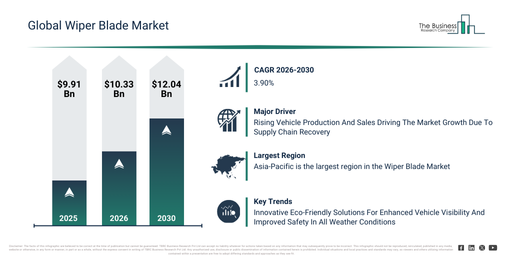
The wiper blade market size has grown steadily in recent years. It will grow from $9.91 billion in 2025 to $10.33 billion in 2026 at a compound annual growth rate (CAGR) of 4.3%. The growth in the historic period can be attributed to vehicle parc growth, demand for windshield visibility, replacement-driven sales, adoption of rubber blades, automotive safety norms.
The wiper blade market size is expected to see steady growth in the next few years. It will grow to $12.04 billion in 2030 at a compound annual growth rate (CAGR) of 3.9%. The growth in the forecast period can be attributed to advanced material innovation, electric vehicle design integration, premium vehicle demand, climate-adaptive blade development, aftermarket product upgrades. Major trends in the forecast period include shift toward aerodynamic blade designs, growing demand for all-weather blades, expansion of aftermarket sales, adoption of hybrid blade technologies, improved durability materials.
Get A Free Sample Report With In-Depth Market Insights:
Wiper Blade Market Expansion Drivers: What’s Shaping Future Growth?
The rising vehicle production and sales are expected to propel the growth of the wiper blade market going forward. Vehicle production and sales refer to the manufacturing output and retail transactions of new automobiles, light trucks, and commercial vehicles distributed through dealerships and sold to end consumers. Vehicle production and sales are rising due to growing urbanization, as more people move to cities, increasing the need for personal and commercial transportation and boosting demand for new vehicles. Rising vehicle production and sales drive higher demand for wiper blades, as each new vehicle requires windshield wipers and the growing number of vehicles on the road increases the need for replacements and aftermarket products to ensure safety and visibility. For instance, in May 2025, according to the European Automobile Manufacturers’ Association (ACEA), a Belgium-based motor vehicle manufacturing company, South American car production grew by 1.7% in 2024 compared to 2023, largely driven by Brazil, which experienced a 6.3% rise, producing approximately 1.9 million cars. Meanwhile, global bus production reached 362,005 units last year, marking a 10.3% increase from 2023. Therefore, rising vehicle production and sales are driving the growth of the wiper blade market.
Wiper Blade Market Driver: Rising Adoption Of Advanced Driver-Assistance Systems Driving The Market Growth Due To Stringent Safety Regulations
The rising adoption of advanced driver-assistance systems (ADAS) is expected to propel the growth of the wiper blade market going forward. Advanced driver-assistance systems refer to electronic technologies integrated into vehicles that use sensors, cameras, and radar to assist drivers with safety and navigation functions, including collision avoidance, lane keeping, adaptive cruise control, and automated braking. The increasing adoption of ADAS is driven by stringent government safety regulations and mandatory requirements, as federal agencies implement standards requiring automatic emergency braking and other advanced safety features in new vehicles to reduce traffic fatalities and improve road safety. Growing ADAS adoption directly supports increased demand for high-performance wiper blades because camera and sensor systems require consistently clear windshields to function accurately, making reliable wiper blade performance critical for maintaining the operational effectiveness of these safety technologies. For instance, in October 2024, according to the MITRE Corporation, a US-based Not-for-profit organization, by the 2023 model year, 10 of the 14 Advanced Driver Assistance Systems (ADAS) features achieved over 50% market penetration, with five features surpassing 90%. In comparison, none of the ADAS features had reached 75% penetration. Therefore, the rising adoption of advanced driver-assistance systems is driving the growth of the wiper blade market.
Wiper Blade Market Breakdown By Product Type And Application
The wiper blade market covered in this report is segmented –
1) By Blade Type: Conventional Blades, Flat Blades, Hybrid Blades
2) By Vehicle Type: Passenger Cars, Light Commercial Vehicles, Heavy Commercial Vehicles
3) By Sales Channel: Original Equipment Manufacturer (OEM), Aftermarket
4) By Application: Windshield Wipers, Rear Wipers
Subsegments:
1) By Conventional Blades: Steel Frame Wiper Blades, Plastic Frame Wiper Blades
2) By Flat Blades: Beam Wiper Blades, Frameless Wiper Blades
3) By Hybrid Blades: Combination Of Conventional And Flat Blade Technologies, Hybrid With Aerodynamic Design
Wiper Blade Market Strategic Trends: What Defines The Next Growth Phase?
Major companies operating in the wiper blade market are focusing on developing innovative solutions, such as eco-designed flat (beam) wiper blades to enhance performance, reduce environmental impact, and improve durability. Eco-designed flat (beam) wiper blades are aerodynamic, frameless wipers made from sustainable materials that provide quieter, streak-free cleaning, longer durability, and reduced environmental impact, while offering better performance in all weather conditions, minimizing wind lift at high speeds, and requiring less frequent replacement compared to conventional wiper blades. For instance, in June 2023, Valeo SA, a France-based automotive technology and aftermarket solutions company, launched Valeo Canopy, an innovative eco-designed flat wiper blade for the European aftermarket. Valeo Canopy is engineered to cut CO2 emissions by about 61% compared with a typical Valeo flat blade commonly sold in Europe, thanks to changes in blade material, sourcing, and packaging across the product lifecycle. Its wiping edge uses a compound made from more than 80% natural, renewable, or recycled ingredients, such as plant-derived oils and carbon black recovered from end-of-life tyres, while the metal and plastic parts incorporate increased shares of recycled steel and recycled polymers. The range is delivered as ready-to-fit replacements that eliminate throwaway adapters and still cover roughly 95% of vehicles in the European fleet, helping workshops and retailers simplify inventory and installation.
Wiper Blade Market Company Landscape And Competitive Strategy
Major companies operating in the wiper blade market report include Robert Bosch GmbH, Denso Corporation, Continental AG, Michelin, Illinois Tool Works Inc., DRiV Incorporated, HELLA GmbH & Co. KGaA, TRICO, ACDelco, PIAA Corporation, WEXCO Industries Inc., Syndicate Wiper Systems (P) Ltd., Tex Automotive, Heyner GmbH, PSV Wipers Limited, ANCO, Pilot Automotive, OSRAM GmbH, Cap. Co. Ltd., Xiongshun Automobile Material (Xiamen) Co. Ltd., Doga Grup
View The Full Wiper Blade Market Report:
Wiper Blade Market Regional Breakdown: Where Is Demand Concentrated?
Asia-Pacific was the largest region in the wiper blade market in 2025. Asia-Pacific is expected to be the fastest-growing region in the forecast period. The regions covered in the wiper blade market report include Asia-Pacific, South East Asia, Western Europe, Eastern Europe, North America, South America, Middle East, Africa.
Reach Out To Our Team:
The Business Research Company: https://www.thebusinessresearchcompany.com/
Americas: +1 310-496-7795
Asia: +44 7882 955267 & +91 8897263534
Europe: +44 7882 955267
Email us at: marketing@tbrc.info
Follow us on:
LinkedIn: https://in.linkedin.com/company/the-business-research-company
YouTube: https://www.youtube.com/channel/UC24_fI0rV8cR5DxlCpgmyFQ
Global Market Model: https://www.thebusinessresearchcompany.com/global-market-model

Wasay has over a decade of experience in market research, data modelling, and analytics, with prior experience at GlobalData and Decision Tree Consulting Services. At The Business Research Company , he leads research operations across syndicated studies, customized consulting engagements, and the Global Market Model platform. His professional experience includes supporting organizations such as Boston Consulting Group, KPMG, and Ernst & Young. Wasay holds a degree in Electronics and Communications Engineering, postgraduate management qualifications from International Management Institute Belgium and Indian School of Business and Entrepreneurship, and completed the Integrated Program in Business Analytics from Indian Institute of Management Indore.